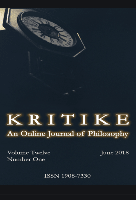
Kritike-An Online Journal of Philosophy
Scope & Guideline
Cultivating Accessibility in Philosophical Scholarship
Introduction
Aims and Scopes
- Interdisciplinary Philosophical Inquiry:
The journal encourages contributions that bridge various philosophical traditions and methodologies, promoting a dialogue that encompasses Western and non-Western philosophies. - Focus on Contemporary Issues:
Kritike addresses pressing social, political, and ethical issues through philosophical lenses, often examining the implications of these issues in the context of modern society. - Exploration of Historical Philosophical Texts:
The journal frequently revisits classical philosophical texts and figures, analyzing their relevance and application to contemporary philosophical debates. - Promotion of Local Philosophies:
A significant aspect of the journal is its emphasis on local and indigenous philosophies, particularly within the Filipino context, thus contributing to the global philosophical landscape. - Critical Theory and Social Critique:
Kritike often engages with critical theory, exploring themes of power, identity, and resistance, making it a platform for social critique and philosophical engagement.
Trending and Emerging
- Philosophy of Technology:
There is a growing focus on the implications of technology in human life, particularly in the context of mobility and agency, indicating an increasing interest in the intersection of philosophy and technology. - Indigenous and Local Philosophies:
The journal has seen a rise in contributions exploring indigenous philosophies, especially within the Filipino context, showcasing a commitment to diversifying philosophical discourse. - Ethics and Social Justice:
Recent themes concentrate on ethical considerations surrounding social justice issues, gender, and the implications of philosophical thought on contemporary societal challenges. - Posthumanism and Environmental Philosophy:
Emerging discussions around posthumanism and environmental ethics suggest an increasing concern with the relationship between humanity and the non-human world, reflecting current global challenges. - Critical Reflections on Education:
The journal is increasingly addressing themes related to educational philosophy, exploring how philosophical inquiry can contribute to critiques of educational practices and ideologies.
Declining or Waning
- Traditional Metaphysical Debates:
There has been a noticeable decline in papers focusing solely on traditional metaphysical questions, such as those concerning the nature of being, which were once more prevalent. - Analytic Philosophy:
The journal appears to have shifted away from a focus on analytic philosophy, with fewer contributions addressing topics typically associated with this tradition, such as formal logic and language analysis. - Eurocentric Philosophical Narratives:
There is a decreasing emphasis on Eurocentric philosophical traditions, as the journal increasingly prioritizes Asian and indigenous perspectives, reflecting a broader trend in philosophical discourse.
Similar Journals
CANADIAN JOURNAL OF PHILOSOPHY
Elevating Discourse, Inspiring InquiryCanadian Journal of Philosophy, published by Cambridge University Press, stands as a pinnacle of scholarly discourse in the field of philosophy. With its ISSN 0045-5091 and E-ISSN 1911-0820, this esteemed journal has cemented its reputation since its inception in 1971, continuing to engage with contemporary philosophical issues up to 2024. The journal is highly regarded, currently holding a Q1 rank in Philosophy and positioned in the 89th percentile of its category according to Scopus rankings. Its focus is on advancing philosophical inquiry, offering a platform for both established scholars and emerging voices to share significant research, critique, and innovative ideas. While the journal is not open access, it provides essential insights that are invaluable for researchers, professionals, and students alike, fostering an environment of intellectual exchange and growth in the philosophical community.
Philosophical Papers
Championing Rigorous Scholarship in PhilosophyPhilosophical Papers, an esteemed journal published by Routledge Journals, Taylor & Francis Ltd, stands as a pivotal resource in the field of philosophy. Having established its presence since 1972, this journal has converged a wealth of intellectual discourse and contributes to the continuous development of philosophical thought until 2024. With a prestigious Q1 category ranking in the arts and humanities, and a notable 86th percentile ranking in Scopus's philosophy category, it underscores its commitment to rigorous scholarship and influential research. Although Open Access options are not currently available, the journal remains a vital platform for philosophers, researchers, and students aiming to engage with pivotal philosophical debates and advancements. Set in the UK, Philosophical Papers exemplifies the intersection of tradition and innovation in philosophical inquiry, making it an indispensable reference for anyone dedicated to exploring the complexities of human thought and existence.

Filosofiya-Philosophy
Advancing Philosophical Discourse GloballyWelcome to Filosofiya-Philosophy, an esteemed academic journal dedicated to advancing the field of philosophical inquiry. Published by NATSIONALNO IZDATELSTVO AZ BUKI, this journal aims to foster scholarly exchange and promote critical discussions on various philosophical themes and issues, including but not limited to metaphysics, ethics, logic, and epistemology. With its commitment to rigorous research and thought-provoking analyses, Filosofiya-Philosophy seeks to engage researchers, professionals, and students alike, enriching the discourse surrounding philosophical studies. Although currently not an open-access journal, it provides valuable insights that are crucial for the continuous exploration of philosophical ideas. Based in Sofia, Bulgaria, it plays a vital role in the dissemination of philosophical knowledge, inviting submissions from around the globe to enhance its academic community and further its impact in the realm of philosophy.

Beytulhikme-An International Journal of Philosophy
Navigating the Rich Tapestry of PhilosophyBeytulhikme-An International Journal of Philosophy is a distinguished publication dedicated to the exploration and dissemination of philosophical scholarship. Published by Beytulhikme Felsefe Cevresi, this journal serves as a platform for researchers, academics, and students to engage with contemporary philosophical discourses and historical inquiries. With its commitment to open access, Beytulhikme ensures that valuable philosophical insights are readily available to a global audience. The journal welcomes a diverse range of submissions, including theoretical papers, critical reviews, and interdisciplinary work that reflects the dynamic nature of philosophical research today. Located in Ankara, Turkiye, Beytulhikme plays a pivotal role in fostering a deeper understanding of philosophical concepts and methods, thus contributing to the academic community and enriching scholarly dialogue. As a key resource for professionals in the field, Beytulhikme not only encourages innovative thinking but also promotes a comprehensive examination of both Eastern and Western philosophical traditions.

Convivium
Promoting Global Access to Philosophical InquiryConvivium is a distinguished open-access journal published by the Universitat de Barcelona, Facultat Filologia, specializing in the field of philosophy. Since its inception, the journal has committed to fostering scholarly dialogue by providing a platform for innovative and critical research. Operating under an open-access model since 2007, Convivium ensures that its articles, which span a range of contemporary philosophical topics, are freely accessible to a global audience, thereby promoting the dissemination of knowledge. Despite facing challenges indicated by its current Scopus rank in the 2nd percentile of the Arts and Humanities, and its Q3 quartile in 2023, Convivium continues to thrive as an important resource for researchers, professionals, and students engaged in philosophical inquiry. With published volumes converging from 2009 to 2014, 2017 to 2018, and 2021 to 2023, the journal is poised to contribute significantly to the ongoing discussions and developments in philosophy.

Revue Roumaine de Philosophie
Exploring the Depths of Philosophical ThoughtRevue Roumaine de Philosophie is a distinguished journal dedicated to advancing the field of philosophy, published by EDITURA ACAD ROMANE in Romania. With an ISSN of 1220-5400, this journal serves as a platform for diverse philosophical discourse, welcoming contributions from both emerging and established scholars. While it currently does not offer open access options, the journal has played a noteworthy role in the philosophical landscape, especially from its inception in 2013 until its discontinuation in Scopus coverage in 2020. The journal's categorization in the 2023 Q4 quartile for Philosophy, along with its rank of #425 out of 718 in Scopus' Arts and Humanities category, underscores its relevance within the academic community, despite not being at the forefront of the field. Located in Bucharest, Romania, the Revue Roumaine de Philosophie invites researchers, professionals, and students to engage with critical philosophical issues and fosters a vibrant intellectual exchange through its published works, ultimately contributing to the richness of philosophical inquiry.
DIALOGUE-CANADIAN PHILOSOPHICAL REVIEW
Connecting Scholars Across Philosophical FrontiersDIALOGUE-CANADIAN PHILOSOPHICAL REVIEW, published by Cambridge University Press, stands as an esteemed platform in the field of philosophy, with a notable impact factor that reflects its scholarly contributions. Established in 1962 and extending its reach into 2024, this journal is indexed under ISSN 0012-2173 and E-ISSN 1759-0949. As part of its commitment to advancing philosophical discourse, DIALOGUE is ranked in the Q2 category for Philosophy in 2023, placing it among the top-tier journals in the discipline. Its Scopus ranking of #338 out of 806 highlights its critical role in shaping contemporary philosophical thought. The journal encourages robust discussions and critical analyses across various philosophical domains, appealing to researchers, professionals, and students alike. Although it does not offer open access, DIALOGUE enriches the academic community by providing valuable insights and fostering dialogue among philosophical scholars in the United Kingdom and beyond.

Phares-Revue Philosophique Etudiante de l Universite Laval
Advancing Intellectual Rigor in the Heart of QuebecPhares-Revue Philosophique Etudiante de l'Université Laval, ISSN 1496-8533, is a prestigious academic journal published by the Faculty of Philosophy at Université Laval, situated in the heart of Quebec, Canada. This journal serves as a vital platform for emerging scholars in the field of philosophy, showcasing innovative ideas, research findings, and critical discourse. As a crucial resource for researchers, professionals, and students alike, *Phares* encourages the exploration of diverse philosophical topics, promoting intellectual engagement and rigor. Although it currently does not provide open access, the journal's commitment to fostering a rich academic community remains paramount. With its high academic standards, *Phares* stands out as a significant contributor to scholarly dialogue, inspiring ongoing inquiry and discourse within the philosophical realm.

Noema-Rivista Online di Filosofia
Engaging minds, enriching ideas, expanding horizons.Noema-Rivista Online di Filosofia, published by Milano University Press, stands as a significant peer-reviewed platform in the field of philosophy, dedicated to advancing scholarly dialogue and critical inquiry. Since its inception as an Open Access journal in 2010, it has provided a vital space for researchers, professionals, and students to engage with contemporary philosophical issues and emerging thought. With its commitment to accessibility, Noema encourages a wider dissemination of knowledge, facilitating the exchange of ideas that bridges the gap between academia and society. Researchers from various philosophical domains are invited to contribute to the journal's rich tapestry of discourse, which aims to explore the intersections of philosophy with other disciplines, enriching both theoretical and practical understandings. Situated in Milan, Italy, Noema not only embodies a blend of traditional and modern philosophical thought but also serves as a testament to the vibrant academic community thriving within its pages.

Philosophies
Championing interdisciplinary approaches to philosophy.Philosophies is a leading open-access journal published by MDPI, dedicated to advancing research in the fields of Philosophy and the History and Philosophy of Science. Established in 2016 and located in Switzerland, this journal aims to stimulate scholarly dialogue and innovation by providing a platform for diverse philosophical perspectives and interdisciplinary approaches. With a commendable impact factor and ranking—Q2 in both Philosophy and History and Philosophy of Science in 2023—Philosophies stands out in the academic community with Scopus rankings placing it in the top tiers of its categories (Rank #176/806 in Philosophy and Rank #65/223 in History and Philosophy of Science). Authors and researchers are encouraged to submit their works as this journal continues to foster open access to knowledge, enabling global dissemination and collaboration among experts and enthusiasts alike. Join us in exploring the profound questions that shape our understanding of the world and human experience.