LABORATORY MEDICINE
Scope & Guideline
Unlocking innovations in biochemistry and diagnostics.
Introduction
Aims and Scopes
- Clinical Diagnostic Innovations:
The journal emphasizes research that explores new diagnostic techniques, including molecular diagnostics, mass spectrometry, and point-of-care testing, aimed at improving accuracy and efficiency in clinical settings. - Laboratory Quality and Standardization:
A significant focus is placed on quality assurance practices, adherence to international standards like ISO 15189, and the development of accreditation systems to ensure the reliability of laboratory results. - Biomarkers and Disease Management:
Research related to the identification and utilization of biomarkers for various diseases is a core area, contributing to better diagnostics and management strategies in clinical practice. - Translational Research:
The journal encourages studies that bridge laboratory findings with clinical applications, thus fostering a better understanding of disease mechanisms and treatment outcomes. - Impact of Technology in Laboratory Medicine:
Investigations into the role of emerging technologies, including artificial intelligence and big data in laboratory settings, are crucial themes that reflect the journal's commitment to modernizing laboratory practices.
Trending and Emerging
- Molecular Diagnostics and Personalized Medicine:
There is a growing emphasis on molecular diagnostics, particularly in relation to personalized medicine, as researchers explore genetic markers and tailored treatment approaches. - Integration of Artificial Intelligence and Big Data:
The integration of AI and big data analytics into laboratory practices is an emerging trend, with studies focusing on enhancing diagnostic accuracy and operational efficiency. - Quality Improvement Initiatives:
The journal is increasingly showcasing research related to quality improvement initiatives in laboratory settings, emphasizing the importance of maintaining high standards and compliance with accreditation requirements. - Point-of-Care Testing Developments:
Research on point-of-care testing is trending upwards, reflecting the need for rapid diagnostics in various clinical scenarios, particularly in emergency medicine and remote healthcare settings. - Interdisciplinary Approaches to Disease Management:
There is a trend towards interdisciplinary research that combines laboratory findings with clinical insights, particularly in chronic diseases and complex conditions, illustrating the journal's commitment to holistic patient care.
Declining or Waning
- Traditional Diagnostic Methods:
There is a noticeable decrease in studies focused on conventional diagnostic techniques, as newer methodologies and technologies gain prominence in laboratory settings. - General Clinical Pathology:
Research articles that cover broad aspects of clinical pathology without specific innovations or insights are becoming less common, suggesting a shift towards more specialized and innovative topics. - Epidemiological Studies:
The frequency of epidemiological studies related to laboratory findings has waned, possibly due to a growing emphasis on molecular and genetic diagnostics over traditional population-based studies.
Similar Journals
African Journal of Laboratory Medicine
Enriching public health through shared knowledge.The African Journal of Laboratory Medicine, ISSN 2225-2002, e-ISSN 2225-2010, is a premier publication dedicated to advancing the field of laboratory medicine within the African context. Published by AOSIS since 2012, this Open Access journal aims to disseminate influential research findings, clinical studies, and innovative techniques in the realms of Clinical Biochemistry, Medical Laboratory Technology, and Public Health. Based in South Africa, the journal not only serves as a critical platform for sharing knowledge and best practices but also plays a significant role in fostering public health discussions relevant to the continent. Over the years, it has established itself with impactful rankings in various categories, including a Q4 in Clinical Biochemistry and Q3 in both Medical Laboratory Technology and Public Health. As such, it caters to a diverse audience of researchers, professionals, and students eager to stay at the forefront of laboratory medicine research and its applications. The journal’s commitment to quality and accessibility positions it as an essential resource for those looking to make a significant impact in their respective fields.
JOURNAL OF CLINICAL LABORATORY ANALYSIS
Exploring the frontiers of clinical laboratory practices.JOURNAL OF CLINICAL LABORATORY ANALYSIS is a premier, peer-reviewed journal published by WILEY, focusing on the expansive field of laboratory medicine. With its ISSN 0887-8013 and E-ISSN 1098-2825, this open access journal has been serving the scientific community since 1987. As of 2023, it holds a notable impact in various domains, achieving category quartiles in Biochemistry, Clinical Biochemistry, Hematology, and more, showcasing its significance across multiple disciplines such as Medical Laboratory Technology and Public Health. Ranked impressively, it is placed 7th in Medical Laboratory Technology, reflecting its crucial role in advancing clinical practice and research. The journal aims to disseminate innovative research findings, methodologies, and reviews that can catalyze advancements in laboratory practices and improve patient outcomes. Accessible to a global audience since its transition to open access in 2019, the journal is not just limited to professionals but is also a valuable resource for students and researchers seeking to stay updated in this dynamic field. For more information, visit the journal's website.
JOURNAL OF CLINICAL PATHOLOGY
Innovating Pathology for Better Health OutcomesJOURNAL OF CLINICAL PATHOLOGY, published by BMJ PUBLISHING GROUP, stands at the forefront of advancements in the field of clinical pathology, offering a platform for groundbreaking research and insights from 1948 to the present. With an impressive impact factor and categorized as Q1 in both Medicine (miscellaneous) and Pathology and Forensic Medicine for 2023, the journal holds a distinguished position in the academic community, ranking 22nd out of 208 journals in its category on Scopus and representing the 89th percentile. While the journal does not currently offer open access, it remains a vital resource for researchers, healthcare professionals, and students seeking to stay current with innovative methodologies, clinical techniques, and diagnostic advancements. Located in London, United Kingdom, the journal aims to bridge the gap between laboratory findings and clinical practice, emphasizing the importance of evidence-based pathology in improving patient care and treatment outcomes. Engage with the JOURNAL OF CLINICAL PATHOLOGY to enhance your understanding and contribute to the evolving landscape of clinical pathology research.
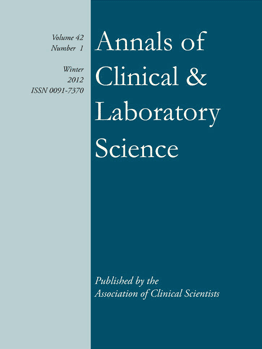
ANNALS OF CLINICAL AND LABORATORY SCIENCE
Transforming Healthcare Through Scientific DiscourseANNALS OF CLINICAL AND LABORATORY SCIENCE, published by the Association of Clinical Scientists, is a pivotal journal in the fields of clinical biochemistry, hematology, immunology, and medical laboratory technology. Since its inception in 1971, this journal has become a vital resource for researchers and practitioners aiming to advance their knowledge and skills in laboratory sciences. Although currently not an open access journal, its rich repository of peer-reviewed articles and studies contributes significantly to the academic discourse in diagnostic and therapeutic practices. The journal is categorized in various quartiles, reflecting its impact and contributions to multiple scientific domains, such as Q4 in Clinical Biochemistry and Q3 in Pathology and Forensic Medicine as of 2023. With an extensive convergence of years up to 2024, it proves to be a timeless source for emerging trends and research innovations. The ANNALS OF CLINICAL AND LABORATORY SCIENCE not only supports the professional development of its readers but also encourages interdisciplinary collaboration, making it an essential tool for professionals, students, and researchers dedicated to improving health outcomes through advanced laboratory sciences.

Advances in Laboratory Medicine-Avances en Medicina de Laboratorio
Empowering Professionals Through Open Access Knowledge.Advances in Laboratory Medicine - Avances en Medicina de Laboratorio is a distinguished open-access journal published by Walter de Gruyter GmbH, dedicated to the field of medical laboratory technology and the broader aspects of laboratory medicine. Launched in 2020, this journal aims to disseminate high-quality research, innovative methodologies, and critical reviews that foster advancements in laboratory practices. With significant rankings, including Q3 in Medical Laboratory Technology and Q4 in Education and Medicine (miscellaneous) as of 2023, it serves as a vital resource for researchers, professionals, and students interested in enhancing their understanding and implementation of laboratory protocols. Based in Germany, the journal not only emphasizes accessibility through its open-access model but also contributes significantly to the evolving landscape of medical laboratory science. Join a community of scholars striving to improve patient outcomes and elevate standards within the laboratory domain.
CRITICAL REVIEWS IN CLINICAL LABORATORY SCIENCES
Empowering Professionals with Cutting-Edge ResearchCRITICAL REVIEWS IN CLINICAL LABORATORY SCIENCES, published by Taylor & Francis Ltd, stands as a premier journal in the field of clinical laboratory science, addressing pivotal advancements and challenges since its inception in 1970. With a commendable impact factor derived from its ranking in Q1 categories across multiple disciplines—including Biochemistry, Genetics and Molecular Biology, and Clinical Biochemistry—this journal is a critical resource for researchers, clinicians, and educators aiming to deepen their understanding and application of laboratory science. The journal's rigorous peer-review process ensures that only the highest quality research is published, providing a platform for profound discussions that influence laboratory practices globally. Although not an open-access journal, it offers various subscription options to facilitate access to its wealth of knowledge. Operating out of Abingdon, England, CRITICAL REVIEWS IN CLINICAL LABORATORY SCIENCES continues to shape the future of clinical biochemistry and laboratory research through its insightful articles, systematic reviews, and expert commentaries, making it an essential read for professionals eager to stay at the forefront of their field.
Practical Laboratory Medicine
Pioneering Discoveries in Clinical Biochemistry and TechnologyPractical Laboratory Medicine is a distinguished peer-reviewed journal published by Elsevier, focusing on the essential advances in the fields of clinical biochemistry and radiological technology. Begun in 2015, this Open Access journal fosters an environment of scholarly communication, ensuring that valuable research is freely available to a global audience. With a current impact factor placing it in the Q3 quartile in both clinical biochemistry and radiological and ultrasound technology, the journal serves as a vital platform for researchers and professionals to disseminate innovative findings and foster interdisciplinary collaboration. The journal’s commitment to covering a broad spectrum of laboratory medicine topics, from clinical practice improvements to technological developments, underlines its importance in enhancing laboratory standards and patient care. Based in Amsterdam, Netherlands, Practical Laboratory Medicine not only contributes to the academic community but also influences practical applications in healthcare settings.
Revista Romana de Medicina de Laborator
Advancing the Frontiers of Laboratory MedicineRevista Romana de Medicina de Laborator is a prominent open-access journal published by SCIENDO, dedicated to the field of medical laboratory technology and biochemistry. Since its inception, this journal has been a vital platform for disseminating research findings and advancements in laboratory medicine. With an ISSN of 1841-6624 and E-ISSN 2284-5623, it has served the academic community since 2008 and has embraced an open-access model since 2013, ensuring that valuable research is accessible to all. While it features niche rankings in Scopus for areas such as Medical Laboratory Technology and Clinical Biochemistry, it consistently strives to engage researchers, professionals, and students. Its rich collection of articles highlights innovative techniques and methodologies, supporting the ongoing development of laboratory practices. Although its coverage in Scopus has been discontinued, the journal continues to publish high-quality studies that contribute significantly to the field, fostering knowledge exchange essential for advancing medical science.
Journal of Laboratory Physicians
Pioneering advancements in laboratory practices and innovations.The Journal of Laboratory Physicians is a prestigious, peer-reviewed publication dedicated to advancing the field of laboratory medicine. Published by THIEME MEDICAL PUBL INC, this journal has established itself as a vital source of research and clinical insights since its inception, transitioning to Open Access in 2009 to broaden its reach and accessibility. With an ISSN of 0974-2727 and an E-ISSN of 0974-7826, it aims to provide a platform for professionals, researchers, and students engaged in laboratory-based studies to share critical findings and foster collaboration across disciplines. The journal's scope encompasses a wide range of topics relevant to laboratory physicians, ensuring that it remains an essential resource for those seeking to stay on the cutting edge of laboratory practices and innovations. By disseminating timely research and reviews, the Journal of Laboratory Physicians plays a crucial role in enhancing the quality of healthcare through improved laboratory services.
Current Research in Translational Medicine
Fostering Collaboration in Cutting-Edge Medical ResearchCurrent Research in Translational Medicine, published by ELSEVIER FRANCE-EDITIONS SCIENTIFIQUES MEDICALES ELSEVIER, is a dynamic open-access journal that has been at the forefront of innovative research since its inception in 2016. With a strong commitment to advancing the fields of biochemistry, hematology, infectious diseases, oncology, and transplantation, the journal provides an invaluable platform for researchers and practitioners to share novel findings that bridge laboratory discoveries and clinical applications. Currently recognized in prestigious categories such as Q1 and Q2 quartiles, this journal emphasizes the importance of translational science in improving health outcomes, supported by a rigorous editorial process and a commitment to high-quality research dissemination. Being listed in reputable databases like Scopus, it enables authors to reach a wide audience, ensuring that their impactful work contributes to the global dialogue on critical medical advancements. With its open access model, Current Research in Translational Medicine encourages widespread collaboration and engagement among the scientific community, solidifying its role as a leading journal in medicine and related fields.