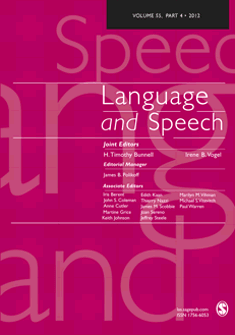
LANGUAGE AND SPEECH
Scope & Guideline
Advancing the Frontiers of Communication Science
Introduction
Aims and Scopes
- Second Language Acquisition (SLA):
Research focusing on the processes involved in learning a second language, including phonetic, phonological, and morphological aspects, as well as the impact of native language on L2 performance. - Speech Perception and Production:
Studies investigating how individuals perceive and produce speech sounds, including the effects of various linguistic and contextual factors on speech intelligibility and fluency. - Sociophonetics and Variation:
Exploration of how social factors influence speech patterns and variation in different dialects and sociolects, including acoustic and articulatory studies. - Multimodal Communication:
Research examining the interplay between verbal and non-verbal cues in communication, including the role of gestures and visual inputs in speech perception. - Cognitive and Neurological Aspects of Language:
Investigations into the cognitive processes underlying language use and speech production, including studies utilizing neuroimaging techniques. - Language Contact and Its Effects:
Exploration of how language contact influences phonetic and phonological features in bilingual and multilingual contexts, including the adaptation of speech sounds.
Trending and Emerging
- Technology in Language Learning and Speech Processing:
An increasing focus on the use of technology, such as motion-capture and machine learning, to enhance language learning and analyze speech patterns, indicating a shift towards more applied research. - Cognitive and Neurolinguistic Investigations:
Emerging themes include the exploration of cognitive mechanisms and neurological underpinnings of language processing, utilizing advanced neuroimaging techniques to understand language in the brain. - Social Dimensions of Language Use:
Research that examines the intersection of language, identity, and social dynamics, including how variables like ethnicity and social context influence language perception and production. - Interdisciplinary Approaches to Language Studies:
A trend towards combining insights from linguistics, psychology, and computational modeling to address complex questions about language acquisition and usage. - Focus on Multimodality and Gesture:
An emerging interest in how multimodal communication, including gestures and visual cues, affects language processing and comprehension, reflecting a broader understanding of communication.
Declining or Waning
- Traditional Phonetics:
Research that solely focuses on traditional phonetic descriptions without integrating contemporary methodologies or interdisciplinary approaches appears to be less prominent, as the field increasingly values dynamic and applied perspectives. - Purely Descriptive Linguistics:
Studies that provide only descriptive accounts of language phenomena, without theoretical or experimental frameworks, are becoming less common in favor of research that offers insights into cognitive or sociolinguistic implications. - Static Models of Language Processing:
There is a decline in studies utilizing static models of language processing, as researchers are increasingly favoring dynamic models that account for contextual and cognitive variability in language use.
Similar Journals

Communication Sciences and Disorders-CSD
Innovating practices in communication disorders since 2013.Communication Sciences and Disorders-CSD, published by the Korean Academy of Speech-Language Pathology & Audiology, is a pivotal academic journal dedicated to the fields of communication sciences, speech-language pathology, and audiology. With an ISSN of 2288-1328 and an E-ISSN of 2288-0917, this journal has been contributing to the body of knowledge since 2013 and is set to continue its impactful journey through 2024. The journal is recognized for its rigorous research and maintains respectable rankings within various categories, achieving a Q2 in Linguistics and Language and Q3 in Communication, Speech, and Hearing for 2023. It offers valuable insights for researchers and professionals committed to advancing understanding and treatment in communication disorders. Though currently not open access, the journal provides robust academic resources that are essential for those striving to innovate and enhance practices in speech and hearing disciplines in South Korea and beyond.
JOURNAL OF COMMUNICATION DISORDERS
Bridging Research and Practice in Communication Disorders.Journal of Communication Disorders (ISSN: 0021-9924; E-ISSN: 1873-7994) is a leading publication in the field of communication disorders, published by Elsevier Science Inc. With a converged publishing timeline from 1967 to 2024, this journal has established itself as a vital resource for researchers, clinicians, and educators dedicated to advancing knowledge in areas such as linguistics, language processing, speech, and hearing. It boasts an impressive reputation, ranking in the Q1 category for Linguistics and Language, and Q1 in LPN and LVN as well as Q2 in Speech and Hearing for 2023, highlighting its influence and scholarly impact within these domains. The journal is recognized for its rigorous peer-reviewed articles and its contributions to our understanding of cognitive neuroscience, experimental psychology, and communication disorders—further evidenced by its ranking in the top percentiles in various fields. Although it does not currently offer Open Access options, readers and contributors alike will appreciate the depth and breadth of research published within its pages. This journal serves an essential role in bridging the gap between research and practical application, making it a must-read for anyone involved in the study or treatment of communication disorders.
Hearing Balance and Communication
Bridging research and practice for better hearing and communication.Hearing Balance and Communication is a prominent peer-reviewed journal dedicated to advancing the fields of Otorhinolaryngology, Speech, and Hearing. Published by Wolters Kluwer Medknow Publications, this journal serves as a valuable resource for researchers, clinicians, and students invested in exploring the multifaceted aspects of auditory and vestibular health. With an ISSN of 2169-5717 and an E-ISSN of 2169-5725, it has established itself as a significant platform since its inception in 2013, boasting a commendable Q3 ranking in both Otorhinolaryngology and Speech and Hearing categories as of 2023. The journal emphasizes the dissemination of original research, reviews, and case studies that foster a deeper understanding of hearing and balance, as well as effective communication practices. Located in the United Kingdom, Hearing Balance and Communication is a key player in bridging research and clinical practice, ensuring that vital findings reach the professionals who can implement them in real-world settings, thus increasingly impacting patient care and public health.

TRAITEMENT AUTOMATIQUE DES LANGUES
Innovating the Intersection of Language and TechnologyTRAITEMENT AUTOMATIQUE DES LANGUES is a prominent academic journal dedicated to the field of automatic language processing, published by the ASSOCIATION TRADUCTION AUTOMATIQUE LINGUISTIQUE APPLIQUEE in France. Established as a crucial resource for researchers and practitioners, the journal explores innovative approaches to linguistics and language applications, contributing significantly to the understanding and advancement of technology in language processing. Although it currently holds a Q4 ranking across categories such as Computer Science Applications and Linguistics in the 2023 Scopus metrics, the journal encourages submissions that push the boundaries of current methodologies, seeking to elevate the discourse within these disciplines. With no open access policies specified, the journal serves as an exclusive platform for scholarly communication through traditional access means. TRAITEMENT AUTOMATIQUE DES LANGUES aims to foster collaboration and stimulate advancements in the richly interlinked areas of language technology, computation, and linguistics, making it an invaluable resource for students, researchers, and professionals alike.
CLINICAL LINGUISTICS & PHONETICS
Advancing the Dialogue Between Language and HealthClinical Linguistics & Phonetics, published by Taylor & Francis Inc, is a leading peer-reviewed journal that occupies a pivotal role in advancing the fields of linguistics and speech-language pathology. With its ISSN 0269-9206 and E-ISSN 1464-5076, this journal has been instrumental since its inception in 1987, providing an esteemed platform for research that addresses the intersection of language and health. Holding a prestigious Q1 ranking in Linguistics and Language and a solid Q2 rank in Speech and Hearing as of 2023, it is well-regarded for its rigorous standards and impactful research contributions. The journal does not currently offer open access options, yet it remains accessible to a broad academic audience that values quality scholarship. By disseminating vital empirical studies and theoretical advancements, Clinical Linguistics & Phonetics not only enriches the academic discourse but also supports professionals seeking to enhance their practice based on the latest evidence in communication disorders and phonetic research.
COMPUTER SPEECH AND LANGUAGE
Unleashing the Power of Computational LinguisticsCOMPUTER SPEECH AND LANGUAGE, published by Academic Press Ltd - Elsevier Science Ltd, stands as a pivotal journal in the fields of Human-Computer Interaction, Software, and Theoretical Computer Science. With an esteemed Q2 ranking in Human-Computer Interaction and top-tier Q1 rankings in both Software and Theoretical Computer Science for 2023, this journal plays a critical role in disseminating innovative research and advancements in computational linguistics and interactive systems. Since its inception in 1986, it has become a sought-after platform for researchers, professionals, and students seeking to deepen their understanding of computer-aided speech processes and language technologies. The journal's comprehensive scope encompasses a wide range of interdisciplinary studies, fostering a collaborative research environment that explores the intersection of technology and human communication.

Yuyan Kexue-Linguistic Sciences
Exploring the Frontiers of Linguistic KnowledgeYuyan Kexue-Linguistic Sciences, published by SCIENCE PRESS, is a pivotal academic journal dedicated to the field of linguistics. With its ISSN of 1671-9484, this journal seeks to explore and illuminate various linguistic phenomena, contributing significantly to the understanding of language in both theoretical and applied contexts. Emphasizing interdisciplinary research, it welcomes contributions that bridge linguistics with areas such as cognitive science, sociology, and communication studies. Although it currently does not offer open access, Yuyan Kexue-Linguistic Sciences aims to provide a platform for researchers, professionals, and students alike to engage with cutting-edge studies and emerging trends in linguistics. Its publication location in Beijing positions it as a vital contributor to the global discourse in the linguistic sciences, catering to both a national and international audience. As the journal continues to grow, it aspires to maintain high academic standards and foster scholarly exchange for years to come.
Pragmatics & Cognition
Navigating the Complexities of Language Use and MindPragmatics & Cognition, published by John Benjamins Publishing Co, is an esteemed journal that serves as a cross-disciplinary platform for the study of language, cognition, and context-dependent communication. With its ISSN 0929-0907 and E-ISSN 1569-9943, the journal has established a notable reputation since its inception in 1993, although its coverage spans various fields from behavioral neuroscience to linguistics and philosophy. Recognized for its scholarly contributions, it holds impressive Scopus rankings, significantly within Linguistics and Language, where it ranks in the 63rd percentile among peers. Although it currently maintains a Q4 designation in Behavioral Neuroscience and a Q1 in Linguistics and Language as of 2023, the journal appeals to a diverse audience addressing the intricate relationships between language use and cognitive processes. As researchers and academics navigate this evolving landscape, Pragmatics & Cognition remains pivotal in fostering essential dialogues and advancing knowledge in the interdisciplinary field, providing rich content that is both insightful and relevant.

Language and Linguistics Compass
Exploring the Frontiers of Linguistic KnowledgeLanguage and Linguistics Compass, published by Wiley, stands as a premier journal in the field of linguistics, showcasing innovative and interdisciplinary research. With its ISSN 1749-818X and E-ISSN matching, the journal has built a robust reputation, achieving an impressive Q1 ranking within the linguistics category for 2023, placing it in the top 4% of its field. Its Scopus rank of 48 out of 1167 highlights its influence and significance among linguistics journals, boasting a commendable 95th percentile. This journal serves as a vital resource for researchers, professionals, and students, offering a wide range of accessible articles that illuminate current trends and advances within the domain of language studies. Although it is not Open Access, the journal is committed to quality and diversity in its publications, ensuring scholarly articles from various sub-disciplines of linguistics are represented from 2008 through 2024. Located in the United Kingdom, Language and Linguistics Compass invites contributions from around the globe, reinforcing its status as a leading forum for linguistic discourse.

CoDAS
Elevating research standards in speech and hearing through open access.CoDAS, an esteemed academic journal published by the SOC BRASILEIRA FONOAUDIOLOGIA, serves as a leading platform for interdisciplinary research within the realms of linguistics, speech, and hearing sciences. Established as an Open Access journal in 2013, it ensures broad dissemination and accessibility of scholarly work, significantly benefitting researchers, clinicians, and students alike. Based in Brazil, CoDAS has garnered credibility with its impressive Q2 ranking in Linguistics and Language, as well as its rankings in Otorhinolaryngology and Speech and Hearing categories, reflecting its substantial contribution to these fields. The journal's impact is underscored by its robust Scopus rankings, including the 67th percentile in Language and Linguistics. With a commitment to fostering innovative research and bridging gaps between theory and practice, CoDAS continues to play a vital role in advancing knowledge and clinical practices in communication disorders and auditory sciences.