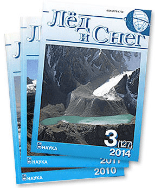
Led i Sneg-Ice and Snow
Scope & Guideline
Bridging disciplines to illuminate Earth’s icy frontiers.
Introduction
Aims and Scopes
- Glaciology and Ice Dynamics:
The journal extensively covers research on glaciers, including their dynamics, mass balance, and responses to climate change, providing insights into the physical processes governing ice behavior. - Climate Change Impact Studies:
Research articles often explore the effects of climate change on snow cover, ice formation, and hydrological regimes, highlighting the interactions between climatic variables and cryospheric processes. - Hydrological and Meteorological Interactions:
The journal includes studies that link meteorological conditions with hydrological outcomes, such as runoff and water availability, emphasizing the significance of snow and ice in regional water cycles. - Paleoclimatology and Historical Analysis:
Papers often delve into historical climate data through ice core samples and glacial studies, contributing to the understanding of past climate variations and their implications for future trends. - Remote Sensing and Modeling Techniques:
The journal showcases innovative methodologies involving satellite observations and numerical modeling to assess snow and ice characteristics, enabling researchers to predict future changes.
Trending and Emerging
- Impact of Climate Change on Cryospheric Systems:
Recent papers increasingly highlight the significant impacts of climate change on glaciers and snow cover, addressing urgent questions about future water resources and ecosystem health. - Use of Isotopic Analysis in Hydrology:
There is a growing emphasis on isotopic studies to understand hydrological processes and past climate conditions, which is becoming a vital tool in glaciology and hydrology. - Integration of Remote Sensing Technologies:
The adoption of satellite-based remote sensing technologies for monitoring snow and ice dynamics is on the rise, facilitating large-scale assessments that were previously challenging. - Interdisciplinary Approaches to Snow and Ice Research:
Emerging themes show a trend towards interdisciplinary studies that connect glaciology with ecology, geology, and hydrology, fostering a more holistic understanding of cryospheric impacts. - Urban and Anthropogenic Influences on Snow and Ice:
Research addressing the effects of urbanization and human activities on local snow and ice conditions is gaining traction, reflecting broader societal concerns about climate resilience.
Declining or Waning
- Traditional In-Situ Measurement Techniques:
There has been a noticeable decline in studies focused solely on traditional in-situ measurement methods for snow and ice characteristics, with a shift towards integrating remote sensing and advanced modeling approaches. - Local Case Studies:
The journal has seen fewer publications centered on localized case studies, as there is a growing trend towards broader, regional analyses that encompass larger spatial scales and comparative studies. - Focus on Non-Climate Related Ice Phenomena:
Research concentrating on ice phenomena that are not directly tied to climate change, such as certain geological or anthropogenic influences, has decreased, indicating a stronger focus on climate-related issues.
Similar Journals

GEOMORPHOLOGY
Pioneering Research in Geomorphological Science.GEOMORPHOLOGY, published by Elsevier, is a leading journal that focuses on the study of landforms, along with the processes that shape them. Established in 1984, the journal has evolved to become an essential resource for researchers in the field of Earth-Surface Processes, currently holding a prestigious Q1 quartile ranking and occupying the 17th position out of 179 journals in Scopus, placing it within the top 10% of publications in this domain. This impact underscores its significance in advancing understanding within geosciences, providing a platform for both foundational and innovative research. GEOMORPHOLOGY publishes a diverse array of articles, from empirical studies to theoretical advancements, ensuring accessibility for a broad audience of students, professionals, and academics alike. With its commitment to high-quality research, this journal serves as a critical reference point for ongoing developments and discoveries in geomorphology.

Journal of Geography-Chigaku Zasshi
Contributing to a Sustainable Future through GeographyJournal of Geography - Chigaku Zasshi is a distinguished publication that serves as a crucial platform for the dissemination of research in the realm of geography and earth sciences. Published by the TOKYO GEOGRAPHICAL SOC in Japan, this journal is indexed with an ISSN of 0022-135X and an E-ISSN of 1884-0884. With a scope that includes Earth-Surface Processes, Geography, Planning and Development, Geology, Geophysics, and Global and Planetary Change, it provides comprehensive coverage of pressing geographical issues. Although it holds a Q4 ranking in multiple categories as of 2023, the journal presents an opportunity for researchers, professionals, and students to contribute meaningful findings in a diverse and competitive landscape. The Journal of Geography actively promotes scholarly dialogue by embracing the complexities of our planet and encouraging innovative approaches to geographical inquiries. This open-access journal aspires to bridge gaps and foster collaboration among scholars worldwide, underscoring its importance in understanding and addressing contemporary geographic challenges.

Sciences in Cold and Arid Regions
Empowering research in earth-surface processes.Sciences in Cold and Arid Regions, published by SCIENCE PRESS, is a pivotal open-access journal dedicated to advancing the understanding of environmental science and engineering in cold and arid environments. With an ISSN of 1674-3822, this journal provides a platform for researchers to share innovative studies and breakthroughs that address the unique challenges faced in these regions, encompassing vital areas such as earth-surface processes and environmental engineering. Although its coverage in Scopus has been discontinued since 2022, it continues to maintain importance within its specialized field, as evidenced by its rankings among other environmental science and earth sciences journals. By embracing open access, Sciences in Cold and Arid Regions ensures that cutting-edge research is freely available to a global audience, fostering collaboration and knowledge exchange among professionals and students alike, and emphasizing the critical need for adaptable strategies in managing cold and arid ecosystems.
TERRESTRIAL ATMOSPHERIC AND OCEANIC SCIENCES
Transforming Insights into Actionable KnowledgeTERRESTRIAL ATMOSPHERIC AND OCEANIC SCIENCES, published by SpringerNature, is a distinguished peer-reviewed journal that has been an essential platform for innovative research in the fields of atmospheric science, oceanography, and Earth and planetary sciences since its inception. With an Open Access policy established in 1990, the journal ensures wide dissemination of knowledge, allowing researchers, professionals, and students to access cutting-edge findings without restrictions. Based in Switzerland and featuring a comprehensive coverage from 1996 to 2024, the journal currently holds a Q3 ranking across various categories, indicating its growing significance in the scientific community. Although it is positioned within the 39th percentile in Earth and Planetary Sciences, its commitment to fostering high-quality research makes it a valuable resource for advancing understanding of terrestrial environments and their interconnections. Researchers seeking a platform for their work in atmospheric and oceanic sciences will find TERRESTRIAL ATMOSPHERIC AND OCEANIC SCIENCES to be an ideal venue for sharing their insights with a global audience.

Earth Interactions
Bridging Disciplines to Decode Earth’s ComplexitiesEarth Interactions is a prominent journal that serves as a critical platform for interdisciplinary research in the field of Earth and Planetary Sciences. Published by the American Meteorological Society, this journal has established itself as a key resource for scholars, researchers, and professionals dedicated to understanding Earth's complex systems and their interactions. With an impressive Q1 ranking in the category of Earth and Planetary Sciences for 2023, it reflects a commitment to high-quality scholarship and impactful contributions to the field. The journal, with its dedicated coverage from 2004 to 2024, encompasses a wide array of topics, providing comprehensive insights into geological, atmospheric, and environmental phenomena. Although it operates under a non-open access model, its significance is underscored by its placement in the top percentile of Scopus rankings (Rank #89/195), making it an exciting resource for those pursuing advanced studies and applications related to Earth's systems.
QUATERNARY INTERNATIONAL
Advancing Knowledge of the Quaternary Period.Quaternary International is a prestigious journal published by Pergamon-Elsevier Science Ltd, focusing on the interdisciplinary study of the Quaternary Period, which encompasses significant geological, hydrological, and climatic changes. With an ISSN of 1040-6182 and E-ISSN 1873-4553, it stands as a critical resource in the realm of Earth-Surface Processes, achieving a strong position within the academic community, evidenced by its 2023 Scopus rank of #32 out of 179 in this category, corresponding to an impressive 82nd percentile. Since its inception in 1989, this journal has provided valuable insights and contributed to the advancement of knowledge in the Earth and Planetary Sciences. Researchers, professionals, and students alike will find a wealth of original research articles, reviews, and case studies that inform and inspire further studies in the Quaternary sciences. Although the journal does not currently offer open access options, its reputation for rigorous peer review and impactful content underscores its significance in shaping scholarly discourse in the field.
Frontiers of Earth Science
Pioneering Research for a Sustainable FutureFrontiers of Earth Science is a prominent academic journal in the field of Earth and Planetary Sciences, published by Springer. With an ISSN of 2095-0195 and an E-ISSN of 2095-0209, this journal serves as a significant platform for researchers and professionals to disseminate their findings from 2007 to 2024. It is recognized for its impactful contributions within the category of Earth and Planetary Sciences, boasting a respected Q2 ranking in 2023. With a Scopus ranking of 64 out of 195, placing it in the 67th percentile, Frontiers of Earth Science continues to drive academic dialogue and innovation. The journal is dedicated to exploring a diverse range of topics, including geology, meteorology, and environmental science, and amplifying the understanding of Earth systems through rigorous research. Located in New York, USA, this journal embraces an Open Access model, ensuring that groundbreaking research is readily available to the global scientific community, thereby enhancing its accessibility and impact.
Earth and Space Science
Exploring the Frontiers of Earth and Space.Earth and Space Science, published by the American Geophysical Union, is a distinguished open-access journal that has profoundly impacted the realms of earth and planetary sciences as well as environmental science since its inception in 2014. With impressive rankings, including Q1 in both Earth and Planetary Sciences and Environmental Science for 2023, this journal ranks 38th out of 195 in the general Earth and planetary sciences category and 51st out of 219 in environmental science, showcasing its commitment to high-quality research dissemination. The journal serves as a vital platform for researchers, professionals, and students, fostering the exploration of critical topics and advancements within these pivotal fields. With an accessible format, researchers can benefit from the rich content available, furthering their knowledge and ensuring that groundbreaking discoveries reach a broader audience. The journal's ongoing commitment to open access aligns with contemporary trends in scholarly communication, emphasizing inclusion and collaboration in tackling pressing global challenges.
GLOBAL AND PLANETARY CHANGE
Charting the Future of Earth and Planetary ResearchGLOBAL AND PLANETARY CHANGE, published by Elsevier, is a premier international journal focused on the critical issues surrounding environmental science, climate change, and planetary dynamics. Since its inception in 1989, this journal has established itself as a leading voice in the field, currently holding a prestigious Q1 ranking in both Global and Planetary Change and Oceanography as of 2023. With a remarkable influence reflected in its Scopus rankings—15th in Earth and Planetary Sciences and 34th in Global and Planetary Change—it serves as an essential platform for researchers, professionals, and students. The journal provides a comprehensive examination of cutting-edge research findings and innovative developments that address the urgent challenges facing our planet. Although it is not an Open Access journal, it remains a vital resource for anyone keen to contribute to or stay informed on the ever-evolving discourse of global environmental change, promoting sustainable solutions for the future.

Journal of Hydrology and Hydromechanics
Exploring the depths of water dynamics and mechanical flow.Journal of Hydrology and Hydromechanics, published by SCIENDO, is a prominent open access journal that has been disseminating crucial research findings in the fields of fluid flow, mechanical engineering, and water science since its inception in 1973. With its open access model established in 2009, the journal ensures that innovative research is available to a global audience, enhancing the visibility and impact of studies related to hydrological systems and their applications. The journal holds a commendable position within the academic community, reflected in its category quartiles, achieving Q2 rankings in 2023 across key areas such as Fluid Flow and Transfer Processes, Mechanical Engineering, and Water Science and Technology. Its Scopus rankings further highlight its relevance, placing it among the top journals in its categories. The Journal of Hydrology and Hydromechanics not only serves as a vital resource for researchers and professionals aiming to advance hydrological knowledge but also provides students with a wealth of information to better understand the complexities of water dynamics and associated engineering challenges.