
Legal Issues of Economic Integration
Scope & Guideline
Bridging Legal Theories with Economic Realities
Introduction
Aims and Scopes
- International Trade Law:
Focuses on the legal aspects governing international trade agreements, dispute resolution mechanisms, and the role of international organizations like the WTO in facilitating trade. - Investment Law and Policy:
Examines the legal frameworks surrounding foreign direct investment, investment protection treaties, and the implications of domestic regulations on international investments. - Sustainable Development and Environmental Law:
Analyzes the intersection of trade law and environmental policies, including how trade agreements can promote sustainable practices and address climate change. - Regional Economic Integration:
Investigates the legal challenges and frameworks involved in regional trade agreements and economic partnerships, particularly within the European Union and ASEAN. - Digital Trade and Data Governance:
Explores legal issues related to digital trade, data protection, and the implications of emerging technologies on trade agreements and market access. - Sanctions and Trade Measures:
Studies the legal ramifications of economic sanctions imposed by states or international organizations, including their impact on trade relations and compliance with international law.
Trending and Emerging
- Climate Change and Trade Agreements:
A significant increase in research concerning how trade agreements can be leveraged to address climate change, promoting sustainable development alongside economic growth. - Digital Trade Regulation:
Emerging discussions around the legal frameworks governing digital trade, data privacy, and cybersecurity reflect the growing importance of digital economies in international trade. - Sanctions and International Relations:
A heightened focus on the legal implications of sanctions imposed by states and international organizations, particularly in light of geopolitical tensions and economic policy shifts. - Gender and Trade:
An emerging theme exploring the intersection of gender equality and economic policies, with a focus on how trade agreements can empower women entrepreneurs and promote inclusive economic growth. - Post-Pandemic Trade Policies:
Research is increasingly addressing the implications of the COVID-19 pandemic on trade policies, including the re-evaluation of supply chains and the need for resilient trade frameworks.
Declining or Waning
- Traditional Trade Barriers:
Research on conventional trade barriers such as tariffs and quotas has diminished as the focus shifts towards more complex regulatory measures and sustainable trade practices. - State Aid in Economic Integration:
The examination of state aid regulations and their implications for intra-EU trade has become less prominent, possibly due to evolving EU policies and a shift towards broader economic integration discussions. - General International Economic Law:
There seems to be a waning interest in general principles of international economic law, as more specific and practical applications, such as digital trade and sustainability, take precedence. - Non-Tariff Measures (NTMs):
While still relevant, the analysis of non-tariff measures has seen a reduction in focus, likely overshadowed by the urgency of addressing climate-related trade issues and international regulatory frameworks.
Similar Journals

Global Trade and Customs Journal
Exploring the intersection of law and international commerce.Global Trade and Customs Journal, published by KLUWER LAW INT, stands as an essential resource for researchers, professionals, and students engaged in the dynamic fields of business, law, and international trade. With an ISSN of 1569-755X and E-ISSN 1875-6468, this journal offers valuable insights and analytical discussions on the complexities of global trade and customs regulations. Although currently non-open access, the journal plays a pivotal role in disseminating critical findings that impact policy-making and commercial practices within the trade sector. Its ranking in the Q4 category for Business and International Management and Q3 for Law underscores its growing significance in the academic community, with Scopus rankings revealing its contributions to law (Rank #726/1025) and business management (Rank #408/443). Published in the Netherlands, and with convergence years spanning 2018 to 2024, the Global Trade and Customs Journal is a must-read for anyone looking to stay at the forefront of legal and business developments on a global scale.
Asian Journal of International Law
Elevating Scholarly Debate in International LawThe Asian Journal of International Law, published by Cambridge University Press, is a premier academic journal dedicated to advancing the discourse on international law across Asia and beyond. With its ISSN 2044-2513 and E-ISSN 2044-2521, the journal has carved a significant niche in the field, achieving a Scopus rank of #463 out of 1025 in the Social Sciences category, placing it in the 54th percentile. As of 2023, it holds a Q3 category in law, reflecting its growing influence and recognition within the academic community. The journal features peer-reviewed articles that critically engage with contemporary legal issues, promote scholarly debate, and provide insights into the legal frameworks affecting the Asia-Pacific region. With no open access options currently available, it caters primarily to academics, professionals, and students seeking in-depth knowledge and critical analysis. The Asian Journal of International Law aims to be at the forefront of international legal scholarship, fostering an understanding of the complex legal landscapes that shape our world.
International Trade Journal
Shaping policies through rigorous research.The International Trade Journal, published by Taylor & Francis Ltd, is a vital resource in the field of international trade, economics, and business management. Established in 1986, this journal offers a platform for rigorous empirical and theoretical research, focusing on the dynamics of global trade and its implications on economic and international policy. With an ISSN of 0885-3908 and an E-ISSN of 1521-0545, it serves as a valuable reference for scholars and practitioners alike. The journal is ranked in the Q3 category for Economics, Econometrics and Finance, signifying its role in disseminating high-quality research. Although it currently does not offer Open Access, the journal's wealth of insights supports researchers and professionals in navigating the complexities of international trade while shaping informed policies. With convergence from 1986 to 2024, the International Trade Journal continues to be an essential tool for fostering knowledge and understanding within this increasingly interconnected global economy.
East Asian Economic Review
Illuminating Economic Developments in East Asia.East Asian Economic Review is a premier academic journal dedicated to the multifaceted exploration of economic issues and developments in East Asia. Published by the Korea Institute for International Economic Policy, this journal serves as a vital platform for researchers, practitioners, and policymakers interested in the region's economic dynamics. Since transitioning to Open Access in 2013, it has enhanced accessibility, allowing for a broader dissemination of knowledge and fostering collaborative research. While the journal currently does not have an impact factor rating, its commitment to high-quality research continues to attract contributions that significantly advance the understanding of economic policies, trade relations, and market trends in East Asia. The East Asian Economic Review stands out as an essential resource for anyone involved in or studying the intricate economic landscape of one of the world's most dynamic regions.
Journal of International Trade Law and Policy
Navigating the Complexities of Trade Law and EconomicsThe Journal of International Trade Law and Policy, published by Emerald Group Publishing Ltd, serves as a crucial platform for the dissemination of research in the fields of international trade law, economics, and political science. Established in 2002, this journal aims to explore the complexities and evolving landscape of trade laws and policies globally, offering valuable insights for researchers, practitioners, and policymakers alike. With an impact factor reflecting its reputable standing, the journal is ranked in the Q3 and Q4 categories across various domains including Law, Political Science, and Industrial Relations, indicating its relevance and contribution to academic discourse. The journal remains committed to advancing knowledge while embracing rigorous peer review processes. Although open access options are currently not available, the journal’s extensive archive promises to be a rich resource for those invested in international trade dynamics as it embarks on its journey toward 2024.
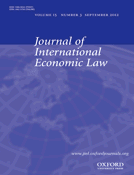
JOURNAL OF INTERNATIONAL ECONOMIC LAW
Exploring the Intersection of Law and Economics GloballyWelcome to the JOURNAL OF INTERNATIONAL ECONOMIC LAW, a prestigious academic journal published by Oxford University Press, dedicated to the interdisciplinary exploration of the intricate relationship between law and economics on a global scale. Since its inception in 1998, this quarterly journal has developed a reputation for excellence, currently holding a Q1 ranking in both Economics, Econometrics and Finance and Law categories. With an impressive Scopus ranking that places it in the 94th percentile for law and the 82nd percentile for economics, it serves as an essential resource for researchers, professionals, and students aiming to advance their understanding of international economic regulations and policies. Our goal is to foster scholarly dialogue and inform legal practices by publishing cutting-edge research, critical reviews, and comprehensive analyses relevant to contemporary issues in international economic law. Although the journal maintains subscription-only access, it remains a crucial platform for disseminating influential ideas and practices within the global academic community, encouraging rigorous debate and innovative thinking in this dynamic field.
International Community Law Review
Illuminating Challenges in International Law.International Community Law Review, published by MARTINUS NIJHOFF PUBLISHERS, is a distinguished journal that contributes significantly to the fields of law and international relations. With an ISSN of 1871-9740 and an E-ISSN of 1871-9732, this journal serves as a vital platform for scholarly discourse on issues pertaining to international law, promoting a deeper understanding and engagement with complex legal frameworks and global challenges. Currently classified in the Q3 quartile for Law and Political Science and International Relations, the International Community Law Review ranks 475 out of 1025 in the Law category and 386 out of 706 in Political Science, reflecting a moderate impact in the academic community. Though it does not currently offer Open Access, the journal's extensive coverage from 2007 through 2024 ensures that it remains a relevant resource for researchers, professionals, and students. Published in the Netherlands, this journal aims to foster the development of international legal thought, support academic research, and facilitate discussions that shape modern international legal practices.

JOURNAL OF WORLD TRADE
Advancing Knowledge in International Trade and EconomicsJOURNAL OF WORLD TRADE, published by Kluwer Law International, is a premier academic journal dedicated to the in-depth exploration of international trade, law, and economics. With an ISSN of 1011-6702 and an E-ISSN of 2210-2795, this journal has become a significant resource for researchers, professionals, and students alike since its inception in 1996, offering valuable insights into the complexities of global trade relations and international legal frameworks. The journal is recognized for its robust academic contributions, holding a Q3 classification in both Economics and Econometrics and Political Science and International Relations for 2023, with an impressive Q2 ranking in Law. The Scopus rankings further highlight its influence within the academic community, particularly in the fields of law and political science. Although it is not an open-access journal, it remains an essential reference for those engaged in scholarly discussion and practical applications of international trade laws. The JOURNAL OF WORLD TRADE is essential for anyone interested in advancing their understanding of the challenges and evolutions within the complex landscape of global trade.

China and WTO Review
Unpacking the Complexities of Trade Relations and Legal FrameworksChina and WTO Review is a scholarly journal published by UK Zhende Publishing Ltd, dedicated to the critical examination of the evolving relationship between China and the World Trade Organization (WTO). With an emphasis on interdisciplinary research, this journal covers the fields of Economics, Law, and Political Science, making it an invaluable resource for researchers, professionals, and students alike. Since its inception in 2015, the journal has been committed to fostering dialogue on the complex economic and legal implications of China's engagement with global trade structures. The journal holds a Q4 classification in Economics and Political Science, and a Q3 ranking in Law, demonstrating its rising academic significance and contribution to the field. Submissions benefit from a thorough peer-review process, ensuring the delivery of high-quality research that aids in understanding international trade dynamics. Although currently categorized in the lower quartiles, its unique focus on China as a major global player positions it as a crucial platform for scholarly insights into contemporary trade issues, encouraging engagement from a diverse academic audience.

Ekonomicheskaya politika
Fostering interdisciplinary dialogue on economic trends.Ekonomicheskaya politika, published by EKONOMICESKAA POLITIKA, is a premier journal dedicated to advancing the fields of economics, finance, and the sociopolitical dimensions impacting economic policies, particularly within the Russian context. Established in 2013, it plays a crucial role in addressing contemporary economic challenges and contributing to scholarly discourse. The journal is indexed in Scopus, demonstrating its relevance and scholarly impact, with its rankings and quartiles reflecting a strong commitment to quality research. Although it operates under a traditional access model, its comprehensive analyses and thought-provoking articles are essential resources for researchers, professionals, and students alike, fostering a deeper understanding of economic trends and policy implications in both global and local arenas. With its convergence of interdisciplinary approaches from economics, political science, and sociology, Ekonomicheskaya politika not only serves as a valuable academic platform but also as a critical reference point for policymakers and practitioners interested in the evolving landscape of economic policy.