Macroeconomics and Finance in Emerging Market Economies
Scope & Guideline
Innovating Financial Solutions for Developing Economies
Introduction
Aims and Scopes
- Macroeconomic Policy Analysis:
The journal examines the impact of various macroeconomic policies, such as monetary and fiscal policies, on economic growth, inflation, and financial stability in emerging economies. - Financial Market Dynamics:
Research in this area includes the analysis of financial markets, investment behavior, and the role of financial institutions, particularly in the context of emerging markets. - Economic Growth and Development:
The journal emphasizes studies that explore the drivers of economic growth and development, including the effects of globalization, trade, and foreign direct investment. - Sector-Specific Studies:
It also covers sector-specific analyses, such as the impact of natural resources, agriculture, and technology on macroeconomic performance. - Quantitative and Qualitative Research Methods:
The journal employs a variety of methodologies including econometric modeling, case studies, and comparative analyses to provide robust insights into macroeconomic and financial phenomena.
Trending and Emerging
- Digital Finance and Economic Growth:
There is a notable increase in research examining the relationship between digital finance, financial inclusion, and economic development, reflecting the rising significance of fintech and digital currencies. - Impact of Global Shocks:
Recent studies are increasingly addressing the impacts of global shocks, such as the COVID-19 pandemic, on emerging market economies, analyzing their vulnerabilities and resilience. - Asymmetric Economic Effects:
Research focusing on asymmetric effects of economic policies and shocks, particularly in relation to exchange rates and inflation, is gaining traction. - Sustainability and ESG Factors:
The integration of environmental, social, and governance (ESG) factors into financial performance analysis is emerging as a critical area of interest, reflecting global sustainability trends. - Behavioral Finance in Emerging Markets:
There is a growing body of work exploring behavioral finance aspects, such as investor psychology and market reactions to crises, particularly in the context of emerging markets.
Declining or Waning
- Traditional Banking Sector Studies:
Research focusing solely on traditional banking sector dynamics has decreased, as the journal shifts towards more innovative financial technologies and their impact. - Static Economic Models:
There is a waning emphasis on static economic models; instead, the journal is increasingly favoring dynamic models that capture the complexities of emerging markets. - Single-Country Focus Research:
Studies that concentrate on single-country analyses are becoming less frequent, with a growing trend towards comparative studies across multiple emerging economies. - Overreliance on Historical Data:
Research that relies heavily on historical data without considering current economic shocks and structural changes is being phased out in favor of more contemporary analyses.
Similar Journals
JOURNAL OF FINANCIAL RESEARCH
Illuminating Contemporary Challenges in FinanceThe JOURNAL OF FINANCIAL RESEARCH, published by WILEY, stands as a pivotal platform for disseminating innovative research in the fields of finance and accounting since its inception in 1978. With an ISSN of 0270-2592 and an E-ISSN of 1475-6803, this journal aims to address contemporary challenges and trends within the financial research landscape. It has achieved notable recognition, being placed in the Q2 category for both Finance and Accounting in the 2023 rankings, signifying its relevance and impact within the academic community. Although it does not currently offer open access, the journal is accessible through various academic databases, catering to a diverse audience of researchers, professionals, and students keen on advancing their knowledge and understanding of financial systems and methodologies. With an evolving scope that encompasses empirical studies, theoretical frameworks, and practical applications, the JOURNAL OF FINANCIAL RESEARCH is committed to contributing valuable insights into the complexities of financial practices and policies.
Asia-Pacific Financial Markets
Charting New Territories in Financial ResearchAsia-Pacific Financial Markets is a distinguished academic journal published by SPRINGER, dedicated to advancing the field of finance research in the Asia-Pacific region. With an ISSN of 1387-2834 and an E-ISSN of 1573-6946, this journal fosters scholarly discourse on contemporary financial markets, investment strategies, and economic policy implications. Situated within the Q3 category in Finance for 2023, it ranks #140 out of 317 in the Scopus database, reflecting its growing significance and impact within the financial research community, as evidenced by its 55th percentile ranking. Since its inception in 1996, the journal has served as a pivotal platform for researchers, professionals, and students alike, featuring rigorous empirical studies and theoretical frameworks that address emerging financial trends and challenges. While it operates under a subscription model, the journal's comprehensive scope and commitment to high academic standards make it an essential resource for anyone looking to deepen their understanding of finance in the dynamic Asia-Pacific landscape.
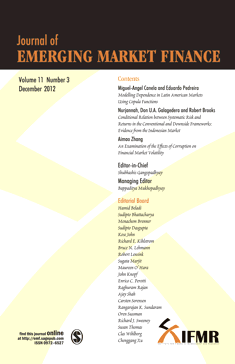
Journal of Emerging Market Finance
Illuminating the Future of Emerging Market EconomiesThe Journal of Emerging Market Finance, published by SAGE Publications India Pvt Ltd, is a premier academic journal that serves as a vital resource for researchers, professionals, and students in the fields of finance and economics. Established in 2002, this journal focuses on the multifaceted dynamics of emerging market economies and their financial systems. With an ISSN of 0972-6527 and an E-ISSN of 0973-0710, it has garnered attention with its respectable Q3 rankings in both the Economics and Econometrics and Finance categories, reflecting its commitment to high-quality research. Despite its limited open-access options, the journal remains a significant platform for scholarly discussions, providing insights on emerging financial instruments, market behaviors, and economic policies in developing economies. As a continuously evolving publication, it aims to bridge the gap between theory and practice, promoting an understanding of the complexities faced in these vibrant markets, ultimately serving the academic community with relevant and impactful research until 2024 and beyond.

EMERGING MARKETS FINANCE AND TRADE
Empowering Insights into Global Trade DynamicsEmerging Markets Finance and Trade is a leading academic journal published by Routledge Journals, Taylor & Francis Ltd, specializing in the dynamic field of finance and trade within emerging markets. This journal boasts an impressive impact factor and ranks in the top quartiles of its categories, attaining Q1 status in Economics, Econometrics and Finance (miscellaneous) and Q2 in Finance as of 2023. With a strong focus on innovative research, it publishes cutting-edge studies and insights that are crucial for understanding the complexities of financial systems in emerging economies. The journal, with ISSN numbers 1540-496X and 1558-0938 for its electronic version, offers a platform for both established researchers and newcomers in the field, highlighting the latest trends, policies, and challenges in finance and trade from 2002 to 2024. While it maintains a subscription-based access model, its significant contributions make it a must-read for academics, professionals, and students alike who seek to navigate and influence the rapidly evolving landscape of emerging markets.
JOURNAL OF INTERNATIONAL MONEY AND FINANCE
Elevating discourse in finance and economic policy.JOURNAL OF INTERNATIONAL MONEY AND FINANCE is a premier scholarly publication dedicated to advancing the understanding of international finance and monetary economics. Published by Elsevier Science Ltd, this esteemed journal has been disseminating critical research since its inception in 1982 and will continue to contribute to the field through 2024. With a strong international presence and headquarters in the United Kingdom, the journal boasts an impressive collection of articles that explore significant trends, challenges, and innovations in the areas of economics and finance. Recognized for its impact, it ranks in the top quartile (Q1) in both the Economics and Econometrics and Finance categories as of 2023, signifying its influence and relevance among peers. Researchers, professionals, and students in these disciplines can benefit from the journal's rigorous peer-review process, ensuring high-quality scholarly outputs. Though not currently an open-access journal, it provides various subscription options to foster access to groundbreaking research in the financial ecosystem.

B E Journal of Macroeconomics
Illuminating contemporary issues in macroeconomic theory.B E Journal of Macroeconomics is a distinguished academic journal published by WALTER DE GRUYTER GMBH that serves as a critical platform for advancing the field of macroeconomic research. Established in 2001, it has gained recognition within the economics community, featuring a broad range of theories and empirical studies relevant to contemporary economic issues. With an impact factor reflective of its academic contributions, the journal is categorized in the Q3 quartile for Economics and Econometrics, ranking 607 out of 716 in its field according to Scopus metrics. The journal's scope includes a comprehensive exploration of macroeconomic trends, policy analysis, and the dynamics of economic systems, catering to researchers, practitioners, and students alike. Though primarily published in a traditional format, researchers have ample opportunities to access its invaluable content through institutional subscriptions, ensuring the dissemination of knowledge across the global economic landscape. Located in Berlin, Germany, B E Journal of Macroeconomics not only enriches the academic discourse but also fosters a deeper understanding of macroeconomic phenomena, making it an essential resource for anyone engaged in the field.
North American Journal of Economics and Finance
Elevating scholarship in economic and financial research.The North American Journal of Economics and Finance is a premier academic journal published by Elsevier Science Inc. since 1992, dedicated to advancing the field of economics and finance through rigorous research and scholarship. With an impressive impact factor and recognition in the Q2 category for Economics and Econometrics and Q1 for Finance as of 2023, this journal holds a significant position in the academic community, ranked #41 out of 317 in Finance and #100 out of 716 in Economics. The journal features high-quality, peer-reviewed articles that cover a broad range of topics, from theoretical frameworks to empirical analyses and practical applications. Though not an open-access platform, the journal provides valuable insights for researchers, practitioners, and students alike, promoting knowledge dissemination in the dynamic landscape of economic and financial studies. With its commitment to excellence, the North American Journal of Economics and Finance serves as an essential resource for those seeking to deepen their understanding of contemporary issues in these critical fields.
IMF Economic Review
Advancing Economic Insights for a Global AudienceIMF Economic Review, published by Palgrave Macmillan Ltd, stands as a preeminent journal in the fields of Economics and Business Management, holding a prestigious Q1 ranking in both categories as of 2023. With an ISSN of 2041-4161 and an E-ISSN of 2041-417X, this journal not only showcases high-quality, peer-reviewed research but also embraces the principles of Open Access, promoting wide dissemination of its findings to researchers, professionals, and students alike. Spanning significant years from 2010 to 2024, the IMF Economic Review features innovative analyses and insights that challenge conventional economic paradigms and foster deeper understanding of global economic dynamics. Its impressive Scopus ranking places it in the top 10% of economics journals globally, affirming its vital role in advancing academic discourse and practical application in economics and finance. For those dedicated to exploring the intricacies of economic theory and practice, the IMF Economic Review is an invaluable resource that not only informs but also inspires.

EKONOMICKY CASOPIS
Illuminating the Path of Economic UnderstandingEKONOMICKY CASOPIS is a distinguished journal published by the Institute of Economics Research SAS and the Institute of Forecasting CSPS SAS, offering a comprehensive platform for the dissemination of innovative research in the field of economics and econometrics. Since its inception in 1978, the journal has been committed to fostering scholarly discourse, showcasing empirical studies, theoretical advancements, and policy analyses that contribute to the understanding of economic phenomena. Although categorized in the Q4 quartile in 2023 and ranking in the lower percentiles within Scopus, EKONOMICKY CASOPIS remains a critical resource for researchers and practitioners seeking to engage with the economic challenges of our time. As the journal continues to evolve through 2024, it invites contributions that align with its objectives of enhancing economic insights and promoting academic discussion in Slovakia and beyond. For researchers looking to publish their work or expand their knowledge, EKONOMICKY CASOPIS serves as a vital resource in the expanding landscape of economic research.
Journal of Chinese Economic and Foreign Trade Studies
Exploring the Dynamics of China’s Economic LandscapeJournal of Chinese Economic and Foreign Trade Studies is a distinguished academic platform dedicated to exploring the intricate dynamics of China’s economic policies and foreign trade practices. Published by Emerald Group Publishing Ltd, this journal caters to a diverse readership interested in the intersection of business, economics, and international management. With an ISSN of 1754-4408 and an E-ISSN of 1754-4416, it demonstrates its influence in the scholarly community, evidenced by its latest categorization as a Q3 journal in Business and International Management and Q2 in Economics, Econometrics, and Finance for 2023. The journal’s rank of #67/288 in the Scopus database places it in the 76th percentile, affirming its significance in the field. Although it operates under traditional access models, the journal invites rigorous academic discourse and provides a vital source of knowledge for scholars interested in the evolving landscape of Chinese trade and economic strategies from 2010 to 2024.