
Miscelanea de Estudios Arabes y Hebraicos-Seccion Hebreo
metrics 2024
Exploring the Rich Tapestry of Arabic and Hebrew Studies
Introduction
Miscelanea de Estudios Arabes y Hebraicos-Seccion Hebreo is a distinguished interdisciplinary journal published by Universidad de Granada, Editorial, focusing on the intricate fields of Arabic and Hebrew studies. Established in 1955, this open-access journal promotes scholarly discourse and research, allowing free access to its articles, which enhances the dissemination of knowledge. With an ISSN of 1696-585X and an E-ISSN of 2340-2547, the journal has garnered attention in various academic categories, reflecting its relevance and impact: achieving Q2 rankings in both Literature and Literary Theory and Religious Studies, as well as a Q3 ranking in Cultural Studies and History as of 2023. Operating from its base in Granada, Spain, Miscelanea de Estudios Arabes y Hebraicos-Seccion Hebreo contributes significantly to the advancement of cultural understanding, and its accessibility since its inception underscores its commitment to fostering academic excellence. Researchers, professionals, and students interested in the rich interplay between linguistic, cultural, and historical contexts will find this journal an invaluable resource for their studies.
Metrics 2024
 0.130.10-3
Metrics History
Rank 2024
Scopus
JCI (Web Of Science)
Quartile History
Similar Journals

Anaquel de Estudios Arabes
Connecting Scholars Through Critical DialogueAnaquel de Estudios Arabes is a distinguished academic journal dedicated to the field of Arab studies, offering a platform for original research and critical discussions that span various disciplines. Published by UNIV COMPLUTENSE MADRID, SERVICIO PUBLICACIONES, this journal has established itself as a vital resource since it became Open Access in 2014, facilitating global dissemination of knowledge. With an ISSN of 1130-3964 and E-ISSN 1988-2645, the journal operates from Madrid, Spain, and supports a diverse range of topics related to history, linguistics, literature, and religious studies, earning esteemed Q2 and Q3 rankings in these categories as of 2023. Researchers, professionals, and students alike benefit from the journal's commitment to quality, reflected in its Scopus rankings across several related fields. As it approaches a pivotal period from 2019 to 2024, the Anaquel de Estudios Arabes continues to contribute significantly to the intellectual landscape of Arab studies, engaging scholars who seek to deepen their understanding of the complex cultural and linguistic heritage of the Arab world.
JOURNAL OF ENGLISH AND GERMANIC PHILOLOGY
Cultivating Knowledge in English and Germanic PhilologyJournal of English and Germanic Philology, published by University of Illinois Press, stands as a prestigious forum for scholarly discourse in the fields of linguistics and literary studies. With its ISSN 0363-6941 and an impressive impact factor aligning it within the Q1 and Q2 quartiles in key academic categories, this journal delves into nuanced explorations of both the English and Germanic languages, enriching the understanding of language and its literary frameworks. The journal aims to foster interdisciplinary dialogue, offering cutting-edge research that appeals not only to linguists and literary theorists but also to educators and cultural historians alike. Although the journal is not open access, its contributions are essential for anyone keen on enhancing their knowledge of linguistic phenomena and literary narratives from these influential linguistic traditions. With a commitment to publishing innovative and rigorous scholarship, the Journal of English and Germanic Philology is a vital resource for academics seeking to advance their work in language and literature.
European Journal of Scandinavian Studies
Advancing the frontiers of Scandinavian scholarship.European Journal of Scandinavian Studies is an esteemed journal published by Walter de Gruyter GmbH, dedicated to advancing scholarship in the fields of Cultural Studies, Linguistics and Language, and Literature and Literary Theory. Since its inception in 2010, the journal has been a pivotal platform for researchers and scholars, showcasing cutting-edge research and critical discussions pertaining to Scandinavian languages and cultures. With an ISSN of 2191-9399 and an E-ISSN of 2191-9402, the journal emphasizes accessibility to impactful academic work, despite its current non-open access model. While the journal is categorized within the Q4 quartile for Cultural Studies and Linguistics/Language, it has shown notable potential in ranking higher in its specialized domains, fostering a growing community of researchers invested in Scandinavian studies. The journal's office is located in Berlin, Germany, further enriching its European scholarly context. As it continues to evolve, the European Journal of Scandinavian Studies serves as a vital resource for academics seeking to engage deeply with the multifaceted aspects of Scandinavian culture and linguistics.
MOYEN AGE
Fostering Insight into Historical Linguistics and Literary TheoryMOYEN AGE is a distinguished academic journal published by LE MOYEN AGE BOECK & LARCIER S A in Belgium, focused on the multifaceted disciplines of History, Linguistics, and Literature. With its ISSN 0027-2841 and E-ISSN 1782-1436, this journal serves as a platform for researchers, professionals, and students alike to engage with scholarly articles that contribute to the understanding of medieval studies. Although currently categorized in the fourth quartile across various fields as of 2023, MOYEN AGE demonstrates a commitment to fostering academic dialogue and exploration around historical linguistics and literary theory. The journal is available via subscription, making it an essential resource for those looking to deepen their knowledge in its scope, which spans from 2001 through 2024. As it continues to evolve, MOYEN AGE remains a relevant source for emerging thinkers and established scholars drawn to the complexities of the medieval era.
SEFARAD
Pioneering Research on Jewish Culture and HistorySEFARAD, published by the CONSEJO SUPERIOR INVESTIGACIONES CIENTIFICAS-CSIC, is a renowned open-access journal that has been a pivotal platform for scholarly communication since its inception in 1996. Based in Spain, it caters to a diverse readership across multiple disciplines, including Cultural Studies, History, Literature and Literary Theory, Religious Studies, and Linguistics and Language. The journal has successfully established itself within respected academic circles, achieving Q2 rankings in both History and Literature and Literary Theory as per the 2023 category quartiles, emphasizing its significance in these fields. With a commitment to fostering interdisciplinary dialogue and enhancing understanding of the Jewish heritage and culture in the Iberian Peninsula, SEFARAD presents original research articles, comprehensive reviews, and critical essays that inspire further scholarly inquiry. Researchers, professionals, and students alike will find this journal an invaluable resource for contemporary studies in its vibrant subject areas.

Journal Asiatique
Navigating the Intersections of Culture, Language, and HistoryJournal Asiatique, published by PEETERS, is a distinguished academic journal based in Belgium with an ISSN of 0021-762X and an E-ISSN of 1783-1504, specifically serving the fields of Cultural Studies, History, Linguistics, and Literature. With a significant impact factor reflected through its categorization in the Q3 quartile for Cultural Studies, History, and Linguistics, and Q2 in Literature and Literary Theory, the journal provides a vital platform for scholarly discourse, encouraging researchers, professionals, and students to contribute to the evolution of these intertwined domains. The journal covers diverse aspects of Asian studies, including cultural, historical, and linguistic perspectives, and has been actively publishing since its establishment. While it does not offer an open-access option, the journal remains an esteemed resource for academic exploration and critical analysis, helping to elevate and disseminate knowledge within its vibrant community.
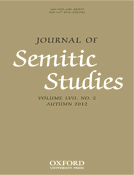
JOURNAL OF SEMITIC STUDIES
Connecting Scholars through Semitic ScholarshipJOURNAL OF SEMITIC STUDIES, published by Oxford University Press, is a premier academic journal that has served as a vital platform for interdisciplinary research in the fields of Semitic languages, history, culture, and religion since its inception in 1956. With a distinguished impact factor and a significant presence in various academic quartiles, including Q1 rankings in History and Literature, this journal is essential for scholars and practitioners seeking to advance their understanding of Semitic studies. The journal's scope includes comprehensive research articles, critical essays, and reviews that contribute to ongoing dialogues in Cultural Studies, Linguistics, and Religious Studies, making it indispensable for researchers, educators, and students alike. Although it currently does not offer open access, the high-quality, peer-reviewed content ensures rigorous academic standards while maintaining engagement with current trends and discussions in its respective fields. As a hub for innovative and influential scholarship, the JOURNAL OF SEMITIC STUDIES continues to foster an environment that encourages exploration and discovery within the rich tapestry of Semitic languages and cultures.

Collectanea Christiana Orientalia
Illuminating the Path of Christian Literary InquiryCollectanea Christiana Orientalia is a distinguished academic journal published by EDITORIAL UNIV CORDOBA-UCOPRESS, specializing in the fields of linguistics, literature, and literary theory. Since its inception, the journal has served as a vital platform for researchers and scholars from around the globe, promoting the exploration of Christian Oriental studies and their implications in contemporary literature and languages. Leveraging an Open Access model since 2013, it ensures widespread accessibility to cutting-edge research, fostering greater dissemination and engagement within the academic community. With an ISSN of 1697-2104 and an E-ISSN of 2386-7442, the journal is recognized for its rigorous peer-review process and has achieved commendable rankings in various categories: Q4 in Linguistics and Language and Q3 in Literature and Literary Theory as of 2023. This includes notable Scopus rankings that place it within the 57th percentile for Literature and Literary Theory, reflecting its significance and contribution to the field. Aspiring to foster dialogue and scholarship, Collectanea Christiana Orientalia invites contributions that delve into the intricacies of Christian thought, linguistics, and literary aesthetics, making it an essential resource for researchers, professionals, and students alike.

Studi Slavistici
Fostering Innovative Perspectives in Cultural StudiesStudi Slavistici is an esteemed academic journal published by FIRENZE UNIV PRESS, focusing on the rich and diverse fields of Cultural Studies, Linguistics and Language, and Literature and Literary Theory. Since its initiation in 2004, it operates under an Open Access model, providing unrestricted access to its contents and fostering a wider dissemination of research. Based in Italy, this journal serves as a vital platform for scholars and researchers engaged in Slavic studies and beyond, encouraging interdisciplinary dialogue and innovative approaches. With its current Quartile rankings in the Q4 category across various domains, it plays a significant role in shaping dialogues within the academic community while offering insights into contemporary and historical perspectives. By maintaining an inclusive vision and engaging with critical issues, Studi Slavistici remains dedicated to advancing knowledge and scholarship in these intricate fields.

Acta Baltico-Slavica
Exploring the Rich Tapestry of Slavic ScholarshipActa Baltico-Slavica, an esteemed academic journal published by the Polish Academy of Sciences, Institute of Slavic Studies, serves as a vital platform for the exploration of Slavic cultures, languages, and historical narratives. Since its transition to Open Access in 2014, the journal has fostered inclusivity and accessibility, allowing researchers, professionals, and students to engage with cutting-edge scholarship in the fields of History, Linguistics and Language, and Literature and Literary Theory. With a commendable impact as indicated by its category quartile rankings (Q2 in History and Literature, Q3 in Linguistics), and Scopus rankings reflecting its significance within the academic community, Acta Baltico-Slavica not only contributes to the rich tapestry of scholarship surrounding the Baltic and Slavic regions but also encourages interdisciplinary dialogue. The journal’s commitment to advancing knowledge across its fields of study makes it a prominent destination for scholarly discourse and research inquiry.