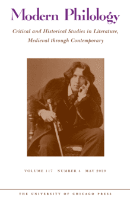
MODERN PHILOLOGY
Scope & Guideline
Fostering Innovative Research in Linguistics and Culture
Introduction
Aims and Scopes
- Interdisciplinary Literary Analysis:
Encourages approaches that integrate insights from history, philosophy, cultural studies, and other disciplines to broaden the understanding of literary texts. - Focus on Historical Contextualization:
Emphasizes the importance of historical contexts in shaping literary works, particularly in relation to social, political, and cultural dynamics across different eras. - Exploration of Gender and Sexuality:
Investigates representations of gender and sexuality in literature, analyzing how these themes evolve in different historical contexts. - Cognitive and Psychological Perspectives:
Utilizes cognitive science and psychology to explore how literature engages with human thought, emotion, and consciousness. - Ecological and Environmental Criticism:
Examines the relationship between literature and ecological issues, reflecting on how literary texts engage with themes of nature, environment, and sustainability. - Global and Transnational Literary Studies:
Promotes the study of literature within a global context, exploring transnational influences and the interconnectedness of literary traditions. - Digital Humanities Approaches:
Incorporates digital tools and methodologies to analyze texts, offering new insights into literary scholarship and expanding access to literary studies.
Trending and Emerging
- Intersections of Literature and Philosophy:
A noticeable trend is the exploration of philosophical themes within literature, particularly how texts engage with metaphysics, ethics, and existential questions. - Critical Race and Ethnicity Studies:
There is an increasing focus on race, ethnicity, and postcolonial studies, examining how these frameworks inform literary analysis and representation. - Digital and Media Studies:
Emerging discussions around digital humanities, media theory, and the impact of technology on literature are gaining traction, reflecting the changing landscape of literary consumption. - Environmental and Ecocritical Perspectives:
Scholarly work is increasingly addressing ecological themes, examining literature's role in environmental discourse and its reflection on human-nature relationships. - Emotional and Affective Turn in Literary Studies:
The exploration of emotions, affect, and their representation in literature is becoming more prominent, reflecting a broader interest in the psychological dimensions of reading and interpretation.
Declining or Waning
- Traditional Historical Narratives:
There appears to be a waning interest in strictly chronological or traditional historical narratives that do not integrate contemporary theoretical frameworks or interdisciplinary approaches. - Conventional Literary Canon Formation:
The emphasis on canonical texts and authors is less prominent, signaling a shift towards more inclusive studies that prioritize marginalized voices and lesser-known works. - Fixed Genre Boundaries:
The rigid categorization of literature into fixed genres is declining, as scholars increasingly explore hybrid forms and cross-genre influences. - Static Interpretations of Texts:
There is a noticeable reduction in papers that offer static or singular interpretations of literary works, with a growing preference for dynamic, multifaceted readings. - Focus on Western Canon Exclusivity:
The exclusive focus on Western literary traditions is diminishing, as there is a greater emphasis on global literature and cross-cultural dialogues.
Similar Journals
Acta Poetica
Connecting Scholars to the Heart of Literary TheoryActa Poetica is a distinguished open-access journal dedicated to advancing research and scholarship in the fields of Cultural Studies and Literature and Literary Theory. Published by the Universidad Nacional Autónoma de México through its Instituto de Investigaciones Filológicas, this journal has been a pivotal platform for the dissemination of literary discourse since it embraced open access in 1979. With a notable presence in both the social sciences and humanities, Acta Poetica has earned a ranking of Q3 and Q2 in the 2023 category quartiles, reflecting its commitment to quality scholarship. The journal invites contributions from researchers, professionals, and students alike, fostering a rich dialogue that explores the nuances of literary criticism and cultural phenomena. With its ISSN 0185-3082 and E-ISSN 2448-735X, the journal aims to make valuable research accessible to a global audience, continuing its legacy of enhancing literary scholarship from its base in Mexico City.
STUDIES IN PHILOLOGY
Illuminating Connections Between Text and TheoryStudies in Philology is a distinguished peer-reviewed journal published by University of North Carolina Press, focusing on the fields of linguistics, literature, and literary theory. Established in 1972, the journal has consistently contributed to the scholarly discourse in its domains, showcasing a rich repository of research that meets the evolving needs of academic inquiry. With an ISSN of 0039-3738 and an E-ISSN of 1543-0383, it provides a platform for innovative studies that enhance understanding and foster critical engagement with texts and language. The journal is currently placed in the Q4 tier within linguistics and language and Q2 in literature and literary theory, reflecting its diverse and significant contributions to the arts and humanities. Although not an open-access journal, it continues to attract submissions from globally recognized scholars, making it a valuable resource for researchers, professionals, and students seeking to deepen their expertise and advance their studies. For more than four decades, Studies in Philology has played an integral role in fostering scholarly communication, and it remains committed to publishing pioneering articles that challenge conventional thinking and broaden the horizons of philological exploration.

Ermeneutica Letteraria-Rivista Internazionale
Fostering Global Dialogue in Literary DiscourseErmeneutica Letteraria-Rivista Internazionale, published by FABRIZIO SERRA EDITORE, serves as a notable platform for the ongoing discourse in the fields of Arts and Humanities, Linguistics, Literature, and Literary Theory. Since its inception in 2019, this scholarly journal has become a significant reference point for innovative research while critically engaging with various literary paradigms and linguistic phenomena. Although currently classified in the Q4 quartile across its respective categories by Scopus, its commitment to open discourse invites submissions that challenge existing norms and broaden the horizons of contemporary literary critique. The journal's holistic approach not only supports the scholarly community in Italy but also aims to foster international dialogue among researchers, professionals, and students in the humanities. The journal is located in Pisa, Italy, and due to its open access policy, it seeks to ensure that knowledge is accessible to a wider audience while contributing to the collective understanding of literary interpretations and linguistic developments.

Revue Italienne d'Etudes Francaises
Advancing Critical Discourse in Francophone ScholarshipRevue Italienne d'Etudes Francaises, published by SEMINARIO FILOLOGIA FRANCESE, is a pivotal open access journal dedicated to the exploration and analysis of French studies within the broader context of history, linguistics, and literary theory. Since its inception in 2011, this journal has fostered scholarly dialogue and critical discourse, offering a platform for researchers, professionals, and students alike to disseminate their work and engage with contemporary issues in these fields. With an ISSN and E-ISSN of 2240-7456, the journal has established itself within the academic community, although it currently ranks in the lower quartiles across various disciplines, as indicated by its Scopus metrics. Nevertheless, the Revue Italienne d'Etudes Francaises remains an essential resource for those seeking to deepen their understanding of Francophone literature, culture, and linguistic dynamics from its base in Rome, Italy, at C/O Fondazione Primoli. As the field of French studies continues to evolve, this journal plays an important role in highlighting the latest research findings and theoretical advancements.

Dicenda-Cuadernos de Filologia Hispanica
Connecting Scholars through Open Access InsightsDicenda-Cuadernos de Filologia Hispanica, published by UNIV COMPLUTENSE MADRID, SERVICIO PUBLICACIONES, is a distinguished academic journal in the fields of linguistics, literature, and literary theory. Since its transition to Open Access in 2017, it has facilitated unrestricted dissemination of knowledge, making it an invaluable resource for researchers, scholars, and students interested in the rich tapestry of Hispanic philology. With an impact factor reflected by its Scopus rankings—at Q3 in Linguistics and Language and Q2 in Literature and Literary Theory—Dicenda serves as a vital platform for innovative research and critical discourse. The journal actively encourages submissions that explore contemporary and historical perspectives within its scope. Located in Madrid, Spain, the journal has steadily established itself as a significant contributor to the ongoing dialogue in the humanities, fostering a deeper understanding of linguistic and literary phenomena.
MILTON QUARTERLY
Advancing Literary Scholarship Since 1967MILTON QUARTERLY, published by Wiley, is a premier academic journal in the field of Literature and Literary Theory. Since its inception in 1967, it has become a leading platform for scholarly discourse, focusing on the works and influence of John Milton and extending to broader themes in literary studies. With an impressive Q1 ranking in its category, the journal is recognized for its high-quality peer-reviewed articles and contribution to advancing literary scholarship. Although it currently does not offer open access options, its impact in the academic community is undeniable, boasting publications that resonate well beyond its pages. The journal is an invaluable resource for researchers, professionals, and students alike, keen on exploring the intersections of literary theory, history, and criticism, making significant contributions to the understanding of literature throughout the centuries.

Estudios de Teoria Literaria-Revista Digital-Artes Letras Humanidades
Exploring the Depths of Theory and CultureEstudios de Teoria Literaria-Revista Digital-Artes Letras Humanidades is a prominent scholarly journal published by UNIV NAC MAR PLATA in Argentina, dedicated to advancing the fields of Literary Theory, Communication, and Cultural Studies. Established with an Open Access model since 2012, the journal fosters global dissemination of research without financial barriers, encouraging a broader dialogue among scholars, practitioners, and students alike. Notably, it enjoys a presence in Scopus, with various category quartiles indicating its commitment to quality and relevance, particularly with rankings such as Q3 in Literature and Literary Theory. By providing a platform for innovative scholarship, Estudios de Teoria Literaria aims to explore complex theoretical frameworks and cultural discourses, making significant contributions to ongoing debates in the humanities. The journal is published from its base in Mar del Plata, Buenos Aires, and continues to expand its influence in both regional and international academic communities.
Dickens Studies Annual
Decoding Dickens: A Journey Through Time and TextDickens Studies Annual, published by Penn State University Press, is a distinguished journal devoted to the scholarly examination of Charles Dickens and his literary contributions. With an ISSN of 0084-9812 and an E-ISSN of 2167-8510, this publication provides a vital platform for researchers, students, and professionals in the field of Victorian literature and cultural studies. The journal aims to explore the complexities of Dickens's works, encompassing critical analysis, historical context, and interdisciplinary approaches, thus positioning itself as a critical resource for understanding the broader impact of Dickens's writing on literature and society. Although not currently adopting an open access model, readers can access a wealth of rigorously researched articles that contribute significantly to ongoing dialogues within Dickens studies. The journal's focus on innovation and excellence ensures that it remains an essential reference for those seeking to deepen their understanding of one of literature's most influential figures.
REVIEW OF ENGLISH STUDIES
Elevating the Study of English Through Rigorous ResearchREVIEW OF ENGLISH STUDIES, published by Oxford University Press, is a prestigious journal that has been advancing the fields of Literature and Literary Theory as well as Linguistics and Language since its inception in 1925. With an impressive impact factor and a commendable ranking, placing it in the Q1 and Q2 categories across relevant disciplines, the journal serves as a vital platform for researchers, scholars, and students alike. Covering a wide range of topics from classical literature to contemporary linguistic analysis, REVIEW OF ENGLISH STUDIES is committed to fostering scholarly discourse and promoting innovative research methodologies. Although it does not offer open access, the journal is highly regarded for its rigorous peer-review process and high-quality publications, making it an essential resource for anyone engaged in English studies. For researchers seeking to keep abreast of the latest developments in the field, this journal stands as an indispensable guide and repository of knowledge.

Jordan Journal of Modern Languages & Literature
Bridging Theory and Practice in Modern LanguagesJordan Journal of Modern Languages & Literature is a prestigious academic journal published by Yarmouk University, Deanship of Research & Graduate Studies. This journal serves as a vital platform for scholars and researchers in the fields of linguistics and literature, offering a well-rounded examination of modern languages and literary theory. With an impressive Q2 ranking in Linguistics and Language and a Q1 distinction in Literature and Literary Theory as of 2023, it consistently features high-quality research that contributes to the advancement of knowledge in these domains. The Scopus rankings further reflect its academic rigor, placing it in the 79th percentile for Literature and Literary Theory and maintaining significant influence in related fields, making it an essential resource for researchers, professionals, and students alike. Although it does not operate under an open-access model, the journal's commitment to publishing groundbreaking studies can significantly aid in the understanding and progression of modern linguistic and literary practices. The Jordan Journal of Modern Languages & Literature continues to be an influential voice in fostering scholarly dialogue and advancing research in the humanities.