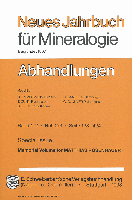
NEUES JAHRBUCH FUR MINERALOGIE-ABHANDLUNGEN
Scope & Guideline
Fostering innovation in geochemistry research.
Introduction
Aims and Scopes
- Petrology and Mineralogy:
The journal publishes extensive research on the petrology of various rock types, including igneous, metamorphic, and sedimentary rocks, highlighting mineral compositions and their geological significance. - Geochemical Analysis:
A significant focus is placed on geochemical studies that explore the elemental and isotopic compositions of minerals and rocks, which provide insights into their formation and evolution. - Xenolith Studies:
Research on xenoliths, particularly their petrological and geochemical characteristics, is a core area, reflecting the journal's commitment to understanding the processes occurring beneath the Earth's surface. - Volcanology and Magmatism:
The journal includes studies on volcanic activity and magmatic processes, emphasizing the geological settings and implications of volcanic rocks and related mineral deposits. - Tectonic Frameworks:
Many articles investigate the tectonic environments and settings of mineral deposits, contributing to the understanding of geological history and resource distribution.
Trending and Emerging
- Geochemical Characterization of Mineral Deposits:
There is a notable increase in studies focusing on the geochemical characterization of mineral deposits, highlighting their economic significance and the need for detailed compositional analyses. - Isotope Geochemistry:
Research utilizing isotopic analyses to understand geological processes is on the rise, demonstrating the growing importance of isotopes in tracing geological histories and processes. - Petrogenesis and Tectonic Settings:
Emerging themes include in-depth studies of the petrogenesis of various rocks and their tectonic settings, which are critical for understanding the geological evolution of specific regions. - Volcanic Processes and Products:
An increasing number of papers are dedicated to volcanic processes and products, focusing on their implications for understanding the Earth's interior and surface dynamics. - Environmental and Economic Geology:
Research addressing the environmental impacts of mining and the economic potential of mineral resources is gaining traction, reflecting a broader interest in sustainable practices in geology.
Declining or Waning
- Sedimentary Geology:
Research related to sedimentary processes and rock types has decreased, possibly reflecting a shift towards more dynamic geological environments in current studies. - Traditional Mineral Identification:
The exploration of conventional mineral identification techniques is waning, as advancements in technology and analytical methods have shifted the focus towards more complex mineralogical studies. - Regional Geological Surveys:
The frequency of publications focusing solely on regional geological surveys is declining, perhaps in favor of more integrative studies that combine multiple geological aspects.
Similar Journals
Acta Geochimica
Advancing Geochemical Knowledge for a Deeper Understanding.Acta Geochimica is a prominent academic journal published by SPRINGER INT PUBL AG, focusing on the dynamic fields of Geochemistry and Petrology. Established in 2016, this peer-reviewed publication has quickly gained recognition within the scientific community, currently holding a category quartile ranking of Q3 in Geochemistry and Petrology as of 2023. With its ISSN 2096-0956 and E-ISSN 2365-7499, the journal offers a platform for researchers and professionals to disseminate and discuss significant advancements in the study of the chemical composition of the Earth and other celestial bodies. While it is not an open-access journal, Acta Geochimica plays a vital role in fostering collaboration and innovation among scientists, contributing to a deeper understanding of geochemical processes. Located in Switzerland at Gewerbestrasse 11, Cham CH-6330, Switzerland, this journal is a critical resource for students, researchers, and professionals seeking to push the boundaries of knowledge in Earth sciences.
MINERALIUM DEPOSITA
Connecting Minds Through Geological DiscoveriesMINERALIUM DEPOSITA is a premier journal in the fields of Economic Geology, Geochemistry, and Petrology, published by Springer. With an impressive 2023 impact factor and designated as Q1 in its category, this journal stands out in the academic landscape, showcasing the latest research and developments from 1966 to 2024. With a prominent rank in Scopus, holding the 3rd position in both Geophysics and Geochemistry and Petrology, it represents an invaluable resource for researchers and professionals alike. Although open access options may not be available, the journal's comprehensive coverage of mineral deposits promotes the global exchange of knowledge and advances in our understanding of the geological sciences. Positioned in Germany, MINERALIUM DEPOSITA serves as a crucial platform for innovative discussions, making it essential reading for students, professionals, and academics dedicated to exploring the complexities of earth sciences.
ACTA GEOLOGICA SINICA-ENGLISH EDITION
Advancing Earth Sciences Through Rigorous ResearchACTA GEOLOGICA SINICA-ENGLISH EDITION is a distinguished academic journal published by Wiley, providing a platform for cutting-edge research in the field of geology. With an ISSN of 1000-9515 and E-ISSN 1755-6724, this journal has been a pivotal resource since its inception in 1988, catering to scholars and professionals until 2024. The journal is recognized for its high-quality articles, achieving a Q2 ranking in the field of Geology according to the 2023 category quartiles, and ranks #122 out of 321 in the Scopus Earth and Planetary Sciences sector, placing it within the 62nd percentile among its peers. Although currently not available as an open access publication, it remains a significant repository of knowledge that supports ongoing geological research and exploration. For researchers, students, and professionals looking to deepen their understanding of geological sciences, ACTA GEOLOGICA SINICA-ENGLISH EDITION stands as an essential journal, promoting collaboration and innovation in the earth sciences.
GEOCHEMISTRY INTERNATIONAL
Unveiling the Secrets of Geochemical ProcessesGEOCHEMISTRY INTERNATIONAL, an esteemed journal published by MAIK NAUKA/INTERPERIODICA/SPRINGER, serves as a vital platform for researchers in the fields of geochemistry, petrology, and geophysics. With a deep history reaching back to its inception, the journal spans significant converged years from 1977 to 1978 and continues its publication through 2024. Although it currently does not offer Open Access options, its scholarly impact is underscored by an established reputation indicated by its Q3 categorization in both Geochemistry and Petrology and Geophysics for 2023. Researchers can leverage this platform to disseminate groundbreaking findings and engage with contemporary discussions in Earth and planetary sciences, where it ranks at the 39th and 32nd percentiles within its respective categories. The journal is an essential resource for professionals, students, and scholars seeking to deepen their understanding of geochemical processes and evolve scientific discourse within this dynamic field.
CONTRIBUTIONS TO MINERALOGY AND PETROLOGY
Exploring Earth’s Secrets Through Rigorous ResearchCONTRIBUTIONS TO MINERALOGY AND PETROLOGY, published by SPRINGER, is a premier journal in the fields of geochemistry, petrology, and geophysics, boasting an impressive impact factor that reflects its status as a leader in the discipline. With a history spanning from 1966 to 2024, this journal has consistently provided a platform for high-quality research that influences our understanding of earth materials and processes. Ranked in the top quartile (Q1) in both geochemistry and petrology, as well as geophysics, it stands out with Scopus rankings of #24 out of 165 in Geophysics and #37 out of 154 in Geochemistry and Petrology, indicating its critical role in advancing scientific knowledge. As a vital resource for researchers, professionals, and students alike, the journal invites contributions that foster collaboration and innovation in the study of minerals and rocks. Although it does not currently offer open access, its scholarly rigor and relevance to contemporary issues ensure it remains an indispensable part of the academic discourse within this field.

Boletin de Geologia
Unlocking the Secrets of Our Planet's Past and Future.Boletin de Geologia is a prominent open-access journal published by UNIV INDUSTRIAL SANTANDER, dedicated to advancing the field of Earth and Planetary Sciences. Since its transition to open access in 2000, this journal has provided a platform for researchers to disseminate their findings and engage with the global scientific community. With an ISSN of 0120-0283 and an E-ISSN of 2145-8553, it is indexed in Scopus and has secured a notable Q3 ranking in the category of miscellaneous Earth and Planetary Sciences as of 2023, reflecting the impact and relevance of its published articles. The journal's geographical scope, rooted in Colombia, allows it to highlight significant geological research pertinent to the region while also contributing to global discussions. Scholars and practitioners interested in innovative research within this field will find Boletin de Geologia an invaluable resource for unlocking knowledge and fostering collaboration in the geological sciences.
LITHOLOGY AND MINERAL RESOURCES
Bridging Knowledge Gaps in Mineral ExplorationLITHOLOGY AND MINERAL RESOURCES, published by PLEIADES PUBLISHING INC, is a specialized journal dedicated to advancing knowledge in the fields of economic geology, geochemistry, and petrology. With its ISSN 0024-4902 and E-ISSN 1608-3229, this journal has established itself as a critical resource for scholars and practitioners alike, examining the intricate relationships between lithology and mineral deposits, and their implications for resource management. As indicated by its positioning in the Q3 quartile for both economic geology and geochemistry and petrology in 2023, the journal is recognized for its valuable contributions to the scientific community, ranking #28 out of 43 in Economic Geology and #112 out of 154 in Geochemistry and Petrology according to Scopus. The journal's publication history reveals a rich tradition of excellence, as it has been continuously contributing to the field from 1984 to 2024. While it does not offer open access options, researchers and practitioners can easily engage with its robust body of work in effective ways to support their own studies and applications. The importance of LITHOLOGY AND MINERAL RESOURCES lies in its commitment to publishing high-quality research that informs practices in mineral exploration and environmental stewardship, making it an essential resource for anyone invested in the future of earth sciences.

China Geology
Exploring the Depths of Earth SciencesChina Geology, published by KEAI PUBLISHING LTD, is a leading open-access journal that serves as a pivotal platform for disseminating high-quality research across a wide spectrum of Earth sciences. Since its inception in 2018, the journal has rapidly established itself with an impressive Q1 ranking in multiple critical categories, including Geology, Economic Geology, and Oceanography, among others, reflecting its significant contribution to the academic community. Positioned as a top-tier journal in the Earth Planetary Sciences domain, it ranks #22 out of 321 in Geology and exhibits an admirable impact in sub-fields such as Earth-Surface Processes and Geochemistry and Petrology. China Geology is committed to promoting rigorous scientific inquiry and facilitating the open exchange of knowledge in the geosciences, making it an essential resource for researchers, professionals, and students eager to explore innovative developments and fundamental advances in geology. The journal’s accessibility ensures that critical findings reach a broad audience, thereby enhancing collaboration and driving forward scientific discourse in the global community.
ORE GEOLOGY REVIEWS
Exploring the Depths of Ore DepositsORE GEOLOGY REVIEWS is a premier academic journal published by Elsevier, renowned for its influential contributions to the fields of Economic Geology, Geochemistry, and Petrology, and Geology. With its esteemed Q1 ranking across these disciplines in 2023, it occupies a leading position in shaping scholarly discussions and advancements within the geological sciences. With an impressive Scopus ranking—47th in Earth and Planetary Sciences for Geology, and among the top 40 in Geochemistry and Petrology—this journal serves as an essential resource for researchers, professionals, and students committed to advancing knowledge in ore geology. Having transitioned to an Open Access model in 2022, ORE GEOLOGY REVIEWS enhances the accessibility of high-quality research, promoting wider dissemination and engagement with cutting-edge findings from 1986 to 2024. As a valued publication addressing the intricacies of ore deposits and geochemical processes, it aims to foster interdisciplinary collaboration and innovation in the field.
PRECAMBRIAN RESEARCH
Charting the Course of Geological Evolution Since 1974PRECAMBRIAN RESEARCH is a leading peer-reviewed journal published by Elsevier, dedicated to advancing the field of Earth sciences, with a specific focus on the study of the Precambrian era. With its distinguished Q1 ranking in both Geochemistry and Petrology and Geology, this journal plays a critical role in disseminating high-impact research, thus contributing to its impressive standing, ranked in the top percentages in Scopus for related fields. Founded in 1974, the journal has evolved continually, ensuring comprehensive coverage of geological aspects spanning from geochemical processes to petrological studies. Researchers and students alike will find this journal indispensable for accessing cutting-edge findings, methodologies, and innovative perspectives essential for understanding the Earth’s formative years. Although it does not provide an open-access option, its subscription provides a gateway to a wealth of knowledge and groundbreaking research pivotal for scholarly advancements leading up to 2024.