
NOTRE DAME LAW REVIEW
Scope & Guideline
Pioneering Insights into American Law
Introduction
Aims and Scopes
- Constitutional Law and Interpretation:
The journal frequently explores themes related to constitutional interpretation, originalism, and the implications of historical contexts on contemporary legal issues. - Administrative Law and Procedure:
A significant focus on the Administrative Procedure Act and its applications, addressing the complexities of administrative law and the evolving nature of agency regulations. - Intersection of Law and Social Issues:
The journal publishes works that analyze the intersection of law with pressing social issues such as public health, environmental justice, and religious liberties. - Historical Analysis of Legal Principles:
Many articles delve into historical legal precedents and their relevance to modern jurisprudence, offering insights into how past legal frameworks influence current legal challenges. - Intellectual Property and Innovation:
The journal examines the role of intellectual property law in fostering innovation and addressing contemporary challenges in technology and public health. - Equity and Legal Remedies:
A focus on equitable principles and remedies, exploring how equity intersects with statutory law and judicial discretion.
Trending and Emerging
- Gun Rights and Constitutional Interpretation:
Recent articles increasingly address the Second Amendment and gun rights, reflecting a heightened interest in constitutional debates surrounding individual liberties and public safety. - Technological Impacts on Law:
The journal has expanded its scope to include discussions on technology's influence on legal frameworks, particularly regarding privacy, digital rights, and the regulation of emerging technologies. - Climate Change and Environmental Law:
Emerging themes in environmental law, particularly related to climate zoning and public health, indicate a growing recognition of the legal implications of environmental issues. - Religious Liberty in Contemporary Contexts:
A renewed focus on how religious liberty interacts with modern legal challenges, particularly in education and public policy, suggests an evolving discourse on this topic. - Reassessment of Administrative Law:
A trend towards reassessing the principles of administrative law, including the effectiveness and challenges of the Administrative Procedure Act, highlights a critical engagement with governance and regulation.
Declining or Waning
- Classical Legal Doctrines:
There has been a reduced emphasis on traditional legal doctrines, such as those surrounding torts and contracts, suggesting a shift towards more contemporary and pressing legal issues. - Federalism and State Sovereignty:
Discussions around state sovereignty and the complexities of federalism appear less frequently, indicating a possible narrowing of focus towards more immediate legal challenges. - Religious Freedom and Exemption Cases:
Although previously a prominent topic, recent articles indicate a declining trend in the exploration of religious freedom cases and their implications in a legal context. - Historical Legal Theories:
While historical analysis remains important, the specific focus on classical legal theories has diminished, with more emphasis placed on practical applications in modern contexts. - Economic Theories in Law:
The integration of economic theories into legal discussions, particularly in relation to antitrust and market regulation, has seen a decrease, suggesting a shift in the journal's thematic focus.
Similar Journals

YALE LAW JOURNAL
Advancing the Frontiers of Legal KnowledgeYale Law Journal, founded in 1891 and published by Yale Law J Co Inc, stands as a preeminent peer-reviewed legal journal in the United States, recognized for its rigorous scholarship and influential contributions to legal theory and practice. With an impact factor that underscores its peerless reputation, this journal maintains a Q1 ranking in the law category, situating it in the top tier of legal publications globally, as indicated by its Scopus rank of 66 out of 1025, placing it in the 93rd percentile. The journal publishes a comprehensive range of articles, essays, and reviews that address vital topics across the legal spectrum, aiming to foster dialogue and innovation within the legal community. Although it does not offer open access, its meticulous curation of content ensures that researchers, practitioners, and students alike have access to the most impactful legal scholarship. Located at 401-A Yale Station, New Haven, CT 06520, the journal continues to shape the legal landscape, making it an essential resource for anyone engaged in the study or practice of law.
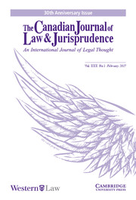
Canadian Journal of Law and Jurisprudence
Fostering Insightful Legal Scholarship for TomorrowCanadian Journal of Law and Jurisprudence, published by Cambridge University Press, serves as a pivotal platform in the field of legal studies, particularly recognized for its comprehensive exploration of jurisprudence in the context of Canadian law. While the journal operates without an open access model, its ISSN 0841-8209 and E-ISSN 2056-4260 ensure broad academic accessibility. Based in the United Kingdom, it has established a notable impact within its category, maintaining a Q3 ranking in Law according to the latest 2023 metrics. With its convergence of issues from 1996 to 2003, periods in 2007, and recently from 2012 to 2024, the journal embraces a rich historical context while addressing contemporary legal challenges. Ranked #439 out of 1025 in the social sciences category on Scopus, the journal is positioned within the 57th percentile, highlighting its significance and influence in legal scholarship. Aimed at researchers, professionals, and students, the Canadian Journal of Law and Jurisprudence is an essential resource for those seeking to deepen their understanding of the evolving landscape of law and its philosophical underpinnings.

European Public Law
Illuminating the evolution of public law in a dynamic Europe.European Public Law is an esteemed journal dedicated to advancing scholarly discourse in the realm of public law across Europe. Published by KLUWER LAW INTERNATIONAL, this journal serves as a pivotal platform for researchers, practitioners, and students who seek to explore the complexities of legal frameworks and their implications on governance in the European context. With an ISSN of 1354-3725 and an E-ISSN of 1875-8207, it ranks in the Q3 category of law journals according to the 2023 assessment, indicating its growing influence within the legal academic community, as reflected by its Scopus rank of #399 out of 1025. Although European Public Law is not currently an open-access journal, its comprehensive publication scope from 2018 to 2024 showcases a commitment to addressing contemporary legal challenges and fostering a deeper understanding of public law's evolution. Whether you are a seasoned professional or an emerging scholar, this journal is an invaluable resource for in-depth analyses, discussions, and innovations in the field of law.

CATHOLIC UNIVERSITY LAW REVIEW
Bridging Law, Education, and Religious Thought.CATHOLIC UNIVERSITY LAW REVIEW is a premier legal periodical published by the Catholic University of America Press, located in the heart of Washington, D.C. with a dedicated focus on the intersections of law, education, and religious studies. Since its establishment in 1973, the journal has served as a critical platform for scholarly discourse, presenting innovative legal analysis and thought-provoking research that caters to scholars, practitioners, and students alike. With an ISSN of 0008-8390, this non-open access journal holds a notable place in the academic community, reflected by its category quartiles in 2023, ranking Q4 in Education and Law, and Q3 in Religious Studies. The Catholic University Law Review is distinguished not only by its commitment to advancing legal scholarship but also by its dedication to exploring the implications of law through a distinctly Catholic lens. Its consistent output of high-quality articles contributes to ongoing debates and developments in these fields, making it an essential resource for those interested in the legal implications of contemporary issues.
Jurisprudence-An International Journal of Legal and Political Thought
Cultivating Rigorous Scholarship in JurisprudenceJurisprudence: An International Journal of Legal and Political Thought, published by ROUTLEDGE JOURNALS, TAYLOR & FRANCIS LTD, serves as a vital platform for scholars and practitioners engaged in the ever-evolving discourse of legal and political theory. With its ISSN 2040-3313 and E-ISSN 2040-3321, this esteemed journal spans a converged period from 2015 to 2024, and has established itself in the Q2 quartile of the law category, ranking #359 out of 1025 and placing in the 65th percentile as per Scopus metrics in 2023. Based in the United Kingdom, this journal is dedicated to exploring the intricate relationships between law, political ideologies, and contemporary societal issues, thereby fostering interdisciplinary dialogue that is crucial for navigating today’s complex legal landscapes. Although it does not currently provide an open access option, Jurisprudence continues to attract a broad readership of researchers, professionals, and students seeking rigorous scholarship and practical insights into legal and political thought. With its strong impact within the field, the journal plays a significant role in shaping future discussions and advancements in legal studies.

Studia Prawnicze KUL
Fostering Dialogue in Law and PhilosophyStudia Prawnicze KUL is an esteemed academic journal published by the John Paul II Catholic University of Lublin, dedicated to the exploration of legal studies and philosophy of law. With the ISSN 1897-7146 and E-ISSN 2719-4264, this journal has adopted an Open Access model since 2019, ensuring that its noteworthy contributions to the field are freely accessible to scholars, practitioners, and students worldwide. The journal aims to disseminate rigorous research, theoretical insights, and practical perspectives in law, fostering scholarly dialogue and collaboration among its diverse readership. As a significant platform for legal scholarship in Poland, Studia Prawnicze KUL provides a vital resource for anyone engaged in the complexities of legal theory and practice, making an important impact in the field of legal studies.

Vestnik Permskogo Universiteta-Juridicheskie Nauki
Illuminating the Path of Contemporary Legal DiscourseVestnik Permskogo Universiteta-Juridicheskie Nauki, published by the Perm State National Research University, serves as a prominent platform for the dissemination of legal scholarship since its inception. With an Open Access policy implemented in 2009, this journal offers a wide range of legal studies, including comparative law, constitutional law, and international law, making it an essential resource for researchers, academics, and practitioners in the field. Although it is a relatively young publication, its commitment to quality and accessibility has established it as a respected voice in jurisprudence, contributing significantly to both national and international legal discourse. Researchers and students alike will find valuable insights within its pages, encompassing the latest developments and theoretical advancements within Russian and global legal systems. For those looking to stay informed on current legal issues and academic debates, this journal is a must-read.

Public Law Review
Advancing Legal Discourse in Public LawPublic Law Review is a distinguished scholarly journal published by LAWBOOK CO LTD, dedicated to the rigorous exploration and analysis of public law issues. As an essential resource for researchers, practitioners, and students alike, this journal provides a platform for the dissemination of critical legal scholarship, offering insights into contemporary public law developments, theory, and practice. With its commitment to maintaining high editorial standards, the Public Law Review plays a vital role in advancing knowledge and fostering debate within the legal community. Although not currently an open-access publication, it remains accessible through various academic repositories and libraries. The journal's ISSN 1034-3024 ensures its visibility within academic and professional circles, making it an indispensable reference for anyone interested in the evolving landscape of public law in Australia and beyond.

UNIVERSITY OF CHICAGO LAW REVIEW
Fostering Innovative Legal Perspectives for TomorrowUniversity of Chicago Law Review is a prestigious academic journal dedicated to advancing legal scholarship, published by the University of Chicago Law School. Renowned for its rigorous peer-review process and high editorial standards, this journal is recognized as a leader in the field of law, achieving a Q1 ranking in the 2023 category of Law and occupying a notable position within the Scopus rankings, specifically at #199 out of 1025 in the Social Sciences - Law category, placing it in the 80th percentile. The journal provides an essential platform for legal scholars, practitioners, and students to engage with cutting-edge research and theory across various legal disciplines, including constitutional law, criminal law, and comparative law. With a commitment to fostering critical discourse, the University of Chicago Law Review has been instrumental in shaping legal thought, making it a vital resource for anyone seeking to contribute to or understand the evolving landscape of legal studies. Although it does not currently offer open access, subscription options provide robust access to its extensive archive of scholarly articles since its inception.

DUKE LAW JOURNAL
Elevating discourse through rigorous analysis.DUKE LAW JOURNAL is a premier scholarly journal published by Duke University, dedicated to advancing the field of law through rigorous research and critical analysis. With an ISSN of 0012-7086 and an E-ISSN of 1939-9111, this distinguished journal has established itself as a vital resource for legal scholars, practitioners, and students alike. As a member of the top quartile (Q1) in Law for 2023 and ranking 267 out of 1025 in the Scopus database, the journal showcases high-impact articles that contribute to the contemporary discourse on legal theory, practice, and reform. While it does not currently offer open access, its rich archive since 1978 provides invaluable insights into significant legal developments in the United States and beyond. The DUKE LAW JOURNAL serves not only as a repository of knowledge but also as a forum for diverse perspectives, making it an essential tool for anyone engaged in the legal profession or academia.