
Politics Philosophy & Economics
Scope & Guideline
Fostering Critical Conversations in Politics, Philosophy, and Economics
Introduction
Aims and Scopes
- Interdisciplinary Analysis of Political Issues:
The journal emphasizes the integration of philosophical perspectives with political and economic analyses, promoting a deeper understanding of political issues through a multi-faceted lens. - Ethics and Justice in Political Economy:
A consistent focus on ethical considerations surrounding justice, equality, and rights in various socio-economic contexts, addressing the moral implications of political and economic decisions. - Democratic Theory and Practice:
The exploration of democratic principles, including competence, participation, and the implications of political actions, is a core area of interest, highlighting the importance of democratic engagement. - Social Justice and Inequality:
The journal frequently addresses themes of social justice, economic inequality, and the moral obligations of societies to address these issues, aiming to contribute to ongoing debates in political philosophy. - Impact of Social Norms on Political Processes:
Research often examines how social norms, cultural contexts, and collective behaviors influence political outcomes and the functioning of democratic systems. - Future Generations and Intergenerational Justice:
A focus on the responsibilities of current generations towards future ones, including discussions on sustainability, inheritance, and the ethical implications of long-term policy decisions.
Trending and Emerging
- Intergenerational Justice:
A notable increase in discussions surrounding intergenerational justice, particularly in relation to sustainability and ethical responsibilities towards future generations, reflects growing concerns about climate change and long-term policy implications. - Social Equality and Relational Justice:
Emerging themes emphasize relational equality and the social dimensions of justice, indicating a shift towards understanding justice not only as a distribution of resources but also as a relational concept that considers social dynamics. - Digital Democracy and Online Engagement:
With the rise of digital platforms, there is a growing focus on how online spaces can facilitate democratic engagement and deliberation, particularly in addressing the challenges posed by political anger and division. - Behavioral Economics in Political Decision-Making:
The integration of behavioral economics into discussions of welfare and political philosophy indicates an increasing interest in understanding how human behavior influences economic and political outcomes. - Cultural Norms and Political Identity:
Recent works are delving deeper into the intersections of culture, identity, and political philosophy, exploring how cultural contexts shape political behavior and the implications for social cohesion and policy-making.
Declining or Waning
- Libertarian Perspectives on Open Borders:
Earlier works often engaged with libertarian arguments for open borders, but recent publications show a decline in this specific ideological focus, suggesting a shift towards more pluralistic views on migration and borders. - Economic Theories of Justice:
While economic considerations in justice remain important, there seems to be a waning focus on traditional economic theories in favor of more interdisciplinary approaches that integrate ethics and political philosophy. - Market-Based Solutions to Social Issues:
The exploration of market solutions to social problems, such as healthcare or education, appears to be less prominent, indicating a potential shift towards critiques of market mechanisms in addressing inequality. - Classical Theories of Democracy:
The journal has progressively moved away from classical democratic theories in favor of contemporary discussions, possibly reflecting a broader trend in political philosophy towards addressing current democratic challenges. - Philosophical Foundations of Libertarianism:
Discussions centered around the philosophical underpinnings of libertarianism seem to be declining, with more emphasis now placed on alternative frameworks that question or critique libertarian principles.
Similar Journals
JOURNAL OF POLITICAL PHILOSOPHY
Pioneering Insights into Political PhilosophyThe JOURNAL OF POLITICAL PHILOSOPHY, published by Wiley, stands as a leading academic forum since its inception in 1993, focusing on the intricacies of political thought and its implications in contemporary society. With an impressive impact factor, it has consistently ranked in the Q1 category for both Philosophy and Sociology and Political Science in 2023, underscoring its prominence among scholarly circles. This prestigious journal, available in both print (ISSN: 0963-8016) and online (E-ISSN: 1467-9760), serves as a valuable resource for researchers, professionals, and students alike, offering peer-reviewed articles that explore vital issues in political philosophy. The journal's commitment to advancing discourse in this field positions it as an essential reading for anyone interested in the philosophical underpinnings of political theory and practice.
Critical Review of International Social and Political Philosophy
Challenging Perspectives on Social and Political IssuesThe Critical Review of International Social and Political Philosophy, published by ROUTLEDGE JOURNALS, TAYLOR & FRANCIS LTD, stands as a pivotal platform in the realms of philosophy, sociology, and political science. With an impressive Q1 ranking in Philosophy and a Q2 ranking in the Social Sciences sector for 2023, the journal is uniquely positioned to explore and critique contemporary issues through a philosophical lens. Although it does not currently offer Open Access, its esteemed reputation is evident in its Scopus rankings: 136th in Arts and Humanities and 610th in Social Sciences, reflecting its substantial impact in these fields. Covering a broad spectrum of topics, the journal invites contributions that delve into theoretical explorations and empirical studies, aiming to foster critical discussions that resonate in today’s sociopolitical landscape. Published in the United Kingdom, the journal continues to serve as an essential resource for researchers, professionals, and students seeking to deepen their understanding of social and political thought.
DEUTSCHE ZEITSCHRIFT FUR PHILOSOPHIE
Exploring the depths of philosophical inquiry.DEUTSCHE ZEITSCHRIFT FUR PHILOSOPHIE is a prominent academic journal dedicated to advancing the field of philosophy, published by WALTER DE GRUYTER GMBH. Since its inception in 1953 and extending its converged years to 2024, it has been a pivotal platform for scholarly discourse, fostering critical thought and innovative ideas in philosophical studies. With its ISSN 0012-1045 and E-ISSN 2192-1482, the journal holds a commendable position in the academic community, recognized as a Q2 journal in the 2023 Philosophy category, currently ranked #390 out of 806 in the Scopus Arts and Humanities rankings, placing it in the 51st percentile. Although it does not offer open access, its commitment to rigorous peer review ensures that each publication meets high academic standards, making it an invaluable resource for researchers, professionals, and students seeking to engage with contemporary philosophical debates and theories. The journal is situated in Berlin, Germany, at Genthiner Straße 13, D-10785 Berlin, Germany, and continues to be an essential outlet for philosophical inquiry and scholarly achievement.
THEORIA
Unlocking the Potential of Theory in Contemporary Contexts.THEORIA is a distinguished academic journal focused on the intersection of theory and practice within the humanities and social sciences. Published by Berghahn Journals, this Open Access journal has been a pivotal platform for disseminating innovative research since 2021, ensuring that scholarly work is accessible to a global audience. With its commitment to fostering intellectual discourse, THEORIA invites contributions that critically explore diverse theoretical frameworks and their applications in contemporary societal contexts. Researchers, professionals, and students will find that the journal not only enriches their understanding but also encourages collaborative dialogue across disciplines. Explore the latest insights and developments in theoretical research, and join a vibrant community dedicated to advancing knowledge and critical thinking.

Catholic Social Science Review
Bridging Scholarship and Social ResponsibilityCatholic Social Science Review is a premier open-access journal dedicated to the field of Catholic social thought, published by the Society of Catholic Social Scientists. Since its establishment in 1996, this journal has served as a pivotal platform for scholars, practitioners, and students alike, promoting rigorous inquiry into the ethical implications of social issues through a Catholic lens. With its ISSN number 1091-0905 and E-ISSN 1944-6292, the journal seeks to engage a diverse audience, providing accessible research that addresses contemporary societal challenges. The commitment to open access ensures that valuable insights and discussions are readily available to an international readership, fostering a collaborative environment for dialogue and understanding in social sciences. The Catholic Social Science Review stands out as an essential resource for those looking to explore the intersection of faith and social justice, making significant contributions to both academic scholarship and practical applications in various professional fields.
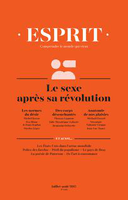
ESPRIT
Unveiling Insights from the Heart of ParisESPRIT is a well-established journal that has been contributing to the fields of Arts and Humanities, Political Science, and Sociology since its inception in 1973. Published in France and bearing the ISSN 0014-0759 and E-ISSN 2111-4579, ESPRIT provides a scholarly platform for research articles that delve into diverse cultural, political, and sociological themes, facilitating critical discourse among academics and practitioners. Although it currently operates under traditional access models, its relevance is underscored by its rankings in Scopus, including a Q4 classification across multiple categories, making it a key resource for those exploring nuanced academic landscapes. With an address located in the heart of Paris, ESPRIT draws from a rich cultural context that enhances its publication scope, poised to inspire and inform a global audience dedicated to the advancement of knowledge in the humanities and social sciences.
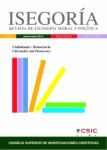
Isegoria
Innovating Perspectives in PhilosophyIsegoria, published by the Consejo Superior Investigaciones Científicas (CSIC)Philosophy, boasting an impressive commitment to disseminating high-quality research since its inception in 1990. With its ISSN 1130-2097 and E-ISSN 1988-8376, Isegoria has emerged as a significant platform for philosophical discourse, particularly noted for its 2023 inclusion in the Q2 quartile of academic rankings in Philosophy. Currently ranked #359 out of 806 journals in the Arts and Humanities category on Scopus, Isegoria captures an audience that values rigorous academic standards and intellectual exploration. Situated in Madrid, Spain, the journal is accessible globally, contributing to vital dialogues and advancing scholarship across diverse philosophical themes and methodologies. Researchers, professionals, and students alike will find Isegoria to be an essential resource for contemporary philosophical inquiry and debate.
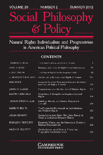
SOCIAL PHILOSOPHY & POLICY
Where Philosophy Meets Public PolicySOCIAL PHILOSOPHY & POLICY is a distinguished journal published by Cambridge University Press, focusing on the intersection of social philosophy and public policy. Established in 1970 and running continuously from 1983, this journal serves as an essential platform for scholarly discourse in the fields of philosophy and social sciences, ranked in the 2023 Q2 category for Philosophy and Q3 for miscellaneous social sciences. The journal aims to critically examine the implications of social policies through a philosophical lens, thus engaging researchers, professionals, and students alike in meaningful discussions. Although it does not currently offer Open Access options, its valuable content is accessible to its audience, bolstered by a significant presence in academic databases. With a robust ranking of #303 in Arts and Humanities Philosophy, and #200 in Social Sciences, SOCIAL PHILOSOPHY & POLICY is poised to influence contemporary thought and practice within the realms of social engagement and policy-making.
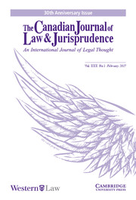
Canadian Journal of Law and Jurisprudence
Advancing Jurisprudence in the Heart of CanadaCanadian Journal of Law and Jurisprudence, published by Cambridge University Press, serves as a pivotal platform in the field of legal studies, particularly recognized for its comprehensive exploration of jurisprudence in the context of Canadian law. While the journal operates without an open access model, its ISSN 0841-8209 and E-ISSN 2056-4260 ensure broad academic accessibility. Based in the United Kingdom, it has established a notable impact within its category, maintaining a Q3 ranking in Law according to the latest 2023 metrics. With its convergence of issues from 1996 to 2003, periods in 2007, and recently from 2012 to 2024, the journal embraces a rich historical context while addressing contemporary legal challenges. Ranked #439 out of 1025 in the social sciences category on Scopus, the journal is positioned within the 57th percentile, highlighting its significance and influence in legal scholarship. Aimed at researchers, professionals, and students, the Canadian Journal of Law and Jurisprudence is an essential resource for those seeking to deepen their understanding of the evolving landscape of law and its philosophical underpinnings.

Phares-Revue Philosophique Etudiante de l Universite Laval
Advancing Intellectual Rigor in the Heart of QuebecPhares-Revue Philosophique Etudiante de l'Université Laval, ISSN 1496-8533, is a prestigious academic journal published by the Faculty of Philosophy at Université Laval, situated in the heart of Quebec, Canada. This journal serves as a vital platform for emerging scholars in the field of philosophy, showcasing innovative ideas, research findings, and critical discourse. As a crucial resource for researchers, professionals, and students alike, *Phares* encourages the exploration of diverse philosophical topics, promoting intellectual engagement and rigor. Although it currently does not provide open access, the journal's commitment to fostering a rich academic community remains paramount. With its high academic standards, *Phares* stands out as a significant contributor to scholarly dialogue, inspiring ongoing inquiry and discourse within the philosophical realm.