
PUBLICATIONES MATHEMATICAE DEBRECEN
Scope & Guideline
Charting the Course of Mathematical Excellence
Introduction
Aims and Scopes
- Algebra and Number Theory:
The journal publishes research that explores algebraic structures, number theory, and related computational techniques, including work on polynomials, Diophantine equations, and algebraic number fields. - Geometry and Topology:
Publications often feature studies on geometric properties of spaces, including Riemannian and Finsler geometries, as well as topological aspects of manifolds and their mappings. - Functional Analysis and Operator Theory:
Research in this area includes studies on linear operators, functional spaces, and their applications in various mathematical contexts, particularly within Banach and Hilbert spaces. - Differential Equations and Dynamic Systems:
The journal includes articles that investigate both ordinary and partial differential equations, dynamical systems, and their applications in mathematical physics and other sciences. - Combinatorics and Discrete Mathematics:
Research on combinatorial structures, graph theory, and discrete algorithms is also a key focus, highlighting innovative approaches to traditional problems. - Mathematical Physics:
The intersection of mathematics and physics is explored through articles that apply mathematical concepts to physical theories, including general relativity and quantum mechanics.
Trending and Emerging
- Finsler Geometry:
An increasing number of articles delve into Finsler geometry, indicating a growing interest in this area and its applications to various mathematical fields. - Algebraic Structures and Generalizations:
There is a notable trend towards exploring generalizations of algebraic concepts, including studies on Hopf algebras, non-commutative structures, and new algebraic identities. - Mathematical Physics Applications:
The integration of mathematical theories within the realm of physics, particularly in areas like general relativity and quantum mechanics, is becoming more prominent, showcasing the interdisciplinary nature of modern mathematics. - Higher-Dimensional Topology and Manifolds:
Recent publications have increasingly focused on higher-dimensional manifolds and their topological properties, reflecting a trend towards more complex geometric analysis. - Advanced Combinatorial Structures:
Research in combinatorics is evolving, with emerging interest in advanced combinatorial structures and their applications in algorithms and number theory.
Declining or Waning
- Classical Analysis:
Research traditionally centered on classical analysis, including topics like real and complex analysis, seems to have diminished in recent years, with fewer articles dedicated to these foundational areas. - Elementary Number Theory:
There appears to be a decline in the number of publications focusing specifically on elementary number theory, as more complex and abstract approaches gain favor in contemporary research. - Geometric Group Theory:
While geometric aspects of mathematics remain strong, the specific focus on geometric group theory has seen a reduction in published works, possibly due to shifts towards more algebraic or topological approaches. - Computational Mathematics:
Although computational techniques are essential, the explicit focus on computational mathematics and numerical methods has decreased, as theoretical advancements take precedence.
Similar Journals

HOUSTON JOURNAL OF MATHEMATICS
Elevating the Standards of Mathematical InquiryHOUSTON JOURNAL OF MATHEMATICS, published by the University of Houston, serves as a valuable platform for disseminating significant findings in the field of mathematics, specifically within the realm of miscellaneous mathematics. Despite its current categorization in Q4 for 2023, the journal plays a crucial role in fostering academic discussion and exploration among researchers, professionals, and students alike. With its ISSN 0362-1588, the journal has been publishing original research since 1996, with a recent gap filled from 2022 to 2023, thereby continuing to contribute to the mathematical community. While it does not currently offer open access options, the journal's commitment to quality research maintains its relevance within the field and invites submissions that can elevate its standing. Located in the vibrant city of Houston, Texas, the journal not only emphasizes theoretical advancements but also encourages applied mathematical research that intersects with other disciplines, enhancing its significance and reach.
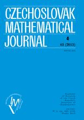
CZECHOSLOVAK MATHEMATICAL JOURNAL
Charting New Territories in MathematicsCzechoslovak Mathematical Journal is a distinguished academic journal published by Springer Heidelberg, dedicated to advancing the field of mathematics through the dissemination of high-quality research. With an ISSN of 0011-4642 and E-ISSN 1572-9141, this journal has been a pivotal platform for mathematicians and researchers from around the globe since its inception. The journal holds a Q3 ranking in the field of Mathematics (miscellaneous), demonstrating its commitment to providing a forum for the latest mathematical theories and applications, particularly in general mathematics, as indicated by its Scopus rank of #285/399 and 28th percentile in the field. While currently not offering open access options, the journal continues to attract a wide readership by making its valuable content available through traditional subscription models. The Czechoslovak Mathematical Journal serves as an essential resource for researchers, professionals, and students aiming to stay informed about recent developments and breakthroughs in mathematics, with focus years converging from 1995 to 2024.
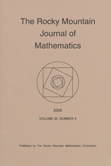
ROCKY MOUNTAIN JOURNAL OF MATHEMATICS
Navigating the Landscape of Mathematical DiscoveryROCKY MOUNTAIN JOURNAL OF MATHEMATICS, published by the Rocky Mountain Math Consortium, serves as a critical platform for researchers and practitioners in the field of mathematics since its inception in 1971. With a notable presence in the academic community, this journal covers a broad spectrum of mathematical disciplines, positioning itself in the Q2 category for Mathematics (miscellaneous) as of 2023. Despite being a subscription-based journal, it is recognized for its rigorous peer-review process and contributions to theoretical and applied mathematics, helping to advance knowledge and foster collaboration among mathematicians. The journal's ISSN number is 0035-7596 and its E-ISSN is 1945-3795, reflecting its commitment to accessibility and dissemination of high-quality research. Based in Tempe, Arizona, at Arizona State University, the journal continues to play an important role in shaping contemporary mathematical discourse through well-researched articles and innovative studies, aiming to bridge gaps between various mathematical subfields and engage a diverse audience, including students and established researchers alike.

RENDICONTI DEL SEMINARIO MATEMATICO DELLA UNIVERSITA DI PADOVA
Advancing mathematical knowledge for a global audience.RENDICONTI DEL SEMINARIO MATEMATICO DELLA UNIVERSITA DI PADOVA, published by the European Mathematical Society, stands as a notable open-access journal with a rich history in disseminating research across various domains of mathematics. With an ISSN of 0041-8994 and E-ISSN 2240-2926, this journal has embraced open access since 2023, significantly enhancing its visibility and accessibility to a global audience. Situated in Germany, its publishing house is based at Technical University Berlin, which emphasizes its academic roots and dedication to fostering mathematical research. The journal features a quartile ranking of Q3 across multiple categories including Algebra and Number Theory, Analysis, Geometry and Topology, and Mathematical Physics as of 2023, indicating a vibrant contribution to the field, despite its challenge in specific rankings. Researchers, professionals, and students alike will find in this journal a platform for innovative ideas and significant findings that are crucial to the evolution of modern mathematics.
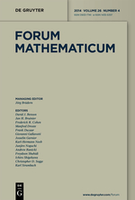
FORUM MATHEMATICUM
Illuminating the Path of Mathematical InquiryFORUM MATHEMATICUM, published by WALTER DE GRUYTER GMBH, is a distinguished academic journal based in Germany, known for its significant contributions to the field of mathematics. With an ISSN of 0933-7741 and an E-ISSN of 1435-5337, the journal features comprehensive studies ranging from applied mathematics to diverse mathematical disciplines. Having maintained a commendable presence since 1989, FORUM MATHEMATICUM has achieved notable classification rankings, including Q2 in Applied Mathematics and Q1 in miscellaneous Mathematics as of 2023. Additionally, it holds a Scopus rank within the top 60th percentile in General Mathematics, making it a prominent platform for researchers and professionals seeking rigorous analysis and innovative methodologies in mathematics. While the journal does not currently offer open access, its rich content is pivotal for advancing mathematical theory and applications, appealing to students and seasoned academics alike.
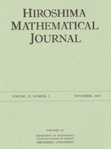
Hiroshima Mathematical Journal
Cultivating Excellence in the Mathematical CommunityThe Hiroshima Mathematical Journal, published by Hiroshima University, Graduate School of Science, serves as a prominent platform for disseminating high-quality research in the field of mathematics. Established in 1959, the journal has been an integral part of the mathematical community, focusing on areas such as Algebra, Number Theory, Analysis, and Geometry and Topology. Although currently classified in Q4 quartile rankings within its categories, the journal is committed to advancing mathematical knowledge and fostering scholarly dialogue. Its accessibility, combined with its long-standing history, makes it an essential resource for researchers, professionals, and students dedicated to exploring and enhancing the mathematical sciences. For those interested in contributing or accessing cutting-edge research, the Hiroshima Mathematical Journal continues to uphold its mission of excellence in mathematical scholarship.

Analele Stiintifice ale Universitatii Ovidius Constanta-Seria Matematica
Fostering Global Collaboration in Mathematical ResearchAnalele Stiintifice ale Universitatii Ovidius Constanta-Seria Matematica is a prominent open-access journal established by OVIDIUS UNIV PRESS in Romania, dedicated to advancing the fields of mathematics, specifically in Analysis and Applied Mathematics. Since its inception, the journal has emphasized the dissemination of high-quality research, making it accessible to a global audience. With an ISSN of 1224-1784 and E-ISSN 1844-0835, it has positioned itself within the academic community, achieving a respectable Q3 ranking in both analysis and applied mathematics in 2023, reflecting its commitment to rigorous scholarship. The journal spans a considerable publication window from 2009 to 2024, catering to the ongoing developments in mathematical sciences and their applications. Researchers, professionals, and students alike will find valuable insights and contributions that enrich their understanding and foster collaboration within the mathematical community. The journal's headquarters is based at the Faculty of Mathematics & Computer Science, Bulevardul Mamaia 124, Constanta, Romania.
Tsukuba Journal of Mathematics
Empowering Mathematicians to Share Transformative IdeasTsukuba Journal of Mathematics is a distinguished publication dedicated to advancing the field of mathematics through the dissemination of innovative research and comprehensive studies. Published by the University of Tsukuba, Department of Mathematics, this journal serves as a vital platform for mathematicians, researchers, and students to engage with cutting-edge mathematical theories and methodologies. Although currently not available as an open-access journal, it maintains a strong academic presence, contributing significantly to the global mathematical landscape. The journal invites submissions across various branches of mathematics, aiming to foster scholarly communication and collaboration. The ISSN 0387-4982 and the E-ISSN 2423-821X further establish its credibility and accessibility among the academic community, supporting its critical objective of facilitating high-quality research output. Situated in Tsukuba, Japan, a hub for scientific research and development, the Tsukuba Journal of Mathematics is committed to bridging gaps in mathematical knowledge and encouraging exploration of novel ideas.

Annales Polonici Mathematici
Advancing Knowledge Through Rigorous ResearchAnnales Polonici Mathematici, a prestigious journal published by the Polish Academy of Sciences, Institute of Mathematics-IMPAN, serves as a vital platform for disseminating innovative research in the field of mathematical sciences. Established as an influential publication within the academic community, this journal addresses a wide array of topics within the Mathematics (miscellaneous) realm, highlighting contributions from both seasoned researchers and emerging scholars. Although currently classified in Q3 of the Mathematics category based on the 2023 metrics, it is steadily making strides towards greater visibility and impact, evidenced by its ongoing convergence years from 2008 to 2024. With its ISSN 0066-2216 and E-ISSN 1730-6272, the journal attracts a diverse readership eager to explore cutting-edge mathematical theories and applications. While the journal does not operate under an open access model, the integrity and rigor of its peer-reviewed content make it an essential resource for researchers, professionals, and students aiming to deepen their understanding and advance their knowledge in mathematics.

Pure and Applied Mathematics Quarterly
Pioneering Insights in Pure and Applied MathematicsPure and Applied Mathematics Quarterly is a prestigious journal published by INT PRESS BOSTON, INC, focusing on the diverse and evolving field of mathematics. Since its inception in 2007, this journal has grown significantly, currently holding a Q1 ranking in the Mathematics (Miscellaneous) category for 2023, positioning it among the leading publications in the discipline. With a commitment to publishing high-quality research, Pure and Applied Mathematics Quarterly fosters innovation and dialogue within the mathematical community by providing a platform for theoretical advancements and practical applications. The journal remains accessible to researchers and professionals through its ISSN 1558-8599 and E-ISSN 1558-8602, although it does not currently offer open access. As a vital resource for mathematicians, educators, and students, this journal endeavors to expand the frontiers of mathematical knowledge and contribute to the academic dialogue surrounding this fundamental science.