PUBLIC FINANCE REVIEW
Scope & Guideline
Transforming Research into Public Finance Solutions
Introduction
Aims and Scopes
- Public Policy Analysis:
The journal critically examines the implications of government policies on fiscal outcomes, incorporating empirical evidence and theoretical frameworks to assess their effectiveness. - Fiscal Sustainability and Management:
A core area of focus is the sustainability of public finances, including the management of public debt, fiscal rules, and the impacts of crises on fiscal health. - Taxation and Revenue Generation:
The journal addresses issues related to taxation, including tax policy design, incidence, compliance, and the effects of tax reforms on economic behavior and equity. - Corruption and Governance:
Research on the relationship between public finance and corruption, analyzing how fiscal policies can mitigate or exacerbate corruption in various contexts. - Public Expenditure and Service Delivery:
The journal explores the efficiency and effectiveness of public spending, including the impacts of fiscal decentralization and the allocation of resources to public goods and services. - Behavioral Economics in Public Finance:
Utilizing insights from behavioral economics, the journal investigates how psychological factors influence taxpayer behavior, public spending decisions, and fiscal policy outcomes.
Trending and Emerging
- Impact of Crises on Public Finance:
Recent publications have increasingly focused on the fiscal implications of crises, such as the COVID-19 pandemic and natural disasters, highlighting the need for resilient fiscal strategies. - Behavioral Insights into Taxation:
There is a growing emphasis on understanding taxpayer behavior through behavioral economics, exploring how psychological factors influence tax compliance and policy effectiveness. - Public Finance and Corruption Dynamics:
Research examining the interplay between public finance and corruption has gained momentum, particularly studies that analyze how fiscal policies can be designed to mitigate corruption risks. - Decentralization and Local Governance:
Emerging themes include the effects of fiscal decentralization on local governance and financial management, reflecting the importance of local contexts in public finance. - Innovative Financing Mechanisms:
The journal has seen an increase in studies exploring innovative financing tools, such as public-private partnerships and new revenue models for public services, indicating a shift towards more creative fiscal solutions.
Declining or Waning
- Static Tax Policy Models:
Research focusing solely on static models of tax policy has decreased, as the journal increasingly emphasizes dynamic and behavioral approaches that account for changing economic conditions. - Generalized Fiscal Policy Theories:
There has been a waning interest in generalized theories of fiscal policy that do not consider specific contextual factors, with more emphasis now placed on empirical case studies and context-driven analyses. - Traditional Public Expenditure Studies:
Studies that merely catalog public expenditure without assessing efficiency or outcomes have become less frequent, reflecting a shift towards more analytical approaches that evaluate the effectiveness of spending. - Historical Comparisons of Tax Systems:
Research focusing on historical comparisons of tax systems without contemporary relevance has seen a decline, as current issues such as sustainability and equity take precedence.
Similar Journals
Series-Journal of the Spanish Economic Association
Fostering Innovation and Collaboration in Economic ScholarshipSeries-Journal of the Spanish Economic Association, published by SPRINGER HEIDELBERG, stands at the forefront of economic research, specifically focusing on the diverse and evolving landscape of economics, econometrics, and finance. Since its transition to Open Access in 2010, the journal has provided a platform for innovative research and thought leadership, fostering accessibility and collaboration within the academic community. With an impressive impact reflected in its Q1 classification in the Economics, Econometrics and Finance category, the journal has gained recognition for its commitment to high-quality, rigorous scholarship, as evidenced by its Scopus rank of #98 out of 288, placing it in the 66th percentile. Its purview encompasses a broad range of topics, making it an essential resource for researchers, professionals, and students looking to keep abreast of the latest developments and trends in economics. With its dedication to advancing knowledge from 2010 to 2024, the journal remains a pivotal contributor to the global economic discourse, seeking to bridge empirical research with practical applications.

Eurasian Economic Review
Unlocking the potential of Eurasian economic studies.Eurasian Economic Review is a premier academic journal dedicated to the dissemination of high-quality research in the field of economics, notably within the Eurasian context. Published by SPRINGER HEIDELBERG in Switzerland, this journal stands out with an impressive Q2 ranking in the 2023 category of Economics, Econometrics and Finance, reflecting its influential role in fostering scholarly dialogue. The journal encompasses a broad array of topics related to economic trends, policy impacts, and theoretical advancements, making it an essential resource for researchers, professionals, and students alike. With a consistent output since its inception in 2011, the Eurasian Economic Review is committed to providing open access to its valuable content, ensuring that important findings are widely available to the global research community. As a member of the top 9th percentile in Scopus rankings for its field, this journal uniquely positions itself as a vital conduit for innovative and impactful research in economics.
NATIONAL TAX JOURNAL
Advancing tax knowledge for a better tomorrow.NATIONAL TAX JOURNAL, published by the esteemed University of Chicago Press, is a premier scholarly journal dedicated to advancing the field of taxation through rigorous research and analysis. With an ISSN of 0028-0283 and an E-ISSN of 1944-7477, it has been a beacon of knowledge since its inception, covering a broad range of topics crucial to taxation policy, tax administration, and economic impacts. The journal is recognized for its significant contributions to the fields of Accounting, Economics, and Finance, boasting a Q1 ranking in all three categories as of 2023. Its distinctive role is underscored by its position within the 61st percentile for Economics and Econometrics and Finance, making it a vital resource for researchers, professionals, and students alike. Though not open access, the depth and relevance of the research published in the NATIONAL TAX JOURNAL are indispensable for those dedicated to understanding and improving tax systems worldwide. Engaging with this journal promises valuable insights that are critical for informed decision-making in taxation and public policy.

Montenegrin Journal of Economics
Bridging Theory and Practice in EconomicsMontenegrin Journal of Economics, published by ECONOMIC LABORATORY TRANSITION RESEARCH PODGORICA-ELIT, stands as a prominent platform for scholarly discourse in the field of Economics, Econometrics, and Finance. With an ISSN of 1800-5845 and an E-ISSN of 1800-6698, this open access journal has been providing accessible research output since 2005, contributing significantly to the global academic community. The journal’s impact is reflected in its Q2 ranking in the 2023 category of Economics, Econometrics and Finance, holding a commendable position within the 81st percentile according to Scopus rankings. The scope includes a wide array of topics pertinent to economics and finance, encouraging contributions that enhance understanding of both local and global markets. With a focus on quality research, the journal aims to disseminate knowledge that supports informed policy-making and fosters economic development, making it an invaluable resource for researchers, professionals, and students dedicated to the evolving landscape of economic studies.
International Review of Economics & Finance
Driving Innovation in Economic Theory and Financial Practice.International Review of Economics & Finance is a premier academic journal published by ELSEVIER, dedicated to advancing the fields of economics and finance through high-quality, peer-reviewed research. With a distinguished history dating back to 1992 and set to continue until 2024, this journal holds an impressive Q1 ranking in both Economics and Econometrics and Finance categories as of 2023, showcasing its influential role in shaping scholarly discussions. The journal’s focus on empirical and theoretical advancements makes it an essential resource for researchers, professionals, and students seeking to understand and engage with cutting-edge economic and financial theories. Indexed in Scopus, the journal ranks in the top tiers for both finance and economics, underscoring its global impact within these disciplines. Although it does not offer open access, the journal remains committed to disseminating vital insights and fostering ongoing dialogue in the academic community.

EKONOMICKY CASOPIS
Advancing Knowledge, Shaping Economic FuturesEKONOMICKY CASOPIS is a distinguished journal published by the Institute of Economics Research SAS and the Institute of Forecasting CSPS SAS, offering a comprehensive platform for the dissemination of innovative research in the field of economics and econometrics. Since its inception in 1978, the journal has been committed to fostering scholarly discourse, showcasing empirical studies, theoretical advancements, and policy analyses that contribute to the understanding of economic phenomena. Although categorized in the Q4 quartile in 2023 and ranking in the lower percentiles within Scopus, EKONOMICKY CASOPIS remains a critical resource for researchers and practitioners seeking to engage with the economic challenges of our time. As the journal continues to evolve through 2024, it invites contributions that align with its objectives of enhancing economic insights and promoting academic discussion in Slovakia and beyond. For researchers looking to publish their work or expand their knowledge, EKONOMICKY CASOPIS serves as a vital resource in the expanding landscape of economic research.
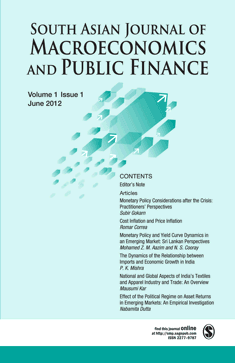
South Asian Journal of Macroeconomics and Public Finance
Pioneering Discussions in South Asian Economic PolicySouth Asian Journal of Macroeconomics and Public Finance (ISSN: 2277-9787, E-ISSN: 2321-0273) is a distinguished academic journal published by SAGE Publications India Pvt Ltd. Operating from the United Kingdom, this journal serves as a vital platform for researchers and professionals in the fields of macroeconomics and public finance, with a commitment to advancing the understanding of these disciplines across South Asia and beyond. With a Q3 ranking in both Economics and Econometrics and Finance as of 2023, it positions itself as a relevant contributor to ongoing discussions and developments, offering insights supported by its Scopus rankings, where it is placed in the 44th and 41st percentiles in Finance and Economics respectively. The journal spans converged years from 2012 to 2024, fostering a collaborative space for cutting-edge research and rigorous analysis. This journal is essential for scholars seeking to engage with contemporary economic challenges and policy implications, paving the way for innovative solutions and informed decision-making.
Public Budgeting and Finance
Navigating the Complexities of Public FinancePublic Budgeting and Finance is a distinguished journal published by WILEY, encompassing pivotal research in the fields of public administration, economics, and finance. With an impressive track record of publications dating back to 1981, this journal plays a crucial role in informing and shaping public policy and fiscal management practices. It operates without open access, ensuring a selective and highly curated set of research that maintains rigorous academic standards. The journal consistently ranks in the second quartile (Q2) across its categories, highlighting its relevance and influence within the academic community. With Scopus rankings placing it in the 45th percentile for Public Administration and Finance, it serves as an essential resource for researchers, practitioners, and students aiming to enhance their understanding of budgeting processes and fiscal governance in both theory and practice. The journal is a go-to source for innovative approaches and evidence-based practices that address contemporary challenges in public finance, making it indispensable for anyone seeking to contribute meaningfully to this vital field.
FinanzArchiv-European Journal of Public Finance
Elevating the conversation around fiscal policies.FinanzArchiv - European Journal of Public Finance is a distinguished publication in the realm of finance, dedicated to advancing scholarship in public finance theories and practices. Published by MOHR SIEBECK in Germany, this journal serves as a critical platform for researchers, practitioners, and students seeking to deepen their understanding of fiscal policies, taxation, and economic governance. With an ISSN of 0015-2218 and an E-ISSN of 1614-0974, it has been an essential resource for academia since its inception in 1981, contributing valuable insights and scholarly dialogue through rigorous research. Although currently categorized in the third quartile (Q3) within the Finance category and recognized for its specific niche, the journal continuously strives to increase its impact within the discipline. Readers can explore a wide range of articles that analyze contemporary issues, ensuring that FinanzArchiv remains a vital source for informed academic and professional discourse in public finance.
INTERNATIONAL JOURNAL OF PUBLIC ADMINISTRATION
Fostering Excellence in Governance and Management StrategiesInternational Journal of Public Administration, published by Routledge Journals, Taylor & Francis Ltd, is a leading peer-reviewed journal that has significantly contributed to the fields of Public Administration and Business Management since its inception in 1979. With an ISSN of 0190-0692 and an E-ISSN of 1532-4265, this esteemed journal presents rigorous research and innovative practices essential for understanding complex governance and management challenges. The 2023 Scopus rankings highlight its relevance, positioning it at Q2 in both Business and International Management and Public Administration, with notable percentiles of 65th and 73rd, respectively. As a valuable resource for researchers, professionals, and students, the journal encourages scholarly discourse that enhances public service delivery and promotes effective management policies in diverse settings. With access options limited, readers are urged to take advantage of its rich archive and current articles as they engage with critical issues shaping public administration today.