
Ragion Pratica
Scope & Guideline
Advancing the Discourse in Law, Philosophy, and Society
Introduction
Aims and Scopes
- Interdisciplinary Legal Studies:
The journal promotes an interdisciplinary approach to legal scholarship, integrating insights from philosophy, sociology, political science, and cultural studies to address complex legal issues. - Social Justice and Marginalized Voices:
A core focus is on social justice, particularly the rights and agency of marginalized groups, including women, indigenous populations, and other underrepresented communities. - Ethics and Law:
Exploration of the ethical dimensions of legal practices, especially in contexts such as artificial intelligence, restorative justice, and international law. - Cultural and Political Contexts:
The journal examines legal issues within their broader cultural and political contexts, analyzing how laws interact with societal norms and power structures. - Critical Theoretical Frameworks:
Utilization of critical theory, including feminist, postcolonial, and Foucauldian perspectives, to challenge traditional legal interpretations and practices.
Trending and Emerging
- Artificial Intelligence and Law:
Recent publications increasingly explore the implications of artificial intelligence on legal frameworks, focusing on ethical considerations and the impact of algorithmic reasoning on justice. - Restorative Justice Practices:
There is a growing emphasis on restorative justice as a viable alternative to traditional punitive measures, particularly in the context of violence and marginalized communities. - Intersectionality and Legal Agency:
The exploration of intersectionality in legal studies, particularly regarding women's agency and indigenous rights, has gained traction, reflecting a broader commitment to social justice. - Environmental and Ecological Law:
Emerging themes include the intersection of law with environmental concerns, particularly how legal frameworks can adapt to address ecological crises and promote sustainability. - Digital Rights and Cyber Law:
The journal is increasingly focusing on digital citizenship and rights within the cyberspace, addressing the challenges posed by technology and its implications for legal frameworks.
Declining or Waning
- Traditional Legal Doctrines:
There is a noticeable decline in discussions centered on traditional legal doctrines and frameworks, as the journal increasingly prioritizes interdisciplinary and critical approaches. - Conventional Jurisprudence:
Papers focusing solely on conventional jurisprudence without a critical or interdisciplinary lens are becoming less frequent, indicating a move towards more innovative and pluralistic legal theories. - Static Legal Interpretations:
The analysis of static or unchanging interpretations of law is waning, with a shift towards dynamic, context-driven interpretations that consider the complexities of contemporary society.
Similar Journals

Ius Humani-Revista de Derecho
Empowering Legal Minds Through Open AccessIus Humani-Revista de Derecho, published by Universidad Hemisferios, serves as a vital platform for discourse in the field of human rights law and its various dimensions. With an Open Access policy established since 2008, this journal ensures that scholarly articles, critical reviews, and original research are readily accessible to a global audience, fostering collaboration and innovation among researchers, professionals, and students alike. Although the journal is based in Quito, Ecuador, its reach extends internationally, making significant contributions to the understanding and application of human rights in legal frameworks. While it is still developing in terms of its HIndex and Scopus rankings, Ius Humani is poised to provide essential insights and discussions that reflect pressing legal issues and emerging trends in human rights law. Join the community of scholars engaging with this important field through Ius Humani, where knowledge is freely shared and impactful conversations are sparked.

Legal Theory
Cultivating Critical Insights in Legal TheoryLegal Theory, published by Cambridge University Press, stands as a significant academic journal dedicated to the exploration of the conceptual foundations and implications of law within the wider realm of philosophy. Established in 1995 and maintaining a consistent publication record through 2023, the journal has garnered a reputation for its high-quality scholarly contributions, reflected in its impressive rankings: Q2 in Law and Q1 in Philosophy as of 2023. With an impactful presence in the Scopus Ranks, Legal Theory is positioned 158th in Philosophy and 337th in Law, highlighting its relevance and influence—especially within the arts and humanities. This journal serves as a critical platform for researchers, professionals, and students who seek to engage with the intricate interplay between legal norms and philosophical inquiries. Though not open access, it offers a wealth of knowledge that is integral to advancing discourse in legal philosophy, making it an essential resource for those looking to deepen their understanding of contemporary legal theories and their implications.
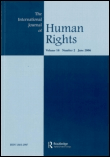
International Journal of Human Rights
Fostering Global Dialogue on Human Rights ChallengesThe International Journal of Human Rights is a prestigious academic publication focusing on critical issues within the realm of human rights, law, sociology, and political science. Published by Routledge Journals, Taylor & Francis Ltd, this journal garners a significant reputation with a 2023 impact factor ranking it in the second quartile (Q2) within both the law and sociology categories. The journal provides a vital platform for researchers and scholars to disseminate original research, theoretical discussions, and comparative studies on pressing human rights concerns globally. With an impressive standing reflected in its Scopus ranks, placing it in the 84th and 72nd percentiles for law and sociology respectively, the journal plays an essential role in advancing the discourse on human rights. While it is not an open access publication, the journal prioritizes high-quality content and rigorous peer review, ensuring that it meets the academic standards demanded by its audience of researchers, professionals, and students committed to the advancement of human rights within diverse contexts.

Cuadernos Electronicos de Filosofia del Derecho
Fostering Multidisciplinary Conversations in Legal PhilosophyCuadernos Electronicos de Filosofia del Derecho, published by Universitat de València, Servicio Publicaciones, is a pioneering open access journal that has been advancing the discourse in legal philosophy since its inception in 1998. With its ISSN 1138-9877, this journal serves as a critical platform for scholars and practitioners interested in the intersection of law and philosophy. The journal operates from Valencia, Spain, and has notably achieved a Q3 quartile ranking in Philosophy and a Q4 ranking in Law as of 2023, reflecting its growing influence in these distinct yet interconnected fields. With an HIndex that illustrates its commitment to rigorous scholarly work, Cuadernos Electronicos de Filosofia del Derecho invites contributions that explore foundational issues, theoretical frameworks, and contemporary challenges in legal thought, making it an essential resource for researchers, professionals, and students alike. As it converges topics through to 2024, the journal embraces a multidisciplinary approach and seeks to foster collaborations and discussions that will shape the future of legal philosophy.
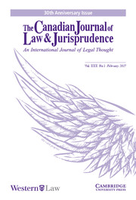
Canadian Journal of Law and Jurisprudence
Decoding Legal Complexity Through Canadian PerspectivesCanadian Journal of Law and Jurisprudence, published by Cambridge University Press, serves as a pivotal platform in the field of legal studies, particularly recognized for its comprehensive exploration of jurisprudence in the context of Canadian law. While the journal operates without an open access model, its ISSN 0841-8209 and E-ISSN 2056-4260 ensure broad academic accessibility. Based in the United Kingdom, it has established a notable impact within its category, maintaining a Q3 ranking in Law according to the latest 2023 metrics. With its convergence of issues from 1996 to 2003, periods in 2007, and recently from 2012 to 2024, the journal embraces a rich historical context while addressing contemporary legal challenges. Ranked #439 out of 1025 in the social sciences category on Scopus, the journal is positioned within the 57th percentile, highlighting its significance and influence in legal scholarship. Aimed at researchers, professionals, and students, the Canadian Journal of Law and Jurisprudence is an essential resource for those seeking to deepen their understanding of the evolving landscape of law and its philosophical underpinnings.
Canadian Journal of Law and Society
Fostering Critical Research at the Intersection of Law and SocietyThe Canadian Journal of Law and Society, published by Cambridge University Press, is a distinguished academic journal dedicated to the multidisciplinary exploration of legal systems, social dynamics, and the intricate relationships that shape law and society. With an ISSN of 0829-3201 and an E-ISSN of 1911-0227, this journal has made significant contributions to the fields of Law, Sociology, and Political Science since its inception in 1986. Recognized in the 2023 category quartiles as Q3 in both Law and Sociology and Political Science, it stands as a credible platform for critical research, theoretical discussions, and empirical studies. Although not an open-access journal, it provides valuable insights that foster academic discourse and enhance understanding within the legal and social sciences domains. Addressed from the Edinburgh Building, Shaftesbury Road, Cambridge, England, the journal serves as an essential resource for researchers, practitioners, and students seeking to navigate the complexities of law and its societal impacts.

Law Culture and the Humanities
Exploring the Nexus of Law and Cultural ExpressionLaw Culture and the Humanities, published by SAGE Publications Ltd, serves as a pivotal forum for interdisciplinary dialogue at the intersection of law and the humanities. With an ISSN of 1743-8721 and an E-ISSN of 1743-9752, this esteemed journal has been contributing to scholarly discourse since its inception in 2005 and continues to do so until 2024. The journal carries a respectable impact factor showcased through its category rankings: Q3 in Arts and Humanities (miscellaneous), Q2 in Cultural Studies, and Q3 in Law. Its Scopus rankings reflect an impressive standing in the social sciences, particularly within Cultural Studies and Law, indicating that it is a fundamental resource for researchers and professionals aiming to explore the nuanced relationships between legal frameworks and cultural expressions. While not an Open Access journal, it offers substantial insights into contemporary debates, making it essential for academics and students engaged in the study of law's cultural dimensions.

Rivista di Filosofia del Diritto-Journal of Legal Philosophy
Fostering Critical Discourse in Legal PhilosophyThe Rivista di Filosofia del Diritto - Journal of Legal Philosophy is a prestigious scholarly publication dedicated to the interdisciplinary exploration of legal philosophy, offering a platform for rigorous academic discourse in both law and philosophy. Published by SOC ED IL MULINO in Italy, this journal plays a vital role in advancing theoretical insights and critical analyses that bridge the gap between legal practices and philosophical thought. With an ISSN of 2280-482X, the journal currently holds a commendable status in the 2023 category quartiles, ranked Q3 in Law and Q2 in Philosophy, reflecting its growing influence in both fields. The Rivista di Filosofia del Diritto ranks 322nd out of 806 in Arts and Humanities for Philosophy and 648th out of 1025 in Social Sciences for Law, highlighting its commitment to quality research in an increasingly competitive academic landscape. Although not open access, the journal made significant strides since its inception in 2016, converging towards its 2024 goals aimed at fostering a deeper understanding of legal concepts through a philosophical lens. Researchers, professionals, and students alike will find this journal an invaluable resource for scholarly materials that challenge the norms and expand the horizons of legal philosophy.
Archiv fur Rechts- und Sozialphilosophie
Fostering interdisciplinary dialogue in legal and social thought.Archiv für Rechts- und Sozialphilosophie, published by FRANZ STEINER VERLAG GMBH in Germany, is a distinguished academic journal that serves as a vital platform for the interdisciplinary exploration of legal and social philosophy. With an ISSN of 0001-2343 and E-ISSN 2363-5614, the journal aims to stimulate scholarly dialogue by presenting a wide range of theoretical and empirical studies that address pressing issues within the fields of law and philosophy. Despite its current Q4 ranking in Law and Q3 in Philosophy, the journal offers valuable insights, fostering a deeper understanding of legal principles and social theories. Although not an open-access publication, it remains accessible to academics and practitioners through esteemed libraries and institutional subscriptions. With converged years spanning from 2011 to 2024, Archiv für Rechts- und Sozialphilosophie stands as an important resource for researchers, professionals, and students who are engaged in the dynamic intersections of our legal frameworks and philosophical inquiries.
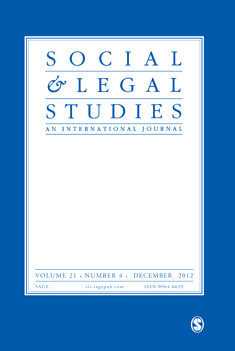
SOCIAL & LEGAL STUDIES
Bridging Law and Society for a Better TomorrowSOCIAL & LEGAL STUDIES, published by SAGE Publications Ltd, stands at the forefront of interdisciplinary research within the spheres of law, sociology, and political science. With an ISSN of 0964-6639 and an E-ISSN of 1461-7390, the journal has established a significant presence in academia since its inception in 1992. This esteemed journal, recognized as a Q1 publication in Law and holding Q2 status in both miscellaneous Social Sciences and Sociology & Political Science categories, garners attention from leading scholars and practitioners alike, evidenced by its impressive Scopus rankings, including a top 88th percentile in Law. Although it does not offer open access, researchers and students can rely on this journal for high-quality, peer-reviewed articles that synthesize theoretical and empirical insights, addressing contemporary legal and social issues. As it converges into 2024, SOCIAL & LEGAL STUDIES continues to be a vital platform for advancing discussions that shape the interplay between societal norms and legal frameworks.