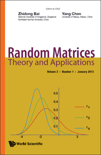
Random Matrices-Theory and Applications
metrics 2024
Charting New Territories in Statistical Research
Introduction
Random Matrices-Theory and Applications is a premier academic journal published by World Scientific Publishing Co Pte Ltd, specializing in the intricate fields of algebra, number theory, discrete mathematics, and statistics. With its ISSN 2010-3263 and E-ISSN 2010-3271, the journal serves as a vital resource for researchers and professionals looking to explore the mathematical landscape of random matrices and their diverse applications across various disciplines. Since its inception in 2012, Random Matrices has achieved recognition in various quartiles, achieving Q2 standings in multiple categories including Algebra and Number Theory and Discrete Mathematics and Combinatorics, indicative of its influential research contributions and rigorous peer-review process. The journal is committed to disseminating high-quality research articles that drive innovation and facilitate knowledge-sharing within the global mathematics community. Scholars interested in advancing their understanding of statistical methodologies related to random matrices will find this journal an indispensable addition to their research toolkit.
Metrics 2024
 0.590.900.9020
Metrics History
Rank 2024
Scopus
IF (Web Of Science)
JCI (Web Of Science)
Quartile History
Similar Journals
Theory of Probability and Mathematical Statistics
Unveiling the Power of Probability for Practical ApplicationsTheory of Probability and Mathematical Statistics, published by the Tarás Shevchenko National University of Kyiv, Faculty of Mechanics and Mathematics, serves as a vital resource for academics and practitioners in the field of statistics and probability. With an ISSN of 0094-9000 and E-ISSN 1547-7363, this journal aims to advance theoretical insights and practical applications related to probability theory and statistical methods. Operating from the heart of Ukraine, this journal has been influential since its inception in 2004 and continues to contribute to the academic community as it converges through a significant period until 2024. Despite currently not offering Open Access options, it maintains a respectable Q3 classification in both Statistics and Probability, highlighting its stability within the scholarly landscape. The journal's Scopus rankings further emphasize its specialization, ranking #121 in Statistics, Probability, and Uncertainty, and #203 in Mathematics, underscoring its importance for researchers, students, and professionals seeking to enrich their understanding and foster innovation in these disciplines.
ANNALS OF PROBABILITY
Championing Excellence in Probability ScholarshipANNALS OF PROBABILITY, published by the Institute of Mathematical Statistics (IMS), is a premier academic journal dedicated to the field of probability theory and its applications. With an impressive impact factor and ranked within the top quartile (Q1) in both Statistics and Probability and Statistics, Probability and Uncertainty categories as of 2023, this journal serves as a vital platform for researchers and practitioners in the field. The journal has a significant convergence period from 1996 to 2024, reflecting its enduring contribution to the scientific dialogue surrounding probabilistic methods and theory. The journal garners a high standing in Scopus rankings, holding a remarkable 35th position out of 278 in Mathematics and boasting an 87th percentile ranking, underscoring its influence and reach. While it does not provide Open Access options, its rigorous peer-review process ensures the publication of high-quality research that advances the understanding and application of probability across various disciplines. Researchers, professionals, and students alike will find the ANNALS OF PROBABILITY instrumental in their academic pursuits and professional development in the evolving landscape of probability and statistics.
INFINITE DIMENSIONAL ANALYSIS QUANTUM PROBABILITY AND RELATED TOPICS
Bridging Theory and Application in MathematicsINFINITE DIMENSIONAL ANALYSIS QUANTUM PROBABILITY AND RELATED TOPICS, published by WORLD SCIENTIFIC PUBL CO PTE LTD, is a key academic journal dedicated to the exploration of advanced themes in applied mathematics, mathematical physics, and quantum probability. Since its inception in 1998, the journal has established itself as a critical resource for researchers and professionals in these interdisciplinary fields, currently standing in the third quartile according to the 2023 category rankings. Scholars can access a wealth of rigorous articles that delve into infinite dimensional analysis, providing valuable insights pertinent to statistical and nonlinear physics, and offering a platform for pioneering research. This journal not only bridges theoretical frameworks and practical applications but also nurtures a collaborative environment for emerging and established scholars. Through its commitment to advancing knowledge, INFINITE DIMENSIONAL ANALYSIS QUANTUM PROBABILITY AND RELATED TOPICS serves as an indispensable tool for anyone engaged in the forefront of quantum probability research.
PROBABILITY THEORY AND RELATED FIELDS
Elevating Research Standards in Probability and Related FieldsPROBABILITY THEORY AND RELATED FIELDS is a premier journal published by SPRINGER HEIDELBERG, dedicated to advancing the field of probability and its applications. With an ISSN of 0178-8051 and an E-ISSN of 1432-2064, this journal has established itself as a leading platform for innovative research, featuring significant contributions to the theories and methodologies in probability, statistics, and uncertainty analysis. Its impressive ranking in the 2023 category quartiles places it in the Q1 tier within Analysis, Statistics and Probability, highlighting its importance in the academic community. The journal is widely recognized for its rigorous peer-review process, ensuring high-quality publications that cater to researchers, professionals, and students alike. Located in Germany at TIERGARTENSTRASSE 17, D-69121 HEIDELBERG, it continues to shape the future of statistical sciences from 1986 until 2024 and beyond. Researchers in the field are encouraged to contribute their findings, ensuring the journal remains at the forefront of innovative statistical research.
RANDOM STRUCTURES & ALGORITHMS
Charting New Territories in Applied Mathematics and GraphicsRANDOM STRUCTURES & ALGORITHMS is a prestigious journal published by Wiley that stands at the forefront of research in the realms of applied mathematics, computer graphics, and algorithms. With a notable Impact Factor, it has consistently maintained a Q1 ranking across several categories including Applied Mathematics and Software, showcasing its significant contribution to these fields. The journal, which has been in circulation since 1990, serves as a vital resource for researchers, professionals, and students keen on exploring the complex interplay between randomness and computational efficiency. Although it operates under a traditional access model, the quality and relevance of the content ensure it attracts a broad readership eager to engage with cutting-edge studies and innovative solutions. For those looking to stay at the cutting edge of developments in random structures and algorithms, RANDOM STRUCTURES & ALGORITHMS is an essential journal that continues to shape the landscape of contemporary research.
ANNALES DE L INSTITUT HENRI POINCARE-PROBABILITES ET STATISTIQUES
Fostering Excellence in Probability and Statistical ScienceANNALES DE L INSTITUT HENRI POINCARE-PROBABILITES ET STATISTIQUES is a prestigious journal published by the Institute of Mathematical Statistics (IMS), dedicated to advancing the field of probabilities and statistics. With a commendable ranking in the Q1 category in both Statistics and Probability, as well as Statistics, Probability, and Uncertainty in 2023, this journal serves as a vital resource for cutting-edge research and applications in these domains. The journal has established itself as a hub for high-impact articles, evidenced by its placement within the 65th percentile in Statistics and Probability and 62nd percentile in Decision Sciences. Covering a broad scope from theoretical foundations to practical implications, it caters to the intellectual needs of researchers, professionals, and students alike. Although it does not offer Open Access options, the integrity and quality of the published works remain uncompromised, making it an essential reference point for emergent trends and rigorous studies in probability theory and statistical methodology. With contributions spanning from 1997 and continuing through to 2024, the journal's legacy and influence are firmly anchored in the academic community.
RUSSIAN JOURNAL OF MATHEMATICAL PHYSICS
Advancing the Frontiers of Mathematical PhysicsRUSSIAN JOURNAL OF MATHEMATICAL PHYSICS is a premier academic journal published by PLEIADES PUBLISHING INC, dedicated to advancing the fields of mathematical physics and statistical and nonlinear physics. With a commendable Impact Factor in the Q2 category for both disciplines as of 2023, the journal serves as an essential platform for researchers, professionals, and students to explore innovative theoretical and applied aspects of these fields. Established between 1996 and 1997, and resuming publication in 1999 through to 2024, the journal reflects a long-standing commitment to disseminating high-quality scholarship. The Scopus rankings place it at a competitive position, ranking #23 out of 85 in Mathematical Physics and #26 out of 62 in Statistical and Nonlinear Physics, showcasing its relevance and influence. While currently not offering open access, the journal’s audience is encouraged to engage with its substantive research and contribute to the ongoing dialogue in mathematical physics, fostering a deeper understanding of complex physical phenomena.

Probability and Mathematical Statistics-Poland
Exploring the Depths of Probability TheoryProbability and Mathematical Statistics-Poland is a pivotal journal in the field of applied and theoretical statistics, published by WYDAWNICTWO UNIWERSYTETU WROCLAWSKIEGO. With an ISSN of 0208-4147, it serves as a platform for disseminating significant research grounded in mathematical statistics, probabilistic models, and their applications across various scientific disciplines. Although the journal resides in the Q4 category for Statistics and Probability, it plays an essential role for researchers seeking a peer-reviewed avenue for their work, particularly those affiliated with academic institutions in Poland and beyond. The journal has been in continuous publication from 2011 to 2023, reflecting its commitment to advancing knowledge in the field despite its current ranking at the 12th percentile in the Scopus listings. As an invaluable resource for researchers, professionals, and students alike, Probability and Mathematical Statistics-Poland encourages contributions that explore innovative statistical methodologies and their practical implications, fostering a deeper understanding of probability theory and its relevance in contemporary research.
ESAIM-Probability and Statistics
Advancing insights in probability and statistics.ESAIM-Probability and Statistics, published by EDP Sciences S A, is a prominent journal focused on advancing the field of probability and statistics. With an ISSN of 1292-8100 and E-ISSN 1262-3318, this journal has been a beacon of scholarly communication since its inception in 1997. Operating out of France, it offers a platform for researchers and professionals to share significant findings and foster collaboration within the statistical community. Designated as Q3 in the Statistics and Probability category for 2023, it plays a vital role in the dissemination of critical research, despite its recent Scopus ranking of 226 out of 278 indicative of its growing visibility and impact. Researchers, students, and professionals alike benefit from its rich pool of analytical insights and innovative methodologies, marking it as an essential resource for those immersed in statistical theory and applications. With a commitment to excellence in research, ESAIM-Probability and Statistics continues to contribute to the instructional and professional development of its readership.
CONSTRUCTIVE APPROXIMATION
Elevating Mathematics through Innovative ApproachesCONSTRUCTIVE APPROXIMATION is a leading academic journal published by SPRINGER, specializing in the fields of analysis, computational mathematics, and miscellaneous mathematics. With a rich history since its inception in 1985, the journal has continued to advance the understanding and application of constructive methods in approximation theory. Representing excellence in the field, it holds a prestigious Q1 ranking across various mathematical categories, underscoring its influence and relevance, with Scopus rankings reflecting its high standing within the academic community—ranked #46 in General Mathematics and #31 in Analysis, both in the top percentiles. Although it does not currently offer Open Access options, researchers and professionals benefit from its valuable insights and innovative research contributions. As a vital platform for disseminating cutting-edge findings, CONSTRUCTIVE APPROXIMATION is an essential resource for all those dedicated to advancing mathematical sciences and applications.