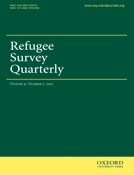
Refugee Survey Quarterly
Scope & Guideline
Shaping policy and practice in humanitarian response.
Introduction
Aims and Scopes
- Refugee Law and Policy:
A core area of focus is the analysis and critique of international and domestic refugee laws and policies, examining their implications for refugee rights, protection, and resettlement practices. - Lived Experiences of Refugees:
The journal emphasizes qualitative research that captures the personal narratives and lived experiences of refugees, aiming to humanize the discourse surrounding displacement. - Intersectionality and Vulnerability:
Research often explores the intersection of various identities and vulnerabilities, including gender, sexuality, and age, highlighting how these factors influence refugees' experiences and access to protection. - Impact of Humanitarian Interventions:
The journal critically assesses the effectiveness of humanitarian interventions and development programs aimed at refugees, focusing on their long-term impacts on communities and individuals. - Global Refugee Governance:
It explores the dynamics of global refugee governance, including the roles of international organizations, states, and non-state actors in shaping refugee protection frameworks. - Comparative Analyses:
The journal often includes comparative studies that analyze refugee experiences across different contexts and regions, contributing to a broader understanding of global refugee issues.
Trending and Emerging
- Decolonial Perspectives on Refugee Studies:
Recent publications emphasize decolonial approaches to understanding refugee experiences, challenging traditional narratives and advocating for the inclusion of marginalized voices in the discourse. - Technological Interventions in Refugee Support:
There is an increasing focus on the role of technology in providing support to refugees, including digital legal services and the use of data for improving humanitarian responses. - Mental Health and Well-being of Refugees:
Emerging research highlights the importance of mental health considerations in refugee studies, addressing trauma and psychosocial support as critical components of effective protection. - Refugee Rights and Advocacy:
There is a growing trend towards examining the role of advocacy in promoting refugee rights, exploring how grassroots movements and international frameworks can empower displaced individuals. - Climate Change and Displacement:
The intersection of climate change and forced displacement is gaining attention, with research focusing on how environmental factors contribute to refugee crises and the need for adaptive policies.
Declining or Waning
- Traditional Approaches to Refugee Assistance:
There has been a noticeable reduction in papers focusing on conventional models of refugee assistance, such as camp-based support systems, as the journal shifts towards more innovative and sustainable solutions. - Historical Analyses of Refugee Movements:
Papers that delve into historical contexts of refugee movements and their implications for current policies have decreased, possibly overshadowed by more urgent contemporary issues. - Legalistic Perspectives without Contextual Insight:
The journal appears to be moving away from purely legalistic analyses that lack consideration of the socio-political context, favoring instead interdisciplinary approaches that integrate lived experiences.
Similar Journals

Balkan Arastrma Enstitusu Dergisi-Journal of Balkan Research Institute-JBRI
Exploring the Rich Tapestry of Balkan HeritageBalkan Araştrma Enstitusu Dergisi (Journal of Balkan Research Institute - JBRI) is a leading academic publication dedicated to advancing research and scholarship in the field of Balkan studies. Published by Trakya University, this journal serves as a vital platform for scholars and practitioners to disseminate innovative findings related to the political, cultural, and historical dimensions of the Balkans. With a commitment to open access, JBRI strives to make valuable research accessible to a global audience, fostering collaboration and knowledge exchange among researchers, professionals, and students. The journal's comprehensive scope includes interdisciplinary approaches that encompass sociology, history, political science, and cultural studies, positioning it as a critical resource for those engaged in the exploration of Balkan heritage and contemporary issues. The journal aims to enhance understanding and appreciation of this dynamic region and ensure that it remains a significant focal point of scholarly inquiry.
Journal of Balkan and Near Eastern Studies
Connecting Cultures: Bridging History and Politics.Welcome to the Journal of Balkan and Near Eastern Studies, a premier academic publication dedicated to advancing scholarship in the complex and dynamic fields of history, political science, and international relations within the Balkans and Near Eastern regions. Published by Routledge Journals, Taylor & Francis Ltd, this journal boasts a robust Q1 status in History and Q2 in Political Science and International Relations for 2023, reflecting its significant impact on contemporary research. The journal, which has been in circulation since 2008, contributes valuable insights and analyses, making it an essential resource for scholars and practitioners aiming to deepen their understanding of these historically rich areas. Research featured in this peer-reviewed journal is recognized for its rigorous methodology and innovative perspectives, with high rankings in Scopus across relevant disciplines (Arts and Humanities History: Rank #120/1760, Percentile 93rd; Social Sciences Political Science and International Relations: Rank #274/706, Percentile 61st). As an Open Access title, the Journal of Balkan and Near Eastern Studies ensures that pivotal research is accessible to a global audience, fostering dialogue and collaboration among researchers, professionals, and students alike.
Osterreichische Zeitschrift fuer Soziologie
Unveiling Theoretical Innovations in SociologyOsterreichische Zeitschrift fuer Soziologie is a prominent academic journal published by Springer Vieweg-Springer Fachmedien Wiesbaden GmbH, based in Switzerland. With an ISSN of 1011-0070 and E-ISSN 1862-2585, this journal serves as a vital platform for advancing scholarship in the field of sociology. It is categorized in the Q3 quartile for Social Sciences (miscellaneous) in 2023, demonstrating its role in contributing to the broader academic discourse. With convergence years spanning from 2001 to 2024, the journal provides a wealth of research articles that address contemporary sociological issues, trends, and theoretical developments. While primarily subscription-based, the journal maintains rigorous academic standards, making it a valuable resource for researchers, professionals, and students seeking to deepen their understanding of social dynamics. Its position in the Scopus rank reflects its commitment to fostering quality scholarship, ranked #167 out of 275 in the General Social Sciences category. Engage with this esteemed publication to stay informed about the latest developments in sociology.

UNIVERSITY OF NEW SOUTH WALES LAW JOURNAL
Illuminating Contemporary Legal Debates with Critical AnalysisUniversity of New South Wales Law Journal, published by the University of New South Wales, Faculty of Law, is a leading academic journal that serves as an essential platform for discourse in the field of legal studies. With an ISSN of 0313-0096 and an E-ISSN of 1839-2881, the journal has been a beacon of legal scholarship since its inception in 1983. Operating from Kensington, New South Wales, Australia, it provides profound insights into various legal issues, emphasizing interdisciplinary perspectives by also being recognized in the fields of philosophy, sociology, and political science. While it maintains a Q3 ranking in Law and has shown increased visibility in Philosophy at Q2 according to the 2023 category quartiles, the journal assures a diverse range of critical analyses from scholars, professionals, and students alike. It is particularly valuable for researchers seeking to engage with contemporary legal debates, ensuring they remain at the forefront of academic and practical discussions in law and related disciplines.

Age of Human Rights Journal
Empowering Research, Enriching RightsAge of Human Rights Journal, published by UNIV JAEN, SERV PUBLICACIONES, serves as a pivotal platform for scholarly discourse in the fields of Law, Political Science, and Sociology, with a specific focus on the promotion and protection of human rights. Since its establishment in 2013, this open access journal has enriched the academic community by providing a vital forum for innovative research, critical analyses, and interdisciplinary collaboration. Operating from Jaén, Spain, it maintains a commendable position within Q3 quartiles for various related categories, reflecting its growing influence and relevance, as indicated by its rankings in Scopus. The journal aims to not only disseminate knowledge but also to foster dialogues that challenge existing paradigms and advocate for the advancement of human rights globally. With continuous contributions through 2024, the Age of Human Rights Journal remains an essential resource for researchers, professionals, and students committed to understanding and improving human rights practices worldwide. Access to its comprehensive array of articles and insights is conveniently available, enhancing its role in the academic landscape.

Netherlands International Law Review
Fostering Insightful Discourse in Global JurisprudenceNetherlands International Law Review is a prestigious academic journal dedicated to the exploration and analysis of international law. Published by Springer International Publishing AG, this journal has established itself as a leading platform for scholarly discourse since its inception in 1953. With its ISSN 0165-070X and E-ISSN 1741-6191, it is indexed in high-impact databases and has achieved an impressive Q1 ranking in the field of Law as of 2023, further solidifying its reputation as a critical resource for legal scholars and practitioners. With its latest Scopus rank of #243 out of 1025 in the Social Sciences (Law) category, the journal exemplifies the high level of research excellence it promotes. The Netherlands International Law Review aims to foster insightful discussions on contemporary issues in international law, making it an invaluable resource for researchers, professionals, and students alike who seek to stay informed on the latest developments and theoretical advancements in this dynamic field. Access to current issues is available through traditional subscription formats, providing a comprehensive view of the evolving legal landscape.

International Journal of Asia Pacific Studies
Bridging Cultures: A Platform for Scholarly ExchangeInternational Journal of Asia Pacific Studies, published by PENERBIT UNIVERSITI SAINS MALAYSIA, is a distinguished academic journal dedicated to advancing scholarly dialogue in the fields of cultural studies, sociology, and political science, particularly within the Asia Pacific region. With an impact factor reflecting its relevance, this open access journal has been freely available since 2005, ensuring wide accessibility for researchers, academics, and students alike. The journal currently holds an impressive ranking of Q2 in Cultural Studies and Q3 in Sociology and Political Science, reflecting its commitment to high-quality publications. Featuring rigorous peer-reviewed research, International Journal of Asia Pacific Studies not only presents cutting-edge insights but also serves as a platform for multidisciplinary exchanges, fostering a deeper understanding of the complex socio-political dynamics in the Asia Pacific. The journal operates from Malaysia and welcomes contributions that illuminate issues and trends shaping the region's cultural landscape, solidifying its role as an indispensable resource for the academic community.
Journal of Eastern African Studies
Connecting Scholars to Eastern Africa's Diverse NarrativesJournal of Eastern African Studies, an esteemed publication within the field of anthropology, cultural studies, history, and political science, is published by Routledge Journals, Taylor & Francis Ltd from its base in the United Kingdom. With an impressive impact factor reflected by its Q1 ranking in multiple categories—including anthropology, cultural studies, and history—this journal stands as a critical resource for scholars and professionals interested in understanding the complexities of Eastern Africa. Since its inception in 2009, the journal has explored diverse themes pertinent to the region's socio-political landscape, indigenous cultures, and historical trajectories, while contributing significantly to ongoing academic discourse. Although currently not an open-access journal, its commitment to high-quality scholarship and its accessibility through major academic databases underscore its importance in advancing research and fostering deeper insights into Eastern African Studies. The journal's rigorous peer-review process ensures that only the most relevant and impactful research is disseminated, solidifying its position as a leading outlet in the field.
Cold War History
Charting the Course of Cold War ImpactsCold War History is a leading academic journal published by Routledge Journals, Taylor & Francis Ltd, focusing on the intricate dynamics and historical implications of the Cold War era. With an ISSN of 1468-2745 and an E-ISSN of 1743-7962, this journal offers a rigorous platform for researchers, professionals, and students interested in the fields of history and political science. Recognized as a Q2 journal in History and a Q3 in Political Science and International Relations for 2023, it ranks impressively within its categories on Scopus, attaining a percentile of 84th in Arts and Humanities and 44th in Social Sciences. Covering the extensive period from 2000 to 2024, Cold War History aims to illuminate the multifaceted narratives and consequences of this pivotal epoch, fostering an understanding of its ongoing impact in contemporary politics and society. Although it is not an Open Access journal, it remains an essential resource for those eager to delve into the complexities of historical and political studies.
EUROPEAN SOCIETIES
Charting New Territories in European Social SciencesEUROPEAN SOCIETIES, published by ROUTLEDGE JOURNALS, TAYLOR & FRANCIS LTD, stands as a pivotal platform for scholarly discourse in the fields of Demography and Geography, Planning and Development. With an impressive Q1 ranking in both categories for 2023, it houses cutting-edge research that resonates with the evolving dynamics of European societies. The journal, accessible in both print and electronic formats (ISSN: 1461-6696, E-ISSN: 1469-8307), aims to illuminate contemporary social issues and foster innovative solutions through rigorous empirical studies and theoretical advancements. Located in the United Kingdom, the journal emphasizes high-quality scholarship and facilitates dialogue among a diverse range of scholars, professionals, and students. The Scopus rankings underscore its authority in the social sciences, particularly as it ranks #1 out of 139 in Demography and #12 out of 821 in Geography, Planning and Development, landing it in the prestigious 99th and 98th percentiles respectively. As researchers continue to navigate complex societal challenges, EUROPEAN SOCIETIES remains an essential resource for those committed to understanding and impacting the social landscape of Europe.