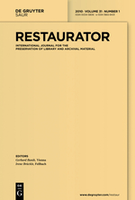
RESTAURATOR-INTERNATIONAL JOURNAL FOR THE PRESERVATION OF LIBRARY AND ARCHIVAL MATERIAL
metrics 2024
Innovative Insights for Timeless Treasures.
Introduction
RESTAURATOR-INTERNATIONAL JOURNAL FOR THE PRESERVATION OF LIBRARY AND ARCHIVAL MATERIAL, published by WALTER DE GRUYTER GMBH in Germany, is an esteemed scholarly journal dedicated to the conservation and preservation of library and archival materials. With a history spanning from its first publication in 1970, this journal has become a vital resource for professionals, researchers, and students in the fields of conservation, materials science, and media technology. The journal holds a Q2 classification in Conservation and positions itself within the top 30% of its peer category, reflecting its commitment to quality research and innovative practices. Although the journal is not open access, it offers invaluable insights into preservation methodologies, case studies, and advances in materials technology, supporting the ongoing dialogue within the conservation community. Its indexed presence in Scopus, especially notable in the Arts and Humanities and Engineering categories, further underscores its relevance and impact in shaping contemporary practices in conservation.
Metrics 2024
 0.220.700.6032
Metrics History
Rank 2024
Scopus
IF (Web Of Science)
JCI (Web Of Science)
Quartile History
Similar Journals

Cabas
Fostering collaboration in the realm of educational studies.Cabas is a distinguished academic journal dedicated to advancing the field of educational interpretation and studies, published by the CENTRO RECURSOS INTERPRETACION ESTUDIOS ESCUELA (CRIEME). With its ISSN 1989-5909 and E-ISSN 1989-5909, it has positioned itself as a vital resource for researchers and practitioners interested in innovative educational methodologies and interpretations since its establishment as an Open Access journal in 2009. Based in Polanco, Cantabria, SPAIN, this journal seeks to disseminate high-quality research that fosters academic exchange and collaboration in the educational sector. Although specific metrics such as HIndex and Scopus ranks are currently unavailable, the journal's commitment to accessibility and knowledge sharing is paramount, allowing a broader audience of educators, researchers, and students to engage with significant findings and discussions in the field.

Bosniaca-Journal of the National and University Library of Bosnia and Herzegovina
Empowering Voices in Library Science and Social SciencesBosniaca - Journal of the National and University Library of Bosnia and Herzegovina, published by the National and University Library of Bosnia and Herzegovina, is an esteemed open-access journal that has been disseminating knowledge since 2016. With an ISSN of 1512-5033 and E-ISSN of 2303-8888, this journal aims to serve as a vital resource for scholars, researchers, and practitioners in the fields of cultural studies, education, and social sciences. Despite its challenging rankings, it provides a platform for addressing and discussing the evolving landscape of Bosnian heritage, library science, and education. By prioritizing open access, Bosniaca ensures that its content is freely available to the global community, fostering collaboration and innovation in research. As it converges new insights in its 2022-2023 issues, the journal continues to play a crucial role in promoting scholarly discourse within and beyond Bosnia and Herzegovina.
JOURNAL OF CULTURAL HERITAGE
Connecting Cultures Through Scholarly Insights.JOURNAL OF CULTURAL HERITAGE, published by Elsevier France - Éditions Scientifiques Médicales Elsevier, is a pivotal academic journal dedicated to the multifaceted study of cultural heritage, including its conservation, anthropology, archaeology, and related fields. With an impressive standing in the academic community, this journal has achieved a Q1 ranking in Anthropology, Archaeology, Conservation, and History, reflecting its critical influence and contribution to these disciplines. The journal serves as a vital resource for researchers, professionals, and students interested in innovative research and developments concerning cultural heritage practices and policies. Although it operates under a subscription model, it provides access to innovative research and insights from the field, making it essential for those engaged in the preservation and study of cultural artifacts and historical narratives.

TRANSACTIONS OF THE ANCIENT MONUMENTS SOCIETY
Celebrating the Cultural Significance of MonumentsTRANSACTIONS OF THE ANCIENT MONUMENTS SOCIETY is a distinguished journal published by the Ancient Monuments Society in the United Kingdom, focusing on the rich interplay between architecture, conservation, and religious studies as they pertain to ancient monuments and heritage. With an ISSN of 0951-001X, this journal serves as an essential platform for researchers, professionals, and students interested in exploring methodologies, case studies, and theoretical perspectives that enhance our understanding of historical preservation and cultural significance. Although it has been classified in Q4 quartiles in prominent categories such as Architecture, Conservation, and Religious Studies, the journal plays a vital role in fostering scholarly dialogue in these areas. Access options and updates are available, making it easier for enthusiasts and experts alike to engage with ongoing discussions surrounding ancient monuments. Despite its discontinued coverage in Scopus, the journal remains an invaluable resource for those aiming to contribute to the conservation discourse and to understand the relevance of ancient sites in contemporary society.
ARCHIVAL SCIENCE
Fostering Excellence in Archival Research and PracticeARCHIVAL SCIENCE, an esteemed journal published by SPRINGER, is a cornerstone in the fields of history and library and information sciences. With an ISSN of 1389-0166 and an E-ISSN of 1573-7500, this journal has been pivotal in shaping academic discourse since its inception in 2001 and continues to publish cutting-edge research as it converges towards 2024. Renowned for its rigorous peer-reviewed articles, ARCHIVAL SCIENCE ranks in the top quartiles of academic performance—Q1 in History and Q2 in Library and Information Sciences—illustrating its significant impact on these disciplines. Its impressive Scopus rankings position it within the 97th percentile for History and the 70th percentile for Library and Information Sciences, making it a vital resource for scholars and practitioners alike. Readers will appreciate the journal's commitment to exploring innovative methodologies, theoretical frameworks, and practical applications within the realm of archival studies. While it does not offer open access, ARCHIVAL SCIENCE remains a must-read for those keen on advancing their understanding of archival practices and their relevance in contemporary society.

PRESERVATION
Championing Historic Preservation for Future GenerationsPRESERVATION is a distinguished journal published by the NATL TRUST HISTORIC PRESERVATION, focusing on critical issues in historic preservation and conservation within the realm of arts and humanities. With an ISSN of 1090-9931, this journal served as a notable platform for research and discourse from 2002 to 2018, although its coverage was discontinued in Scopus, where it held ranks that reflected its niche but valuable contributions to both visual arts and conservation. Despite its cessation, the journal remains a key resource for professionals and academics dedicated to preserving cultural heritage and advancing the study of preservation practices. The importance of PRESERVATION lies in its commitment to fostering an understanding of the challenges in maintaining historical integrity amidst modern developments. Researchers, practitioners, and students alike will find a wealth of knowledge and inspiration through its past issues, making it an essential reference point for those engaged in the ongoing dialogue around preservation methodologies and impacts.
STUDIES IN CONSERVATION
Fostering Interdisciplinary Insights in ConservationSTUDIES IN CONSERVATION, published by Routledge Journals, Taylor & Francis Ltd, stands as a premier peer-reviewed journal in the field of conservation, holding a distinguished Q1 ranking in the Conservation category for 2023. With its origins dating back to 1952 and poised to continue through 2024, this respected journal provides a vital platform for disseminating high-quality research and innovative practices aimed at the preservation of cultural heritage and natural environments. The journal boasts an impressive Scopus rank of #15 out of 103 within its category, reflecting its influential role in shaping the dialogue among researchers, professionals, and students dedicated to conservation efforts. While Open Access options are not currently available, the journal remains accessible to a broad readership eager to engage with its in-depth analyses and critical studies that address urgent conservation challenges. The editorial team seeks to promote diverse perspectives and foster interdisciplinary collaboration, making STUDIES IN CONSERVATION an essential resource for anyone committed to advancing the field of conservation.
LIBRARY TRENDS
Exploring the Future of Library ScienceLIBRARY TRENDS is a leading academic journal published by Johns Hopkins University Press, dedicated to the field of Library and Information Sciences. With an established history spanning from 1980 to 2023, this peer-reviewed journal provides a platform for insightful research, innovative practices, and critical analysis addressing contemporary issues in library science. While it holds a respectable Q3 quartile ranking within its category, it ranks #145 out of 280 in Scopus, indicating its significance in the academic community. With an impact factor that reflects the growing importance of the field, LIBRARY TRENDS invites contributions that encompass a wide range of topics, including digital libraries, information technology, and user studies. Although it is not an open-access journal, the content it provides is invaluable for researchers, professionals, and students seeking to enhance their understanding and improve their practices in the rapidly evolving landscape of library and information science. Discover more by exploring the latest issues and join the vibrant discourse shaping our information ecosystems.

Loggia Arquitectura & Restauracion
Illuminating the Art of Restoration and Architectural IntegrityLoggia Arquitectura & Restauracion is a pivotal academic journal dedicated to the fields of architecture, conservation, and the visual arts, published by UNIV POLITECNICA VALENCIA, EDITORIAL UPV in Spain. With an ISSN of 1136-758X and an E-ISSN of 2444-1619, this Open Access journal has been providing a platform for scholarly discussions since 1996, enhancing the global dialogue on architectural methods and restoration practices. Boasting a Q3 ranking in both Architecture and Conservation, along with a Q2 ranking in Visual Arts and Performing Arts, the journal reflects a commitment to academic rigor and innovation, as it navigates the convergence of these important fields from 2019 to 2024. The research published in Loggia addresses critical contemporary issues, enriching the knowledge base for academics, practitioners, and students alike. With a current Scopus rank that situates it within the competitive landscape of arts and humanities, Loggia serves as a vital resource for those seeking to explore the intersection of culture, history, and sustainability in architectural practice.
Ge-Conservacion
Exploring New Frontiers in Visual and Performing Arts ResearchGe-Conservacion, published by GRUPO ESPANOL I I C, stands as a pivotal journal in the fields of Conservation, Museology, and Visual Arts and Performing Arts, facilitating an open-access platform since 2009. Based in Spain, this journal serves as a vital repository for innovative research and scholarly dialogue, significantly impacting the community with its Q1 and Q2 rankings across several categories in 2023. With an objective to advance multidisciplinary understanding and practices related to cultural heritage conservation, it attracts a diverse readership of researchers, professionals, and students eager to engage with contemporary issues and methodologies. The journal's commitment to accessibility enhances its reach and influence, making it an essential resource for anyone passionate about preserving the integrity and significance of our artistic and historical treasures.