Revue d Anthropologie des Connaissances
Scope & Guideline
Innovating Insights in Anthropology and Beyond.
Introduction
Aims and Scopes
- Ethnographic inquiry into knowledge practices:
The journal emphasizes ethnography as a core methodology, investigating how knowledge is produced and understood in various cultural and social contexts. - Interdisciplinary approaches to social phenomena:
It fosters interdisciplinary research that bridges anthropology, sociology, and science and technology studies (STS), allowing for a comprehensive understanding of complex social issues. - Focus on materiality and environmental concerns:
There is a consistent focus on the material aspects of knowledge production, including environmental issues, ecological interactions, and the socio-political implications of material practices. - Critical examination of ignorance and knowledge production:
The journal addresses the concept of ignorance in knowledge systems, exploring how what is not known influences social actions and policies. - Engagement with contemporary societal challenges:
Research published in the journal often engages with pressing global issues, including climate change, public health, and technological transformations, highlighting the relevance of knowledge in addressing these challenges.
Trending and Emerging
- Preparation and anticipation in social practices:
Recent publications emphasize the concept of preparation—how individuals and communities prepare for uncertainties and disruptions, reflecting a growing interest in anticipatory practices in various fields. - Intersections of technology and society:
There is an increasing trend towards exploring how technological advancements intersect with societal practices, particularly in areas like public health, environmental monitoring, and data governance. - Engagement with activism and social movements:
Papers reflecting on the role of knowledge in activism and social movements are gaining traction, indicating a shift towards understanding how knowledge informs and shapes collective actions. - Materiality and environmental justice:
Emerging themes highlight the relationship between materiality—such as waste, pollution, and resource management—and social justice, reflecting a heightened awareness of ecological concerns within anthropological research. - Ethnographies of contemporary crises:
The journal is increasingly publishing ethnographic studies that address contemporary crises, such as climate change and public health emergencies, showcasing the relevance of anthropological methods in urgent societal contexts.
Declining or Waning
- Historical analyses of scientific practices:
There has been a noticeable decline in papers focusing on historical perspectives of scientific practices, which were more prevalent in earlier issues. - Theoretical discussions on epistemology:
Themes centered around abstract theoretical discussions of epistemology seem to be waning, with a shift towards more applied and practical investigations in contemporary contexts. - Discussions on traditional anthropological perspectives:
Traditional anthropological topics, such as cultural relativism and ethnographic description, appear to be less frequent, giving way to more interdisciplinary and contemporary issues.
Similar Journals
ANTHROPOLOGIE
Pioneering Research in Anthropology and Science HistoryANTHROPOLOGIE, published by Elsevier France - Éditions Scientifiques Médicales Elsevier, is a leading academic journal dedicated to advancing the fields of Anthropology and the History and Philosophy of Science. With a publication history that dates back to 1947, this esteemed journal has steadily carved its niche within the scholarly community, achieving a commendable Q2 rank in both the aforementioned categories in 2023. Although it does not offer Open Access, ANTHROPOLOGIE provides robust access options through institutional subscriptions, ensuring that researchers and practitioners alike can delve into its rich repository of knowledge. The journal's impact is underscored by its competitive Scopus rankings, particularly its position within the 65th percentile for History and Philosophy of Science and 56th percentile within Anthropology. Through rigorous peer-reviewed articles that illuminate a wide array of anthropological inquiries and philosophical debates, ANTHROPOLOGIE continues to be an essential resource for those committed to exploring the complexities of human behavior, culture, and scientific understanding in an ever-evolving world.
Philosophy and Society-Filozofija i Drustvo
Engaging Minds, Shaping SocietiesPhilosophy and Society-Filozofija i Drustvo is an esteemed, peer-reviewed journal published by the UNIV BELGRADE, INST PHILOSOPHY & SOCIAL THEORY, with ISSN 0353-5738 and E-ISSN 2334-8577. Established as an Open Access platform since 2002, the journal provides a vital avenue for scholars to disseminate their research in the fields of philosophy, sociology, and political science. Based in Belgrade, Serbia, it has become increasingly influential, reflected in its Scopus rankings—#413 in Arts and Humanities (Philosophy) and #1185 in Social Sciences (Sociology and Political Science). The journal aims to foster critical discourse and multidisciplinary dialogue, serving both seasoned researchers and emerging scholars alike. As it continues its journey in the converged years from 2018 to 2024, Philosophy and Society remains committed to exploring philosophical inquiries within contemporary societal contexts, addressing pressing issues and questions that shape our world.

SOCIAL HISTORY OF MEDICINE
Connecting History and Health for a Deeper InsightSOCIAL HISTORY OF MEDICINE, published by Oxford University Press, is a premier journal dedicated to advancing the field of medical history through a social lens. With a rich history since its inception in 1988, the journal spans key developments and explorations up to the present, emphasizing the intricate relationships between social structures and medical practices. Holding a Q1 ranking in History and a Q3 ranking in Medicine (miscellaneous), it attests to its influential position within both disciplines, facilitating a comprehensive understanding of how societal factors shape health and medicine. Researchers, professionals, and students alike benefit from its rigorous peer-reviewed articles that encourage interdisciplinary dialogue and foster new insights. The journal is indexed in Scopus, currently ranked 132nd out of 1760 in Arts and Humanities—History, placing it in the 92nd percentile, and 232nd out of 398 in Medicine, with a 41st percentile ranking. Although not open access, the content is invaluable for anyone interested in the historical intersections of medicine, making it an essential resource for scholarly inquiry.
JOURNAL OF RELIGION
Illuminating the Intersection of Belief and SocietyJOURNAL OF RELIGION, published by University of Chicago Press, stands as a prominent scholarly platform in the field of religious studies. With an ISSN of 0022-4189 and an E-ISSN of 1549-6538, this journal has been serving the academic community since its inception in 1982, providing a crucial forum for innovative research and critical analysis of various religious phenomena. The journal's placement in the Q3 category for Religious Studies and its ranking in the 66th percentile among peers underscore its impact within the academic landscape, making it a valuable resource for researchers and professionals alike. Although it does not offer open access, the journal remains committed to advancing knowledge in the discipline, targeting a diverse audience from students to established scholars. With upcoming issues extending to 2024, JOURNAL OF RELIGION continues to foster interdisciplinary dialogue and contribute to the understanding of religion in contemporary society.
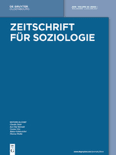
ZEITSCHRIFT FUR SOZIOLOGIE
Illuminating Social Relationships and Institutions Since 1972ZEITSCHRIFT FUR SOZIOLOGIE is a distinguished journal in the field of sociology, published by WALTER DE GRUYTER GMBH, a renowned academic publisher based in Germany. Since its inception in 1972, the journal has consistently contributed to the advancement of sociological knowledge, bridging theoretical frameworks and empirical research. With an impact factor reflecting its relevance in the academic community, it has achieved a commendable ranking of Q3 in the Sociology and Political Science category as of 2023. Its Scopus ranking positions it among the top half in its field, with a notable percentile of 49th. Although it does not offer open access, the journal remains a vital resource for researchers, professionals, and students seeking to explore contemporary sociological issues and critical analyses. Its comprehensive scope includes topics that address the complexities of social relationships and institutions, making it a pivotal publication for those committed to understanding the dynamics of society.

Metode Science Studies Journal
Exploring the Intersections of Knowledge and InquiryMetode Science Studies Journal, published by UNIV VALENCIA, BOTANICAL GARDEN UV, is an esteemed open-access journal dedicated to advancing scholarly discourse in the fields of history and philosophy of science and multidisciplinary studies. Since its inception in 2013, the journal has positioned itself as a vital resource for researchers, professionals, and students, fostering an environment for innovative research and cross-disciplinary dialogue. Based in the vibrant city of Valencia, Spain, this journal aims to publish high-quality articles that explore the intricate relationships between scientific practices and philosophical inquiries. With a current impact factor demonstrating its relevance in the academic community, the journal is indexed in Scopus, ranking in the 52nd percentile for history and philosophy of science and the 33rd percentile for multidisciplinary studies. Scholars can access a breadth of research outputs that span from 2015 to 2024, thereby contributing significantly to the intellectual landscape of the respective fields.

REVUE HISTORIQUE
Where Innovative Research Meets Historical DiscourseREVUE HISTORIQUE is a distinguished scholarly journal dedicated to the field of history, published by PRESSES UNIV FRANCE. With an ISSN of 0035-3264 and an E-ISSN of 2104-3825, this journal has been a vital resource for historians and academics since its inception, exploring various dimensions of historical research and discourse. The journal is currently categorized in the Q3 quartile for history according to the 2023 metrics, highlighting its significance and academic rigor, although it is rated in the 19th percentile in the Scopus Ranks among Arts and Humanities journals. Based in France, the journal encompasses a wide range of historical topics and serves as a platform for innovative research, critical analysis, and scholarly discourse, making it an essential read for anyone looking to deepen their understanding of the past. Researchers, professionals, and students alike will benefit from its comprehensive articles, which reflect the latest trends and developments in historical research. As a non-open access journal, subscribers and institutional access are essential to engage with its rich content.

Dynamis
Empowering Voices in the Study of Science and MedicineDynamis is a distinguished journal published by EDITORIAL UNIV GRANADA, focusing on the interdisciplinary fields of History and Philosophy of Science as well as Medicine. Since its inception in 1981, this journal has provided a platform for scholarly discussion and exploration of the evolution of scientific thought and medical practices, with a consistent commitment to enriching academic dialogue up to the year 2024. Operating within the Q4 category for both History and Philosophy of Science and Medicine in the 2023 rankings, it holds a unique niche despite its positioning and aims to amplify underrepresented voices and perspectives via rigorous academic analysis. Although not currently an open-access publication, Dynamis continues to serve as a vital resource for researchers, professionals, and students who are keen to understand the historical contexts and philosophical implications in these fields. Its impact within the academic community is reflected in its Scopus rankings, offering valuable insights into the interplay between history, philosophy, and medicine. Situated in beautiful Granada, Spain, Dynamis remains committed to fostering a deeper understanding of the sciences through a historical and philosophical lens.
ANNALES DE BRETAGNE ET DES PAYS DE L OUEST
Illuminating the Cultural Heritage of Western FranceANNALES DE BRETAGNE ET DES PAYS DE L OUEST, published by UNIV HAUTE-BRETAGNE, serves as a vital scholarly resource within the fields of arts and humanities, particularly focusing on literature, literary theory, and history. Established in 1974, the journal has diligently explored the cultural and historical dimensions of Brittany and Western France, while promoting interdisciplinary discourse among researchers and professionals. Despite its recent discontinuation in Scopus, the journal continues to hold significance with an ISSN of 0399-0826 and an E-ISSN of 2108-6443, reflecting its dedication to preserving and disseminating regional scholarly work. With a focus on fostering knowledge production and exploration of local histories, ANNALES DE BRETAGNE ET DES PAYS DE L OUEST remains an essential publication for students and scholars aiming to engage with the rich cultural tapestry of Western France.
International Journal of Canadian Studies
Bridging Cultures: The Heart of Canadian StudiesThe International Journal of Canadian Studies, published by University of Toronto Press Inc, serves as a vital platform for scholarly discourse on Canadian culture, politics, and history, reflecting the multidisciplinary nature of studies pertaining to Canada. With an ISSN of 1180-3991 and an E-ISSN of 1923-5291, this journal is poised to contribute significantly to the academic community, fostering insights into Canada’s role in a global context. Adapting to the evolving landscape of research, the journal has implemented a converged publishing model, covering the years from 2020 to 2024, and holds a Q4 ranking in its category for 2023, positioning it within a competitive framework. While the journal currently does not offer open access, it remains committed to enhancing access for scholars and practitioners interested in Canadian studies. Despite its recent establishment in the Scopus ranking system, the journal is dedicated to elevating its impact and utility for researchers, professionals, and students who seek to deepen their understanding of Canadian issues and narratives.