Review of Development Finance
Scope & Guideline
Catalyzing Change through Rigorous Research
Introduction
Aims and Scopes
- Development Finance Research:
The journal emphasizes research that explores the role of finance in economic development, including the impact of financial systems on poverty alleviation and economic growth. - Macroeconomic Analysis:
It publishes studies that analyze macroeconomic variables and their effects on financial stability, credit risk, and economic performance, particularly in developing and emerging markets. - Financial Technologies and Innovation:
A core area of focus is on the implications of financial technologies (FINTECH) for development, assessing how innovations can enhance financial inclusion and economic resilience. - Credit and Lending Behavior:
The journal frequently examines the dynamics of credit markets, including lending behaviors of banks and the impact of credit rationing on economic activity, especially for small and medium enterprises (SMEs). - Impact of External Shocks:
Research on how external factors, such as climate shocks and global economic uncertainties, influence financial markets and economic conditions in developing countries is a consistent theme. - Cross-Border Investments and Economic Policy:
The journal investigates the effects of cross-border investments and economic policies on local economies, providing insights into how global trends affect emerging markets.
Trending and Emerging
- Climate Finance and Sustainability:
An increasing focus on the intersection of climate change and finance, as seen in studies addressing climate shocks and their implications for credit ratings, underscores the importance of sustainability in development finance. - Impact of COVID-19 on Financial Systems:
The COVID-19 pandemic has prompted a surge in research examining its effects on remittances, credit markets, and financial technologies, reflecting a broader interest in resilience and recovery in the face of global crises. - Financial Inclusion and Economic Growth:
There is a growing emphasis on the relationship between financial inclusion and economic development, particularly how access to finance impacts growth trajectories in emerging economies. - Behavioral Finance and Economic Decision-Making:
Emerging research on behavioral aspects of finance, including trust and herding behavior in economic contexts, suggests a trend towards incorporating psychological factors in financial decision-making processes. - Cross-Border Financial Flows and Globalization:
The journal is increasingly addressing the complexities of globalization, particularly through studies on cross-border investments and their implications for local economies amid changing global dynamics.
Declining or Waning
- Historical Analysis of Financial Markets:
Themes focusing on historical bibliometric analyses of financial market studies, such as the 45 Years of the Exchange Rate Study, appear to be less emphasized, suggesting a shift towards more contemporary and applied research. - Traditional Banking Practices:
Research centered on traditional banking practices and their direct effects on economic outcomes has waned, possibly due to the rising interest in modern financial technologies and their transformative potential. - Static Economic Models:
Static models that do not incorporate the dynamic interactions of various economic factors are less frequently published, indicating a move towards more complex, multifaceted analytical frameworks. - Sector-Specific Studies:
There is a noticeable reduction in studies focusing exclusively on specific sectors, such as agriculture or manufacturing, as interdisciplinary approaches that consider broader economic contexts are gaining traction.
Similar Journals
INTERNATIONAL ECONOMICS AND ECONOMIC POLICY
Empowering Research to Inform Economic Decision-MakingINTERNATIONAL ECONOMICS AND ECONOMIC POLICY, published by Springer Heidelberg, is a pivotal journal in the field of economics, focusing on both theoretical and empirical research that addresses pressing international economic issues. With an ISSN of 1612-4804 and an E-ISSN of 1612-4812, this journal has been a reliable source of insights since its inception and is poised for continuous growth, converging its themes from 2005 to 2024. Ranked in the Q2 category of Economics and Econometrics in 2023, it stands at a commendable 63rd percentile among similar journals, emphasizing its significance and impact in the academic community. Located in Heidelberg, Germany, the journal provides an access portal for researchers, professionals, and students to engage with cutting-edge economic analyses that inform policy and practice globally. By publishing original articles, reviews, and policy discussions, INTERNATIONAL ECONOMICS AND ECONOMIC POLICY plays a crucial role in shaping the discourse within the global economics landscape.
Economic Systems
Connecting empirical research with real-world applications.Economic Systems is a premier academic journal published by Elsevier, specializing in the dynamic field of economics and econometrics. With an ISSN of 0939-3625 and E-ISSN 1878-5433, this journal is known for its rigorous peer-reviewed articles that delve into economic theory, policy analysis, and empirical research, making it an invaluable resource for researchers, professionals, and students alike. Based in the Netherlands, the journal has established a strong reputation, evidenced by its Q2 ranking in Economics and Econometrics and a commendable position within the 74th percentile of its category in Scopus rankings. Covering a breadth of topics relevant to contemporary economic systems, from their structural assessments to real-world applications, Economic Systems aims to inform and advance the discourse within the field. While it operates under a subscription model, the journal ensures accessibility to groundbreaking research, encouraging a deeper understanding of the economic challenges facing today’s societies.

Journal of Economics Finance and Administrative Science
Connecting academia to real-world economic challenges.Journal of Economics Finance and Administrative Science, published by Emerald Group Publishing Ltd, is a premier open-access journal that has been at the forefront of advancing knowledge since its inception in 2012. With an ISSN of 2077-1886 and E-ISSN of 2218-0648, the journal caters to the disciplines of economics, finance, and administrative sciences within an international context, specifically observing trends from Peru and beyond. This highly regarded journal holds a Q1 ranking in Economics, Econometrics and Finance for 2023, landing it in the top percentile among its peers, with an impressive Scopus rank of #33 out of 288 in general economics. Since transitioning to open access in 2017, the journal has democratized access to cutting-edge research, making it indispensable for researchers, professionals, and students alike. By publishing rigorous empirical studies, comprehensive reviews, and innovative theoretical contributions, the Journal of Economics Finance and Administrative Science aims to facilitate knowledge exchange and foster collaboration within the global academic community.

JOURNAL OF MONEY CREDIT AND BANKING
Transforming Understanding of Economic SystemsJOURNAL OF MONEY CREDIT AND BANKING, published by Wiley, stands as a premier academic outlet in the domains of finance, economics, and accounting. With an ISSN of 0022-2879 and an E-ISSN of 1538-4616, this journal serves as a vital resource for researchers seeking to explore the dynamic interactions between money, credit, and banking systems. Compiling groundbreaking research since its inception, the journal boasts an impressive Q1 quartile ranking across key categories in the 2023 metrics, reflecting its prestige in the fields of Accounting, Economics, and Finance. It ranks among the top in its class with a Scopus ranking that underscores its contribution and influence in scholarly discourse, especially in the evolving contexts of economic policy and financial markets. Although not available as an open-access publication, the journal’s commitment to high-quality peer-reviewed research makes it indispensable for professionals, students, and academicians aiming to stay abreast of developments in monetary theory and practice. With the aim of fostering scholarly exchanges, the JOURNAL OF MONEY CREDIT AND BANKING remains a cornerstone for advancing understanding and application of critical financial concepts.
Technological and Economic Development of Economy
Innovating Insights for a Dynamic Economic Future.Technological and Economic Development of Economy, published by VILNIUS GEDIMINAS TECH UNIV, is a leading journal dedicated to advancing the fields of economics and finance. With an ISSN of 2029-4913 and an E-ISSN of 2029-4921, this open access journal has been providing a platform for innovative research since 2005 and has been fully open access since 2018, promoting the free exchange of knowledge. The journal's impressive ranking in the 2023 Scopus Ranks, where it holds the 23rd position out of 317 in the finance category, demonstrates its significance in the academic community, achieving a remarkable 92nd percentile. Located in Lithuania at SAULETEKIO AL 11, VILNIUS LT-10223, it aims to encourage interdisciplinary dialogue on technological advancements and their economic implications, making it an essential resource for researchers, professionals, and students who seek to explore the intersections of these vital fields. With a converged publication timeline extending through 2024, the journal is well-positioned to influence future economic policies and technological innovations.
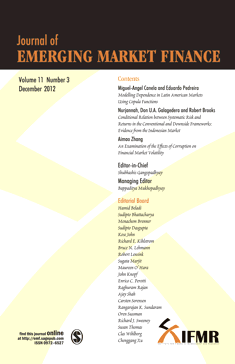
Journal of Emerging Market Finance
Charting New Frontiers in Economic AnalysisThe Journal of Emerging Market Finance, published by SAGE Publications India Pvt Ltd, is a premier academic journal that serves as a vital resource for researchers, professionals, and students in the fields of finance and economics. Established in 2002, this journal focuses on the multifaceted dynamics of emerging market economies and their financial systems. With an ISSN of 0972-6527 and an E-ISSN of 0973-0710, it has garnered attention with its respectable Q3 rankings in both the Economics and Econometrics and Finance categories, reflecting its commitment to high-quality research. Despite its limited open-access options, the journal remains a significant platform for scholarly discussions, providing insights on emerging financial instruments, market behaviors, and economic policies in developing economies. As a continuously evolving publication, it aims to bridge the gap between theory and practice, promoting an understanding of the complexities faced in these vibrant markets, ultimately serving the academic community with relevant and impactful research until 2024 and beyond.

African Review of Economics and Finance-AREF
Illuminating Africa's Financial Landscape through ResearchAfrican Review of Economics and Finance (AREF) is a distinguished academic journal dedicated to advancing knowledge in the fields of economics and finance within the African context. Published by PORTHOLOGOS PRESS, the journal aims to provide a platform for research that addresses critical economic and financial issues that affect Africa, promoting innovative solutions and fostering discussion among scholars and practitioners. With its ISSN 2042-1478 and E-ISSN 2410-4906, AREF has established itself as a vital resource for researchers, professionals, and students seeking to deepen their understanding of African economies. The journal’s commitment to open access ensures that its valuable research findings are readily available to a global audience, thereby enhancing visibility and engagement. Through rigorous peer-review processes and thoughtful editorial leadership, AREF contributes significantly to the discourse on economic development, policy analysis, and financial practices in the region.

International Journal of Financial Studies
Empowering finance research through open access.The International Journal of Financial Studies is a premier publication dedicated to advancing the field of finance through open-access research. Published by MDPI based in Switzerland, this journal offers researchers, professionals, and students a platform to disseminate their findings in an accessible format since its establishment in 2013. With its ISSN of 2227-7072 and a commendable impact reflected in its Q2 ranking in finance, it occupies an influential position among finance-related journals, as evidenced by its 65th percentile rank in Scopus. The journal encompasses a wide array of topics in finance, making it essential reading for those seeking to stay abreast of current research trends and methodologies. As an open-access journal, all articles are freely available, significantly enhancing the visibility and reach of published studies, which is crucial for fostering collaboration and innovation within the global financial community. Published continuously until 2024, the International Journal of Financial Studies is not just a source of knowledge; it is a critical contributor to the progression of financial scholarship.
Journal of Risk Finance
Pioneering research for a secure financial future.The Journal of Risk Finance, published by Emerald Group Publishing Ltd, is a premier academic journal dedicated to advancing the understanding of risk management and finance practices since its inception in 1999. With a strong foothold within the Q2 rankings in both Accounting and Finance categories, it proudly holds a significant place in the scholarly landscape, ranking #54 out of 317 in the Scopus Economics and Finance category, placing it in the 83rd percentile. The journal aims to facilitate the exchange of innovative research and practical insights, catering to an audience of researchers, professionals, and students eager to explore contemporary issues in risk finance. While not an open access journal, it provides numerous access options, ensuring that essential findings reach a broad readership. Set in the United Kingdom and covering publications up to 2024, the Journal of Risk Finance continues to be an indispensable resource for those committed to this critical field.

Economics and Finance Letters
Nurturing scholarly exchange for a dynamic economic landscape.Economics and Finance Letters is a distinguished peer-reviewed journal published by CONSCIENTIA BEAM, dedicated to advancing the field of economics and finance. With its ISSN 2312-6310 and E-ISSN 2312-430X, this journal aims to provide an accessible platform for the dissemination of innovative research findings and theoretical developments in economics and finance. Aiming for impactful contributions within the realm of general economics, it holds a notable position in the Scopus rankings, where it is placed at #277 out of 288 in its category, showcasing its rapid ascent in academic reputation despite its relatively recent establishment from 2023 to 2024. While the journal operates on a traditional subscription model, it emphasizes an open exchange of ideas, promising to nurture scholarly dialogues among researchers, professionals, and students alike. By focusing on timely topics and fruitful discussions in economics and finance, Economics and Finance Letters is poised to carve out its niche in the academic landscape, providing both the rigor and relevance needed in today’s evolving economic context.