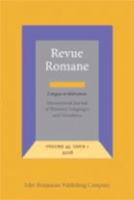
REVUE ROMANE
metrics 2024
Bridging Cultures Through Linguistic and Literary Dialogue
Introduction
REVUE ROMANE is a prestigious academic journal published by John Benjamins Publishing Co, located in the Netherlands. With a rich heritage dating from 1996 to 2024, this esteemed journal focuses on the dynamic interplay of *Linguistics* and *Literature*, making it an essential resource for scholars, researchers, and students alike. By showcasing a range of theoretical and empirical studies, the journal has positioned itself in the Q3 and Q2 quartiles for *Linguistics and Language* and *Literature and Literary Theory* respectively, reflecting its significant impact on these fields. With impressive Scopus rankings, including a notable 79th percentile in Arts and Humanities within Literature and Literary Theory, REVUE ROMANE serves as a critical platform for the exploration of both language and literary expressions, encouraging dialogues that bridge cultural and linguistic divides. Although it is not open access, its contributions are invaluable for advancing knowledge and fostering scholarly discourse in the realms of linguistic and literary investigation.
Metrics 2024
 0.120.200.209
Metrics History
Rank 2024
Scopus
JCI (Web Of Science)
Quartile History
Similar Journals

Sibirskii Filologicheskii Zhurnal
Exploring Cultural Narratives Through Scholarly InsightSibirskii Filologicheskii Zhurnal is a prestigious academic journal published by the Russian Academy of Sciences, Institute of Cytology and Genetics. With ISSN 1813-7083, it is dedicated to advancing research in the fields of Cultural Studies, Linguistics and Language, and Literature and Literary Theory, and has achieved notable rankings, including Q2 in Cultural Studies and Linguistics, and Q1 in Literature for 2023. The journal provides a platform for scholarly discourse, contributing valuable insights to its fields with an evolving scope that spans from 2018 to 2024. Though not an open-access journal, Sibirskii Filologicheskii Zhurnal serves as a vital resource for researchers, professionals, and students in the Russian Federation and beyond, fostering a deeper understanding of linguistic and literary phenomena. Its commitment to high-quality content makes it an essential addition to any academic's library.
REVISTA DE FILOLOGIA ESPANOLA
Illuminating the Landscape of Linguistics and LiteratureREVISTA DE FILOLOGIA ESPANOLA is a distinguished academic journal dedicated to the fields of linguistics and literature, published by the CONSEJO SUPERIOR INVESTIGACIONES CIENTIFICAS (CSIC) since 1954, and has been an Open Access journal since its inception. Situated in Madrid, Spain, this journal has emerged as a crucial platform for the dissemination of scholarly research, with notable rankings including Q2 in Linguistics and Language and Q1 in Literature and Literary Theory as of 2023. The journal's commitment to fostering academic dialogue is reflected in its impressive Scopus rankings, including a 79th percentile in the Arts and Humanities for Literature and Literary Theory. Covering a wide range of topics from linguistic theory to literary critique, REVISTA DE FILOLOGIA ESPANOLA is essential reading for researchers, professionals, and students alike, providing valuable insights and cutting-edge research in the ever-evolving landscape of Spanish philology.

Archivum
Fostering Innovation in Linguistic and Literary StudiesArchivum, published by UNIV OVIEDO in Spain, stands as a vital resource in the fields of Linguistics and Language as well as Literature and Literary Theory. With an impact factor reflective of its commitment to scholarly excellence, this journal has proudly maintained an Open Access model since 1951, ensuring that its rich repository of knowledge is freely available to researchers, professionals, and students alike. Covering a converged span from 2019 to 2023, Archivum has strategically positioned itself within the academic milieu, currently categorized in the Q4 for Linguistics and Language and Q3 for Literature and Literary Theory as of 2023. The journal is indexed in Scopus, with rankings that reflect its growing influence, such as #690 in Literature and Literary Theory and #887 in Language and Linguistics. Despite its challenges in visibility, Archivum remains essential for those seeking to engage with contemporary discussions and research within the humanities. Located in the heart of Asturias, it embodies the scholarly spirit of Spain, fostering a collaborative environment for innovation and inquiry in linguistic and literary studies.

Minerva-Revista de Filologia Clasica
Exploring the depths of linguistics and literature.Minerva-Revista de Filologia Clasica, an esteemed academic journal published by the Universidad de Valladolid, is a pivotal resource in the fields of Classics, Linguistics, and Literature. With its ISSN 0213-9634 and E-ISSN 2530-6480, this journal has been championing open access since 2017, making high-quality research accessible to a global audience. Based in Valladolid, Spain, Minerva is dedicated to the exploration and dissemination of scholarly work related to classical philology, offering a platform for the exchange of ideas among researchers, educators, and students alike. Recognized in the 2023 category quartiles as Q3 in Classics and Q4 in Linguistics and Language, this journal provides valuable insights and contributes significantly to its fields, allowing authors and readers to engage with important discussions and innovative perspectives. As the academic landscape evolves, Minerva continues to adapt, fostering a vibrant community committed to the advancement of knowledge in antiquity and its linguistic dimensions.

Romanica Olomucensia
Cultivating a Global Community of Literary ScholarsRomanica Olomucensia is a distinguished open-access academic journal published by Palacky University, Department of Romance Philosophical Faculty in the Czech Republic. With its commitment to fostering advanced research in the fields of Literature and Literary Theory as well as Linguistics and Language, this journal aims to provide a platform for scholars, researchers, and students to share their findings and insights. Since its inception, Romanica Olomucensia has consistently been recognized for its quality, securing a position in the Q2 category in the literature domain and achieving a Q3 ranking in linguistics per the 2023 category quartiles. The journal is indexed in Scopus, reflecting its standing in the academic community, with impressive ranks in various arts and humanities disciplines. It has been an open-access journal since 2018, promoting unrestricted access to all its publications, thus enhancing global academic outreach. With a focus on innovation and interdisciplinary studies, Romanica Olomucensia serves as an essential resource for anyone interested in the dynamic interplay of language and literature.

Revista Letras
Navigating the Depths of Literary and Cultural StudiesRevista Letras (ISSN: 0100-0888, E-ISSN: 2236-0999) is a prominent academic journal published by Universidade Federal do Paraná, Editora, renowned for its commitment to advancing knowledge in the fields of literature, linguistics, and cultural studies. As a pivotal platform for scholarly exchange, the journal aims to foster rigorous research and interdisciplinary dialogue, addressing themes relevant to both Brazilian and global literature. With an emphasis on open access, Revista Letras ensures that its research is widely disseminated, enabling greater accessibility for researchers, professionals, and students alike. Located in Curitiba, Paraná, Brazil, the journal actively participates in the academic community, contributing to the ongoing conversation surrounding literary and linguistic studies. Its dedication to quality scholarship makes it an invaluable resource for anyone looking to deepen their understanding of these dynamic fields.

Theleme-Revista Complutense de Estudios Franceses
Fostering Dialogue in the World of French ScholarshipTheleme-Revista Complutense de Estudios Franceses is a distinguished academic journal published by UNIV COMPLUTENSE MADRID, SERVICIO PUBLICACIONES, dedicated to the exploration of French studies within the fields of linguistics and literature. With an ISSN of 1139-9368 and an E-ISSN of 1989-8193, this journal has proudly maintained its Open Access policy since 1992, ensuring that scholarly research is accessible to a global audience. Based in Spain, the journal is committed to advancing knowledge and fostering discussion in French linguistic and literary theory, as evidenced by its publication history from 2019 to 2024. Despite its current classification in the Q4 quartile for both Linguistics and Literature and Literary Theory as of 2023, Theleme is positioned to grow in its academic influence, reflecting trends in interdisciplinary research. The journal’s rankings in Scopus underscore its unique contributions and the importance of its discourse in the arts and humanities. Researchers, professionals, and students are encouraged to engage with Theleme as a resource for innovative ideas and comprehensive studies that navigate the rich landscape of French language and literature.

GERMANISCH-ROMANISCHE MONATSSCHRIFT
Unveiling New Dimensions of Language and LiteratureGERMANISCH-ROMANISCHE MONATSSCHRIFT, published by UNIVERSITATSVERLAG C WINTER HEIDELBERG GMBH, is a vital academic journal dedicated to the fields of linguistics, literature, and literary theory. With its ISSN 0016-8904, this journal fosters scholarly discussions and disseminates innovative research that intersects Germanic and Romance languages and literatures. While it does not currently offer Open Access options, its contributions have positioned it within the Q4 quartile in both Linguistics and Language, and Literature and Literary Theory according to the 2023 category rankings. The journal's Scopus ranking reflects its emerging place within the academic community, situated at the 40th percentile for Literature and Literary Theory, and the 20th and 18th percentiles within Language and Linguistics, respectively. Scholars and students are encouraged to engage with this resource as it offers a platform for new perspectives that are pivotal to understanding the complex interrelations of these linguistic traditions, enriching both teaching and research initiatives.

Estudios Romanicos
Fostering Global Collaboration in Romanic StudiesEstudios Romanicos, published by the Universidad de Murcia, is an esteemed open-access journal that has significantly contributed to the fields of Linguistics, Language, Literature, and Literary Theory since its inception in 1978. With an impact factor that elevates it to Q3 in Linguistics and Language and Q2 in Literature and Literary Theory as of 2023, this journal ranks impressively within its categories—placing it in the 76th percentile for Literature and Literary Theory, making it an essential resource for academic discourse. Based in Murcia, Spain, the journal embraces an open-access model, ensuring that its rich content is accessible to a global audience—fostering collaboration and cross-disciplinary research. The convergence of knowledge from diverse linguistic and literary perspectives allows researchers, professionals, and students alike to engage with cutting-edge scholarship and extend the boundaries of their own studies.
ANGLIA-ZEITSCHRIFT FUR ENGLISCHE PHILOLOGIE
Illuminating the Path of English Linguistic ResearchANGLIA-ZEITSCHRIFT FUR ENGLISCHE PHILOLOGIE, published by WALTER DE GRUYTER GMBH, stands as a significant periodical in the fields of Linguistics and Literary Theory. With a rich publication history dating back to 1878 and ongoing contributions until 2024, this esteemed journal serves as a vital resource for researchers, professionals, and students interested in the evolution of the English language and literature. Although it does not currently offer open access, its rigorous peer-reviewed articles have secured a respectable standing, ranking Q3 in Linguistics and Language and Q2 in Literature and Literary Theory as of 2023. The journal, located in Berlin, Germany, continues to drive academic discourse and foster scholarly engagement in the intricacies of English philology, making it an essential platform for the latest research and developments in the field.