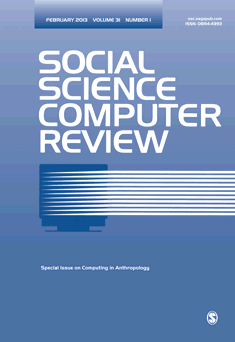
SOCIAL SCIENCE COMPUTER REVIEW
Scope & Guideline
Elevating research with cutting-edge computational methods.
Introduction
Aims and Scopes
- Computational Social Science:
The journal emphasizes research that applies computational techniques to analyze social behavior, including social media analytics, network analysis, and large-scale data mining. - Digital Communication and Media Studies:
A core area of focus is the study of digital communication, particularly how social media platforms influence public discourse, political engagement, and community dynamics. - Public Policy and Governance:
Research often explores the implications of technology on public policy, governance, and citizen engagement, examining how digital tools affect democratic processes and governmental responsiveness. - Health Communication and Behavior:
The journal includes studies on health communication, especially in the context of crises (like COVID-19) and the role of social media in shaping public health narratives. - Social Inequalities and Digital Divide:
A consistent theme is the exploration of social inequalities exacerbated by digital technologies, including access disparities and the implications for marginalized communities. - Machine Learning and AI Applications:
There is a strong emphasis on the application of machine learning and AI in social research, particularly in understanding complex social systems and predicting human behavior.
Trending and Emerging
- Impact of AI and Automation:
Recent publications increasingly explore the implications of AI and automation on social behavior, governance, and economic structures, highlighting the need to understand how these technologies reshape societal norms. - Political Polarization and Digital Discourse:
There is a growing focus on the role of social media in political polarization, particularly how algorithms and online interactions contribute to divisive narratives and societal fragmentation. - Health Communication in Crisis Contexts:
Research is increasingly centered on health communication strategies during crises, such as pandemics, emphasizing the role of misinformation and the effectiveness of digital communication channels in public health. - Ethics of Digital Data Use:
Emerging themes include the ethical implications of using digital data in research, particularly concerning privacy, consent, and the responsibilities of researchers in handling sensitive information. - Interdisciplinary Approaches to Social Issues:
There is a trend towards interdisciplinary research that combines insights from social sciences, data science, and humanities to address complex social issues, reflecting a holistic approach to understanding human behavior in digital contexts.
Declining or Waning
- Traditional Survey Methods:
There is a noticeable decrease in research utilizing traditional survey methodologies without integrating digital tools. The evolution towards mixed-methods and technology-enhanced approaches shows a waning interest in purely conventional methods. - Generalized Media Effects Studies:
Research that broadly examines media effects without specific contextual or technological considerations is less frequent. The trend now favors more nuanced investigations that account for digital contexts and platform-specific interactions. - Descriptive Studies on Social Media Usage:
There is a decline in purely descriptive studies that catalog social media usage patterns without analytical depth. The focus is shifting towards more analytical and predictive frameworks that leverage computational methods. - Static Models of Political Behavior:
Research employing static models of political behavior without considering dynamic interactions and the role of digital platforms is becoming less common, as scholars increasingly adopt more complex and adaptive modeling approaches.
Similar Journals

Revista de Investigaciones Politicas y Sociologicas
Fostering Insightful Dialogue on Social DynamicsRevista de Investigaciones Politicas y Sociologicas, published by the prestigious Universidad de Santiago de Compostela, stands as a significant academic platform in the fields of political science and sociology. Aimed at fostering scholarly dialogue, this journal publishes innovative research that contributes to the understanding of complex social dynamics and governance structures. Although not currently indexed in Scopus, the journal serves as a vital resource for researchers, professionals, and students interested in contemporary socio-political issues. Located at the heart of Santiago de Compostela, Spain, it encourages contributions that explore theoretical frameworks and empirical studies, making it an essential reading for those seeking to deepen their knowledge in these interrelated disciplines. As an open-access journal, it provides unrestricted access to valuable insights and findings, facilitating broader dissemination and engagement within the academic community.

Vivat Academia
Connecting Ideas, Shaping Futures.Vivat Academia is a prestigious peer-reviewed journal dedicated to advancing knowledge and scholarly discourse in the fields of education and social sciences. Published by FORUM XXI, this journal has been an open access platform since 1991, promoting unrestricted access to research that fosters understanding and innovation in academia. With its ISSN 1575-2844, Vivat Academia provides researchers, professionals, and students with a robust repository of original articles, reviews, and case studies. By facilitating discussions and sharing insights on contemporary education practices and social dynamics, it remains an invaluable resource for those seeking to influence policy and pedagogical approaches. Registered at CALLE CINE 38 BAJO DERECHA, MADRID 28024, SPAIN, this journal exemplifies the commitment to fostering an inclusive and progressive academic community, ensuring that valuable research reaches a global audience.

CIC-Cuadernos de Informacion y Comunicacion
Innovating Dialogue in Communication ResearchCIC-Cuadernos de Informacion y Comunicacion is a leading academic journal published by the Universidad Complutense de Madrid, serving as a vital resource for scholars and practitioners in the fields of information and communication studies. Launched in 1995 as an Open Access journal, it provides an invaluable platform for disseminating innovative research and critical analysis related to communication theory, media studies, and information technology. With its focus on fostering interdisciplinary dialogue, CIC encourages submissions that explore contemporary challenges and advancements in the information landscape. Although the H-index and Scopus rankings are currently not specified, the journal’s commitment to excellence and accessibility positions it as an important contributor to academic discourse. The journal is based in Madrid, Spain, and aims to reach a global audience of researchers, professionals, and students dedicated to furthering knowledge in the rapidly evolving domains of communication and information sciences.
Journal of Computer-Mediated Communication
Navigating the Evolving Landscape of Digital CommunicationThe Journal of Computer-Mediated Communication, published by Oxford University Press, stands as a premier platform for scholarly discourse in the fields of Communication, Computer Networks and Communications, and Computer Science Applications. Since its inception in 1995, this Open Access journal has provided invaluable insights into the evolving dynamics of human interaction through digital mediums. The journal has garnered an impressive reputation, evidenced by its Q1 ranking in multiple categories and a remarkable Scopus rank of #22 out of 511 in the Communication field, placing it in the 95th percentile. Covering diverse topics up to 2024, it is essential for researchers, professionals, and students alike seeking to explore the intersections of technology and communication. With its commitment to advancing knowledge and fostering academic engagement, the Journal of Computer-Mediated Communication is pivotal for anyone invested in understanding the profound impact of technology on social interaction.

JOURNAL OF COMMUNICATION
Pioneering Insights in Communication Studies.Welcome to the JOURNAL OF COMMUNICATION, a premier academic publication in the fields of Communication and Linguistics, published by Oxford University Press Inc. Since its inception in 1951, this journal has been dedicated to fostering scholarly dialogue and advancing research in the dynamic landscape of communication studies. With an impressive impact factor and Q1 ranking in both Communication and Linguistics categories for 2023, it stands among the most influential journals, ranking 6th out of 1088 in Language and Linguistics and 10th out of 511 in Communication, reflecting its esteemed position in the academic community. The journal aims to publish innovative and rigorous research that explores the multifaceted dimensions of communication, making it an essential resource for researchers, professionals, and students alike. Although it is not an open-access journal, readers can access the valuable insights and groundbreaking studies contained within its pages at Journals Dept, 2001 Evans Rd, Cary, NC, 27513, United States, ensuring that crucial findings and theoretical advancements remain within reach of those passionate about the field.
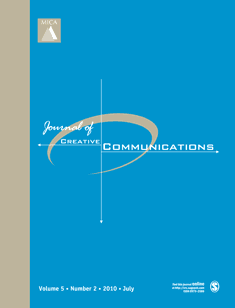
Journal of Creative Communications
Advancing Scholarly Excellence in Creative DiscourseThe Journal of Creative Communications, published by SAGE PUBLICATIONS INC, stands as a prominent forum within the field of communication, holding a Q2 rank in the Communication category according to the 2023 metrics. With an ISSN of 0973-2586 and an E-ISSN of 0973-2594, this journal offers a comprehensive exploration of inventive communication practices, theories, and methodologies, making it a vital resource for researchers, professionals, and students alike. Since its inception in 2006, the journal has been committed to fostering innovative discourse and scholarly excellence, as evidenced by its Scopus ranking at #157 of 511 in Social Sciences – Communication, placing it in the 69th percentile. While the journal does not currently offer open access options, it continues to maintain a high impact factor through rigorously peer-reviewed contributions. As it converges towards 2024, the Journal of Creative Communications seeks to elevate the discourse surrounding contemporary communication issues, pushing the boundaries of creativity and inquiry in an ever-evolving landscape.

Information Communication & Society
Navigating the Intersections of Society and Digital InnovationInformation Communication & Society, published by Routledge Journals, Taylor & Francis Ltd, is a premier journal in the fields of communication and library and information sciences, boasting an impressive impact factor and consistently high rankings in Scopus, including Rank #18/511 in Communication and Rank #14/280 in Library and Information Sciences for 2023. With its focus on the dynamic interplay between information technology and society, the journal serves as a vital platform for researchers, professionals, and students, facilitating the discussion of contemporary issues that shape digital environments. Since its inception in 2001 and converging from 2005 to 2024, the journal has maintained a rigorous peer-review process to ensure that it publishes high-quality research that contributes to ongoing debates and developments in the digital age. Although it does not offer open access, the journal's esteemed reputation and Q1 categorization underscore its impact within the academic community, making it an essential resource for anyone interested in the evolution of communication in the modern world.

Fonseca-Journal of Communication
Elevating Research Impact in Communication and Social SciencesFonseca-Journal of Communication, published by EDICIONES UNIV SALAMANCA in Spain, serves as a vital platform for the dissemination of scholarly research in the fields of Communication, Linguistics, and Social Sciences. Since its transition to Open Access in 2010, this journal has ensured that innovative ideas and research findings are accessible to a global audience, fostering knowledge exchange among researchers, professionals, and students alike. With an impressive ranking in various categories—Q3 in Communication, Q2 in Linguistics and Language, and Q3 in Social Sciences—the journal reflects its commitment to excellence and relevance in contemporary academic discourse. Its Scopus rankings confirm its growing impact in the linguistic and social research spheres, making it a valuable resource for those seeking to advance their understanding and contribute to scholarship in these fields. Through its rigorous peer-review process and diverse content, Fonseca aims to stimulate critical conversations and inspire future research.

Information Technology & People
Bridging technology and human experience.Information Technology & People is a renowned academic journal published by Emerald Group Publishing Ltd, dedicated to advancing insights in the intersection of technology, organizational context, and human behavior. Established in 1990, the journal has extensively contributed to the field of Computer Science Applications, Information Systems, and Library and Information Sciences, reflecting top-tier research as evidenced by its Q1 quartile ranking in 2023 across these categories. With a notable Scopus ranking, including a percentile of 91st in Library and Information Sciences, it serves as an essential resource for researchers, professionals, and students eager to explore contemporary issues and innovations in the deployment and impact of information technology on society. While not operating under an open access model, the journal provides a gateway to pivotal studies and findings that shape the future of IT and its implications for people and organizations. Located in the United Kingdom, Information Technology & People continues to be a vital platform for disseminating cutting-edge research that bridges the gap between technology and human experience.
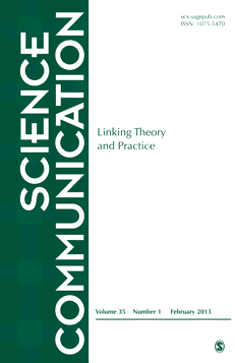
SCIENCE COMMUNICATION
Advancing the Dialogue Between Science and SocietySCIENCE COMMUNICATION is a premier journal that has established itself as a vital platform for the exploration of the intersection between science, society, and communication practices. Published by SAGE Publications Inc, this journal boasts a commendable impact within the field, evidenced by its 2023 ranking as Q1 in Sociology and Political Science, placing it in the top percentile of its category. With an impressive Scopus rank of 14 out of 1466 in the social sciences domain, it serves as an essential resource for researchers, professionals, and students dedicated to understanding how scientific information is communicated and perceived across various platforms and audiences. Spanning a rich publication history from 1979 to 2024, SCIENCE COMMUNICATION publishes original research, case studies, and reviews that contribute to the development of effective communication strategies in science. Although the journal does not currently offer open access options, its content remains pivotal for fostering informed discourse within academia and beyond. Engaging with this journal is invaluable for anyone interested in enhancing science literacy and engagement in contemporary issues.