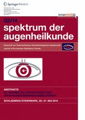
Spektrum der Augenheilkunde
Scope & Guideline
Shaping the Future of Ophthalmic Medicine
Introduction
Aims and Scopes
- Clinical Ophthalmology Research:
The journal emphasizes research that contributes to clinical practices in ophthalmology, including studies on surgical techniques, patient outcomes, and novel treatment approaches. - Innovative Diagnostic Techniques:
There is a strong focus on the development and evaluation of innovative diagnostic methods, such as imaging technologies and biomarker assessments, to enhance the understanding and treatment of ocular diseases. - Multidisciplinary Approach to Eye Diseases:
The journal encourages interdisciplinary research that integrates aspects of immunology, genetics, and systemic diseases, highlighting the complex interactions between systemic health and ocular conditions. - Patient-Centric Studies:
Research that addresses patient experiences, satisfaction, and quality of life in relation to eye disease management is a core focus, emphasizing the importance of patient involvement in treatment decisions. - Educational Contributions:
The journal also serves as a platform for educational content, providing resources and reviews that support the ongoing education of ophthalmologists and related healthcare professionals.
Trending and Emerging
- Uveitis and Related Conditions:
An increasing number of publications focus on various forms of uveitis, including diagnostic challenges and treatment strategies, reflecting a growing recognition of the complexity and significance of these conditions in ophthalmology. - Impact of Systemic Diseases on Ocular Health:
Research exploring the connections between systemic diseases (e.g., diabetes, autoimmune disorders) and ocular health is on the rise, emphasizing the importance of a holistic approach to patient care. - Technological Innovations in Eye Surgery:
The journal is witnessing a surge in studies related to new surgical techniques and technologies, such as minimally invasive procedures and advanced imaging, which are transforming standard practices in ophthalmic surgery. - Patient-Reported Outcomes in Eye Care:
There is a notable trend towards incorporating patient-reported outcomes and experiences into ophthalmological research, highlighting the shift towards patient-centered care models. - Ocular Surface Disease and Dry Eye Management:
Research focused on ocular surface disease, including innovative treatments and management strategies for dry eye conditions, is increasingly prevalent, reflecting the growing awareness of these common yet often overlooked issues.
Declining or Waning
- Historical Perspectives in Ophthalmology:
Recent issues show a reduced emphasis on historical analyses of ophthalmology as a discipline, suggesting a shift towards contemporary clinical and technological advancements. - Basic Research in Ocular Pathophysiology:
There appears to be a waning interest in fundamental research focused solely on the underlying biological mechanisms of eye diseases, as more emphasis is placed on translational and applied research. - Review Articles on Established Treatments:
The frequency of review articles discussing well-established treatments and protocols has decreased, indicating a potential shift towards exploring newer therapeutic approaches and clinical trials. - Theoretical Studies Without Clinical Application:
The journal has seen fewer publications that focus on purely theoretical studies lacking direct clinical application, as there is a growing emphasis on research that can translate into practical outcomes for patient care.
Similar Journals
OPHTHALMIC PLASTIC AND RECONSTRUCTIVE SURGERY
Advancing surgical excellence in ophthalmic care.Ophthalmic Plastic and Reconstructive Surgery is a premier academic journal dedicated to the advancement of knowledge in the fields of ophthalmology, plastic surgery, and reconstructive techniques. Published by Lippincott Williams & Wilkins, this esteemed journal boasts an impact factor that positions it among the top resources in its category, with a 2023 ranking of Q3 in both Medicine (Miscellaneous) and Ophthalmology, and Q2 in Surgery. Established in 1984 and continuing through 2024, it serves as an essential platform for researchers and clinicians, presenting cutting-edge studies and innovative practices that enhance patient care and surgical outcomes. While the journal is not open access, its rigorous peer-review process ensures the publication of high-quality, relevant research, appealing to a diverse audience of professionals and students committed to excellence in ophthalmic surgery. With its comprehensive scope and dedication to emerging trends, Ophthalmic Plastic and Reconstructive Surgery remains a vital resource for those seeking to expand their knowledge in surgical advancements and patient management within the field.
JOURNAL FRANCAIS D OPHTALMOLOGIE
Fostering collaboration in the global ophthalmological community.JOURNAL FRANCAIS D OPHTALMOLOGIE, published by MASSON EDITEUR, is a prominent peer-reviewed journal that serves as a vital resource in the field of ophthalmology. Launched in 1978, this esteemed publication continues to make significant contributions to the advancement of ocular health and vision science, with its scope encompassing clinical practices, innovative research, and the latest technological advancements in ophthalmic care. Based in France, the journal is recognized in the 2023 category quartiles with a Q3 ranking in ophthalmology, reflecting its dedication to quality scholarship within a competitive landscape, as evidenced by its positioning in the 30th percentile of the Scopus rankings. While it operates without Open Access, the journal remains crucial for professionals, researchers, and students alike, providing a platform for sharing knowledge and fostering collaborations in the global ophthalmological community.
SURVEY OF OPHTHALMOLOGY
Shaping the Future of Eye Care ResearchSURVEY OF OPHTHALMOLOGY is a premier journal published by Elsevier Science Inc, dedicated to advancing knowledge in the field of ophthalmology. With an impact factor reflective of its high-quality research—ranking 7th out of 137 in the Scopus category for medicine and ophthalmology, this journal maintains a prestigious Q1 categorization in its field for 2023. Since its inception in 1956, the journal has provided comprehensive reviews and original articles covering various aspects of ophthalmic research and clinical practice, supporting the ongoing education of researchers, professionals, and students alike. While open access options are not available, the journal remains an essential resource for the latest developments, discoveries, and expert insights that shape the future of eye health. Based in the United States, at STE 800, 230 Park Ave, New York, NY 10169, the journal continues a legacy of excellence in ophthalmology until 2024 and beyond, making it a pivotal element of scholarly discourse in this vital medical discipline.
Clinical and Experimental Optometry
Exploring the forefront of optometry and ophthalmology.Clinical and Experimental Optometry, published by Taylor & Francis Ltd, is a distinguished journal dedicated to advancing the field of optometry and ophthalmology. With an impressive scope covering both clinical practices and experimental research, this journal serves as a vital resource for researchers, healthcare professionals, and students alike. Recognized in the Q2 category for Ophthalmology and Q1 category for Optometry in 2023, it underscores its significance in fostering innovative research and clinical knowledge. The journal has been in publication since 1986 and continues to accept contributions up until 2024, reflecting its ongoing commitment to disseminating high-quality scholarly work. With a Scopus ranking of 40 in Ophthalmology and 5 in Health Professions - Optometry, it is positioned among the leading journals in the field. Although not an open-access journal, it remains integral for anyone invested in the latest trends and findings in vision science, making it an essential part of the academic landscape in the UK and beyond.
JAPANESE JOURNAL OF OPHTHALMOLOGY
Empowering Eye Health Through Innovative ResearchJapanese Journal of Ophthalmology, published by Springer Japan KK, is a premier peer-reviewed journal dedicated to advancing the field of ophthalmology. With an impressive impact reflected in its Q1 categories—ranking among the top journals in both Medicine (miscellaneous) and Ophthalmology, as per the 2023 metrics—it serves as an essential platform for researchers and professionals to disseminate their findings. Covering a broad spectrum of topics from clinical studies to innovative technologies in eye care, this journal not only supports the ongoing education of its readership but also fosters significant developments within the field. The journal, which has been in circulation since 1973 and is set to continue through 2024, offers access to vital research, thereby enabling practitioners and scholars to keep abreast of the latest advancements. Its distinguished Scopus ranking of #30 out of 137 in Medicine - Ophthalmology, placing it in the 78th percentile, further underscores its influence and importance in contributing to the global understanding of eye health.
Augenheilkunde Up2date
Advancing Insights in Ophthalmology.Augenheilkunde Up2date is a pivotal journal in the field of ophthalmology, published by GEORG THIEME VERLAG KG, a renowned publisher known for its commitment to advancing medical knowledge. With its ISSN 1616-9719 and E-ISSN 1616-9735, this journal serves as a vital resource for researchers, professionals, and students interested in the latest developments and nuanced discussions in eye health. Although not available as open access, its curated content offers significant insights into contemporary research, clinical practices, and emerging trends in ophthalmology, thus promoting the continuous professional development of its readers. There is an emphasis on providing comprehensive reviews that encapsulate the pertinent advancements in the field, making it an essential publication for those aiming to enhance their expertise in eye care and vision science.

Asia-Pacific Journal of Ophthalmology
Shaping the future of ophthalmology, one study at a time.Asia-Pacific Journal of Ophthalmology is a distinguished open access journal published by the Asia-Pacific Academy of Ophthalmology (APAO), specializing in the latest advancements and research in ophthalmology. Since its inception in 2013, this journal has established itself as a vital platform for disseminating innovative findings and clinical practices across the Asia-Pacific region and beyond. With an impressive Scopus ranking of #10 out of 137 in the field of Medicine (Ophthalmology), placing it in the 93rd percentile, it garners significant attention and respect within the academic community. Currently holding a Q1 categorization in both Medicine (miscellaneous) and Ophthalmology, the journal embraces a broad scope that encompasses clinical studies, experimental research, and reviews aimed at enhancing the understanding and management of eye health. Its open access model since 2019 ensures that all published works are freely accessible, promoting greater collaboration and knowledge sharing among researchers, clinicians, and students. Situated in the Netherlands with a prominent address in Hong Kong, the journal serves as an essential resource for anyone dedicated to the field of ophthalmology.
Journal of the Korean Ophthalmological Society
Connecting Scholars to Transform Vision ScienceThe Journal of the Korean Ophthalmological Society, with ISSN 0378-6471 and E-ISSN 2092-9374, is a pivotal resource in the field of ophthalmology, published by the esteemed Korean Ophthalmological Society. Based in South Korea, this journal is committed to advancing knowledge in ophthalmology through the dissemination of research that spans both clinical and experimental studies. Despite its current Q4 ranking in the 2023 Ophthalmology category, it serves as a crucial platform for emerging scholars, practitioners, and students seeking to contribute to and learn from the latest developments in eye care. While the journal does not currently offer open access, it is dedicated to fostering scientific dialogue and innovation within the community. With convergence years from 2018 to 2024, the journal's focus on contemporary issues in ophthalmology positions it as a relevant and timely source of information, critical for those engaged in this dynamic field. For further inquiries, the journal can be contacted at their address in Seoul, South Korea: SKY 1004 BLDG 701, 50-1 Jungnim-ro, Jung-gu, 04508.
CANADIAN JOURNAL OF OPHTHALMOLOGY-JOURNAL CANADIEN D OPHTALMOLOGIE
Illuminating the future of vision care.Canadian Journal of Ophthalmology - Journal Canadien d'Ophtalmologie, published by the prestigious Canadian Ophthalmological Society, serves as a leading platform for disseminating cutting-edge research in the field of ophthalmology. With an ISSN of 0008-4182 and E-ISSN 1715-3360, the journal boasts a commendable impact factor and maintains a strong presence within the medicine and ophthalmology categories, ranking in the Q2 quartile. This journal not only provides significant insights into clinical practices and advancements but also contributes to the understanding of ocular health issues facing contemporary society. Since its inception in 1966, it has published high-quality research, making substantial strides in both practical and theoretical aspects of ophthalmology until 2024. Although it is not an open-access journal, it establishes a vital resource for researchers, professionals, and students alike, fostering an informed community dedicated to improving vision care.
INTERNATIONAL OPHTHALMOLOGY
Advancing Vision Science, One Study at a Time.International Ophthalmology is a prestigious journal published by Springer, dedicated to advancing the field of ophthalmology through the dissemination of high-quality research and clinical studies. With an ISSN of 0165-5701 and an E-ISSN of 1573-2630, this journal has been a vital resource since its inception in 1978, serving the global community of ophthalmologists, researchers, and healthcare professionals. The journal holds a significant Q2 ranking in the category of ophthalmology and has achieved a commendable position as #56 in Scopus's rankings, placing it within the top tier of its field. Although it does not offer open-access options, articles published in International Ophthalmology are widely cited and respected, playing a crucial role in the ongoing dialogue regarding contemporary ophthalmic practices and innovations. With a broad scope covering all aspects of eye care, this journal is essential for those aiming to keep abreast of the latest developments and research findings that shape the future of vision science and clinical practice.