
TRaNS-Trans-Regional and -National Studies of Southeast Asia
Scope & Guideline
Unveiling Cultural and Historical Tapestries of Southeast Asia
Introduction
Aims and Scopes
- Interdisciplinary Research:
The journal promotes research that integrates various disciplines such as economics, sociology, political science, and environmental studies, reflecting the complex interrelations within Southeast Asia. - Socio-Economic Dynamics:
Research focusing on the socio-economic transformations in Southeast Asia, including studies on economic development, poverty alleviation, and social inequality, is a core area of interest. - Cultural Studies:
The journal emphasizes contributions that explore the rich cultural heritage of Southeast Asia, including studies on identity, migration, and the impact of globalization on local cultures. - Political Analysis:
The examination of political systems, governance, and regional conflicts is central to the journal's scope, addressing both historical and contemporary issues affecting Southeast Asia. - Environmental and Sustainability Studies:
Research on environmental challenges, sustainability practices, and climate change impacts in Southeast Asia is increasingly prioritized, reflecting global concerns about ecological preservation.
Trending and Emerging
- Digital Transformation and Technology:
There is an increasing emphasis on how digital technologies are transforming economies and societies in Southeast Asia, with research exploring the implications of digitalization for governance, business, and social interactions. - Migration and Mobility:
Studies on migration, both internal and international, are gaining prominence, focusing on the socio-economic implications of labor migration, refugee movements, and diaspora communities. - Environmental Justice and Sustainability:
Emerging research on environmental justice addresses the unequal impacts of climate change and environmental degradation, emphasizing the need for sustainable development practices. - Regional Cooperation and Integration:
There is a growing interest in the dynamics of regional cooperation within Southeast Asia, particularly in the context of ASEAN and transnational collaborations addressing common challenges. - Health and Pandemic Responses:
The COVID-19 pandemic has spurred a surge in research related to health systems, public health responses, and the socio-economic impacts of health crises in the region.
Declining or Waning
- Traditional Historical Studies:
There has been a noticeable decrease in papers focused solely on traditional historical narratives, indicating a shift towards more contemporary issues and interdisciplinary approaches. - Nationalism and Statehood:
Research centered exclusively on nationalism and statehood in Southeast Asia is appearing less frequently, possibly due to the growing focus on transnational issues and regional integration. - Economic Growth Models:
While economic studies remain prevalent, traditional models of economic growth that do not incorporate sustainability or social equity considerations are declining, as newer frameworks gain traction. - Crisis Management and Conflict Resolution:
Papers focusing on crisis management and conflict resolution specific to historical conflicts are becoming less common, overshadowed by broader studies on peace-building and regional cooperation.
Similar Journals

Contemporary Southeast Asia
Advancing Understanding of Southeast Asia's ComplexitiesContemporary Southeast Asia is a leading academic journal published by the Institute of Southeast Asian Studies (ISEAS), Singapore, offering insightful analyses and discussions on the dynamic socio-political landscape of Southeast Asia. With an ISSN of 0129-797X and an E-ISSN of 1793-284X, this journal has been a significant contributor to the fields of Development, History, Political Science, and Sociology since its inception in 1979, and it continues to shape discourse through its robust publication record extending into 2024. The journal holds prestigious rankings, including Q2 in Development and Political Science, Q1 in History, and Q2 in Sociology, reflecting its rigorous scholarship and impact in the academic community. Researchers, professionals, and students will find valuable resources within its articles that address critical issues pertinent to the region, fostering a deeper understanding of Southeast Asia’s role in global contexts. Although the journal currently does not provide Open Access options, its contributions remain invaluable to those engaged in the study of this vibrant and diverse area.

Inner Asia
Cultivating Insight into Overlooked RegionsInner Asia, a distinguished journal published by BRILL, serves as a vital platform for scholarly discourse in the interdisciplinary fields of Anthropology, Arts and Humanities, Development, and Geography, Planning and Development. Since its inception in 1999, this peer-reviewed journal has facilitated in-depth research and analysis of the diverse cultures, histories, and socio-economic issues pertaining to Inner Asia, contributing significantly to the comprehension of this often-overlooked region. Although it currently operates without open access, the journal is committed to rigorous academic standards, as evidenced by its recent rankings—placing within the Q3 and Q4 categories across multiple relevant disciplines, denoting its solid reputation among global academic circles. Researchers, professionals, and students alike rely on its comprehensive studies to inform their work and expand their understanding of the complexities of Inner Asia, ultimately fostering greater interdisciplinary dialogue and collaboration.

Journal of International Studies-JIS
Advancing Global Understanding Through Scholarly InsightsJournal of International Studies (JIS), published by UNIV UTARA MALAYSIA PRESS, stands as a vital source of scholarly insights in the realms of Political Science, International Relations, Business, and Management. With an ISSN of 1823-691X and E-ISSN 2289-666X, this Open Access journal, accessible since 2005, encourages the dissemination of knowledge without barriers. Based in Malaysia, JIS has gained recognition for its rigorous peer-review process, marking its impact in diverse categories: Q4 in Business and International Management, Q3 in Political Science and International Relations, and Q4 in Strategy and Management as per the 2023 category quartiles. Though it holds ranks in the 30th and 11th percentiles across Scopus categories, its commitment to publishing high-quality research renders it an essential platform for scholars and practitioners striving to engage with contemporary global issues. Researchers, professionals, and students alike will find value in their contributions that aim to foster greater understanding and collaboration in the interconnected fields of international studies.
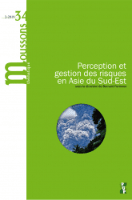
Moussons-Recherche en Sciences Humaines sur l Asie du Sud-Est
Connecting Scholars to the Heart of Southeast AsiaMoussons-Recherche en Sciences Humaines sur l'Asie du Sud-Est is a distinguished academic journal dedicated to the exploration and analysis of the diverse cultural, social, and historical dynamics influencing Southeast Asia. Published by the UNIV PROVENCE AIX-MARSEILLE I, PRESSES UNIV, this journal has been an essential resource for researchers, students, and professionals since its establishment. As an Open Access publication since 2004, Moussons provides a platform for unrestricted access to cutting-edge research and scholarly discourse on Southeast Asian studies, thereby fostering a global academic community. With a commitment to advancing knowledge in the humanities, this journal aims to enhance understanding of the region's complexities and its significance in a broader global context. The journal's ISSN is 1620-3224 and its E-ISSN is 2262-8363, with publication location in Aix-en-Provence, France. Engage with Moussons to contribute to and benefit from the expanding field of Southeast Asian research.
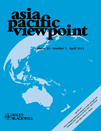
Asia Pacific Viewpoint
Unveiling the Forces Shaping Asia-Pacific FuturesAsia Pacific Viewpoint, published by WILEY, is a leading academic journal dedicated to the exploration of social, economic, and environmental dynamics within the Asia-Pacific region. With an ISSN of 1360-7456 and E-ISSN of 1467-8373, this esteemed journal spans from 1996 to 2024, contributing invaluable insights into the fields of Development and Geography, Planning, and Development. Recognized for its rigorous scholarship, it holds a respectable Q2 ranking in both Development and Geography categories as of 2023, and reflects its impact in the Scopus rankings—standing at #83/306 and #240/821 in their respective fields. Although it does not offer open access, the journal remains a crucial resource for researchers, professionals, and students aiming to understand the complexities shaping the Asia-Pacific landscape. The journal is headquartered in the United Kingdom, further solidifying its commitment to high-quality, international research that drives discussions and informs policy-making across diverse sectors.

Zhurnal Novaya Ekonomicheskaya Assotsiatsiya-Journal of the New Economic Association
Elevating Research Standards in Economic StudiesZhurnal Novaya Ekonomicheskaya Assotsiatsiya-Journal of the New Economic Association, published by CONSAS CONFERENCE, is a pivotal platform for advancing research in the fields of economics and finance. With an ISSN of 2221-2264, this journal facilitates the dissemination of innovative and insightful research findings that contribute to the understanding of contemporary economic issues. Operating as an open-access journal, it ensures broad accessibility for researchers, professionals, and students engaged in economic studies. The journal’s recent recognition within the Q4 category in Economics and Econometrics, alongside a Q3 classification in Finance for 2023, highlights its growing significance within the academic community. Despite its relatively nascent journey from 2016 to 2024, the journal, based in the Russian Federation with an address at VAN DER STERR BLDG, RHODES DR, MOWBRAY 7785, SOUTH AFRICA, contributes crucial scholarly dialogue by welcoming diverse perspectives and methodologies. By prioritizing rigorous research and comprehensive review processes, it aims to elevate the standards of economic discourse and facilitate impactful exchanges among scholars worldwide.
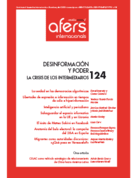
Revista CIDOB d Afers Internationals
Fostering collaboration and insight in international affairs.Revista CIDOB d Afers Internationals is a distinguished academic journal published by FUNDACIO CIDOB, specializing in the fields of Political Science and International Relations. Since its establishment, the journal has embraced an Open Access model, allowing unrestricted access to its content since 1998, thereby fostering global dissemination and collaboration among researchers and professionals. Based in Barcelona, Spain, the journal is recognized for its rigorous scholarship, achieving a Q2 quartile ranking in the 2023 category of Political Science and International Relations. With a Scopus rank of #361 out of 706 in the relevant field, it operates within an impactful academic framework that encourages innovative thought and analysis from its contributors. The periodical hosts a broad array of articles that delve into contemporary global issues, making it an indispensable resource for students, academics, and practitioners seeking to deepen their understanding of international affairs. As the journal looks ahead, it continues to evolve, converging academic insight from 2016 to 2024 and beyond, inviting scholars to contribute to the ever-expanding discourse on international relations.
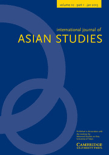
International Journal of Asian Studies
Engaging with the Dynamics of Asian SocietiesThe International Journal of Asian Studies, published by Cambridge University Press, stands as a pivotal platform for scholars exploring the complexities and dynamics of Asian societies. With an ISSN of 1479-5914 and an E-ISSN of 1479-5922, this journal began its journey in 1996 and has actively contributed to the field through a range of multidisciplinary research articles, fostering engagement in both the Arts and Humanities and Social Sciences. Holding a respectable Q2 category in Arts and Humanities and a Q3 category in Social Sciences for the year 2023, it is recognized for its critical insights and scholarly contributions, earning a rank of 40/173 in Arts and Humanities and 174/275 in Social Sciences within Scopus metrics. Researchers seeking to address contemporary issues in Asian studies will find invaluable access to this forum, which not only presents rigorous academic discourse but also aims to bridge cultural and social narratives across the Asian continent.
SOJOURN-Journal of Social Issues in Southeast Asia
Analyzing the Pulse of Southeast Asian CommunitiesSOJOURN - Journal of Social Issues in Southeast Asia is a distinguished academic publication that has been at the forefront of exploring and analyzing the complex social issues within the Southeast Asian region since its inception. Published by the Institute of Southeast Asian Studies (ISEAS)Anthropology, Sociology, and Political Science. With its ISSN 0217-9520 and E-ISSN 1793-2858, SOJOURN holds a Q3 ranking in both anthropology and sociology categories, reflecting its significant contribution to the literature and its commitment to enhancing understanding of the societal dynamics in Southeast Asia. Although currently not an open-access journal, it provides a vital platform for researchers, professionals, and students dedicated to looking beyond surface issues and diving deep into the cultural and political landscapes of the region. As the journal continues to publish until 2024, it remains an essential resource for knowledge and scholarship, fostering academic dialogue and innovative research in a rapidly evolving socio-political environment.

European Spatial Research and Policy
Empowering Researchers and Policymakers with Open Access KnowledgeEuropean Spatial Research and Policy, published by LODZ UNIV PRESS, is a distinguished Open Access academic journal that has been contributing to the field of Geography, Planning, and Development since its inception in 2009. With an ISSN of 1231-1952 and an E-ISSN of 1896-1525, this journal has established itself as a vital resource for researchers and policymakers in understanding spatial dynamics and policy implications across Europe. Recognized within the 2023 Q2 category for Geography, Planning, and Development, it ranks impressively #236 out of 821 in its category on Scopus, placing it in the 71st percentile. The journal’s aim is to foster interdisciplinary dialogue and disseminate innovative research that addresses pressing spatial challenges. Since transitioning to Open Access in 2013, it has enhanced accessibility for scholars, making its rich content readily available to a global audience. Located in Lodz, Poland, European Spatial Research and Policy is poised to continue its commitment to excellence in spatial research, offering critical insights for academics, professionals, and students alike.