
ACTA VETERINARIA SCANDINAVICA
Scope & Guideline
Transforming veterinary research into global knowledge.
Introduction
Aims and Scopes
- Animal Health and Disease Management:
Research on the diagnosis, treatment, and prevention of diseases in domestic and wild animals, including studies on zoonotic diseases and their implications for public health. - Veterinary Surgery and Anesthesia:
Investigations into surgical techniques, postoperative care, and pain management in various species, highlighting advancements in veterinary surgical practices. - Veterinary Epidemiology and Public Health:
Epidemiological studies that assess disease prevalence, risk factors, and the impact of veterinary practices on animal and human health. - Animal Nutrition and Welfare:
Research focusing on the dietary needs of animals, nutritional deficiencies, and their effects on overall health and welfare. - Clinical Veterinary Research:
Clinical studies that provide insights into treatment outcomes, diagnostic methods, and case reports to enhance veterinary practices. - Comparative Medicine:
Studies that explore health issues across different species, providing a broader understanding of veterinary medicine and potential cross-species applications.
Trending and Emerging
- Antimicrobial Resistance:
A significant increase in studies addressing antimicrobial resistance among various animal species is evident, reflecting growing concerns about public health and the need for responsible antibiotic use. - Veterinary Rehabilitation and Pain Management:
Emerging research on rehabilitation techniques and pain management strategies for animals showcases a rising interest in improving the quality of life for both companion and farm animals. - One Health Approach:
The integration of animal health, human health, and environmental health into a cohesive research framework is gaining traction, emphasizing the interconnectedness of these fields. - Genetic and Molecular Studies:
There is a growing emphasis on genetic research, including studies on breed-specific diseases and genetic predispositions, which aim to enhance animal breeding and health management. - Animal Welfare Assessment:
Increased focus on animal welfare metrics and assessments reflects the growing public interest in humane treatment and the ethical implications of veterinary practices.
Declining or Waning
- Traditional Veterinary Practices:
Research focused on conventional veterinary practices and methods appears to be declining, possibly as the field moves towards more innovative and evidence-based approaches. - Basic Research in Animal Physiology:
Studies concentrated solely on fundamental physiological mechanisms without direct clinical applications are becoming less frequent, as there is a growing emphasis on translational research. - Invasive Animal Research:
There is a noticeable decrease in studies involving invasive techniques on animals, likely due to ethical considerations and the push for non-invasive methods in veterinary research. - Historical Case Studies:
Papers detailing historical veterinary cases or practices are less common, as contemporary research tends to prioritize current challenges and advancements in veterinary medicine.
Similar Journals

Large Animal Review
Advancing veterinary science for large animals.Large Animal Review is a prestigious academic journal dedicated to advancing the field of veterinary science, particularly focusing on the health and management of large animals. Published by the SIVAR-SOC ITALIANA VETERINARI ANIMALI REDDITO, this journal is an invaluable resource for researchers, practitioners, and students eager to explore innovative methodologies, research findings, and case studies related to veterinary medicine for larger species. With a commitment to quality, Large Animal Review holds a Q3 categorization in the Veterinary (miscellaneous) sector according to the 2023 metrics, indicative of its growing influence within the academic community. The journal benefits from an international readership and is dedicated to fostering interdisciplinary collaborations, making it an essential addition to any professional's library. The journal is accessible through various platforms, ensuring wide distribution of its valuable content, as it strives to enhance the understanding and welfare of large animals across diverse settings.
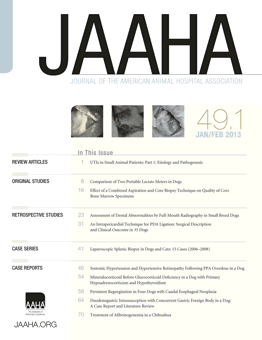
JOURNAL OF THE AMERICAN ANIMAL HOSPITAL ASSOCIATION
Elevating standards in veterinary medicine with cutting-edge insights.JOURNAL OF THE AMERICAN ANIMAL HOSPITAL ASSOCIATION (ISSN: 0587-2871, E-ISSN: 1547-3317), published by the American Animal Hospital Association, is a premier resource for veterinary professionals, researchers, and students focusing on the field of veterinary medicine. Established in 1973, this esteemed journal serves as a vital platform for disseminating cutting-edge research and clinical insights in the management and care of small animals, boasting a remarkable Q1 ranking in Small Animals and a Q2 ranking in Medicine (miscellaneous), reflecting its high impact in the field. With a Scopus rank of #6 in the veterinary small animals category and a 72nd percentile standing, it offers valuable content covering a diverse range of topics pertinent to animal health and welfare. Although not open access, the journal provides essential resources that contribute significantly to the ongoing professional development of veterinary practitioners and the broader scientific community, thus solidifying its status as a cornerstone of veterinary literature.

Thai Journal of Veterinary Medicine
Cultivating excellence in veterinary medicine across Thailand.Thai Journal of Veterinary Medicine, published by Chulalongkorn University, serves as a vital resource for researchers, practitioners, and students in the field of veterinary science. With an ISSN of 0125-6491, the journal has been providing a platform for the dissemination of original research and reviews since its inception, with a focus on advancing veterinary practice and animal health in Thailand and the broader Southeast Asian region. The journal is recognized in the Scopus database, currently ranked in the Q4 category for Veterinary (miscellaneous), reflecting its commitment to quality despite being in a highly competitive space. The scope of the journal encompasses a wide array of topics pertinent to veterinary medicine, ensuring accessibility to diverse veterinary disciplines. While the journal currently does not offer an open-access option, it remains dedicated to contributing valuable knowledge and insights to the veterinary community, supporting the improvement of animal welfare and public health initiatives in the region. As it continues to publish until 2024, the Thai Journal of Veterinary Medicine invites contributions that align with its objectives of fostering scholarly discourse and advancing veterinary research.

AUSTRAL JOURNAL OF VETERINARY SCIENCES
Connecting Scholars to Transform Veterinary ScienceAUSTRAL JOURNAL OF VETERINARY SCIENCES is a prominent platform for innovative research in the field of veterinary science, published by UNIV AUSTRAL CHILE, FAC CIENCIAS VETERINARIAS. This journal, bearing the ISSN 0719-8000 and E-ISSN 0719-8132, serves as a vital resource for researchers, veterinarians, and students interested in advancing their knowledge in veterinary practices and animal health. With its influence reflected in its Q3 category ranking in the Veterinary (miscellaneous) field, and its Scopus rank of #95 out of 194, the journal highlights a robust commitment to disseminating valuable findings and insights. Between the years 2017 to 2024, it aims to provide open access to significant advancements and discussions in veterinary science, ensuring that vital research is accessible to a global audience. Located in Valdivia, Chile, the journal emphasizes its role in enhancing veterinary scholarship and fostering professional development within the community.
Journal of the South African Veterinary Association
Advancing Veterinary Science Through Open AccessJournal of the South African Veterinary Association is a prominent Open Access journal dedicated to advancing the field of veterinary science since its inception in 1945. Published by MEDPHARM PUBLICATIONS PTY LTD, this journal stands out with an impactful HIndex and a commendable categorization in 2023, ranking Q3 in Medicine (miscellaneous) and Q2 in Veterinary (miscellaneous). With a Scopus rank of 96 out of 194 in the veterinary field, it serves as an essential resource for researchers, veterinary professionals, and students, promoting the dissemination of high-quality research and knowledge. The journal offers a platform for peer-reviewed articles covering diverse topics relevant to veterinary and animal health issues, encouraging expansive dialogue and collaboration within the academic community. Based in Centurion, South Africa, and accessible globally since it adopted an Open Access model in 1997, the journal exemplifies a commitment to accessibility and the sharing of knowledge.

BERLINER UND MUNCHENER TIERARZTLICHE WOCHENSCHRIFT
Pioneering Research for a Healthier Animal WorldBERLINER UND MUNCHENER TIERARZTLICHE WOCHENSCHRIFT is an esteemed journal in the fields of Veterinary Science and Medicine, published by SCHLUETERSCHE VERLAGSGESELLSCHAFT MBH & CO KG. Since its inception in 1946, this journal has served as a vital platform for advancing knowledge and research in veterinary medicine within Germany and beyond. With a current impact factor that places it in the Q4 category in both Medicine and Veterinary, it continues to provide significant insights for professionals, researchers, and students engaged in the veterinary community. Although it is not an Open Access journal, its rich content contributes to the foundational literature of the field, making it an essential reference. Researchers looking to publish their findings or keep informed on the latest advancements in veterinary and medical practices will find this journal an invaluable resource. It is headquartered in Hannover, Germany, and serves as a testament to the ongoing dedication to veterinary research since the mid-20th century.

ACTA VETERINARIA BRNO
Pioneering Insights in Veterinary Medicine Since 1974ACTA VETERINARIA BRNO is a distinguished journal published by the Veterinární a farmaceutická univerzita Brno in the Czech Republic, focusing on innovative and scholarly research in the field of veterinary sciences. With an established history dating back to 1974, this journal has evolved to maintain its relevance in contemporary veterinary research, as evidenced by its inclusion in Scopus and a respectable Q3 rank in the miscellaneous veterinary category. Despite operating under traditional access models, ACTA VETERINARIA BRNO remains a vital resource for researchers and practitioners seeking to advance their understanding of veterinary medicine and related disciplines. With its commitment to publishing high-quality, peer-reviewed articles, the journal serves as a crucial platform for disseminating significant findings, thereby contributing to the enhancement of animal health and welfare globally.

Revista Romana de Medicina Veterinara
Exploring innovative solutions for animal health.Revista Romana de Medicina Veterinara is a leading peer-reviewed journal dedicated to the field of veterinary medicine, published by the General Association of Romanian Veterinarians. With its ISSN 1220-3173 and E-ISSN 2457-7618, the journal aims to advance the domain of veterinary science through dissemination of high-quality research articles, case studies, and reviews that cover a wide array of topics including animal health, veterinary diagnostics, and treatment methodologies. Although primarily focused on the Romanian veterinary landscape, its scope is designed to engage a global audience of researchers, practitioners, and students seeking to enhance their knowledge and practice in veterinary medicine. The journal is committed to open accessibility, ensuring that vital research is readily available to the academic community without financial barriers, thereby encouraging collaboration and innovation. By providing a platform for cutting-edge veterinary research, Revista Romana de Medicina Veterinara plays a crucial role in fostering advancements that can significantly impact animal health and welfare both locally and internationally.

IRISH VETERINARY JOURNAL
Leading the way in veterinary discoveries and insights.IRISH VETERINARY JOURNAL is a premier open-access publication in the field of veterinary science, established to disseminate high-quality research and innovations that advance the veterinary profession and animal health. Published by BMC since 2004, this journal not only ensures worldwide access to cutting-edge findings but also maintains an impressive ranking as Q1 in the Veterinary (miscellaneous) category according to the 2023 metrics, highlighting its significance and influence. With an impressive Scopus rank of #19/194 and a 90th percentile placement, it provides a robust platform for researchers, professionals, and students alike to engage with the latest studies, reviews, and case reports. The journal's coverage spans from its inception in 1973 to the present, catering to a diverse audience interested in various aspects of veterinary science, ensuring that it remains an essential resource for those passionate about the welfare of animals and the advancement of veterinary practices.
JOURNAL OF VETERINARY MEDICAL SCIENCE
Pioneering Insights for Veterinary Professionals Worldwide.JOURNAL OF VETERINARY MEDICAL SCIENCE, published by the Japan Society of Veterinary Science, serves as a critical platform for advancing the field of veterinary medicine. With an ISSN of 0916-7250 and E-ISSN of 1347-7439, this journal covers a broad spectrum of topics relevant to veterinary science, publishing original research, reviews, and case studies that contribute to the scientific knowledge base and clinical practice. Recognized for its quality, the journal has achieved a Q2 ranking in the Veterinary (miscellaneous) category for 2023, placing it within the top 35% of journals in its field as per Scopus rankings. With a convergence of years spanning from 1991 to 2024, it reflects a rich history of scholarly contributions. Researchers, professionals, and students engaged in veterinary science will find valuable insights and advancements within its pages, significantly supporting their work and enhancing veterinary practices globally. The journal is located at the University of Tokyo, and while it does not currently offer open access, it remains an essential resource in veterinary medical literature.