Analytica Chimica Acta
metrics 2024
Transforming challenges into solutions in chemical analysis.
Introduction
Analytica Chimica Acta is a prestigious peer-reviewed journal published by ELSEVIER, renowned for its significant contribution to the fields of analytical chemistry, biochemistry, environmental chemistry, and spectroscopy. Established in 1947, this journal has solidified its reputation, reflected in its impressive impact factors and Scopus rankings, including a Q1 classification in Analytical Chemistry and Spectroscopy, and a Q2 ranking in both Biochemistry and Environmental Chemistry. With its comprehensive scope, Analytica Chimica Acta aims to publish innovative research, critical reviews, and technical notes that advance the understanding and application of analytical methods. As an essential resource for researchers, professionals, and students alike, it encourages the dissemination of high-quality research that addresses contemporary challenges in chemical analysis and promotes interdisciplinary collaboration. While the journal operates primarily on a subscription basis, it also offers unique opportunities for authors to reach a broad audience and engage in the global scientific discourse.
Metrics 2024
 1.005.705.50234
Metrics History
Rank 2024
Scopus
IF (Web Of Science)
JCI (Web Of Science)
Quartile History
Similar Journals

Chemosensors is a distinguished open-access journal published by MDPI, focusing on the innovative field of analytical chemistry and physical and theoretical chemistry. Since its inception in 2013, the journal has rapidly established itself as a pivotal platform for the dissemination of cutting-edge research related to the development and application of chemical sensors, encompassing various methodologies and technologies that contribute to advancements in diagnostics, environmental monitoring, and industrial applications. Based in Switzerland, the journal operates with a commitment to accessibility, ensuring that all published articles are freely available to a global readership. With a current impact factor that positions it in the Q2 quartile for both Analytical Chemistry and Physical and Theoretical Chemistry, Chemosensors attracts a diverse audience of researchers, professionals, and students eager to explore new findings and foster collaborative efforts in sensor technology and its applications. As it continues to grow, Chemosensors remains devoted to advancing scientific knowledge and innovation in its field, making significant contributions to the global scientific community through its rigorous peer-review process.
Analytical Science Advances
Pioneering Research for Tomorrow's Analytical ChallengesAnalytical Science Advances is a dynamic journal published by WILEY, dedicated to the ever-evolving field of analytical chemistry. With an ISSN of 2628-5452, this open-access platform aims to disseminate high-quality research and insightful reviews that push the boundaries of analytical methodologies and instrumentation. Since its inception in 2020, the journal has gained traction, securing a commendable Q2 ranking in 2023 within its category, highlighting its significance in the scientific community. Currently positioned at Rank #68 out of 156 in Scopus' analytical chemistry category, it boasts a 56th percentile ranking, reflecting its contributions to advancing analytical techniques. Researchers, professionals, and students will find this journal an invaluable resource for keeping abreast of the latest developments, emerging technologies, and innovative approaches in analytical science, ensuring the journal's relevancy and influence in shaping future discoveries.
Open Chemistry
Pioneering Open Access to Cutting-Edge Chemical InsightsOpen Chemistry, published by DE GRUYTER POLAND SP Z O O, is a distinguished peer-reviewed journal that has been serving the global chemistry community since its inception. With an ISSN of 2391-5420 and an E-ISSN also of 2391-5420, this open-access journal has been accessible to researchers and practitioners alike since 2015, ensuring a wide dissemination of high-quality research findings. Located in Germany, specifically at BOGUMILA ZUGA 32A STR, 01-811 WARSAW, MAZOVIA, POLAND, Open Chemistry aims to publish innovative research across various chemical disciplines, with special attention to miscellaneous chemistry and materials chemistry. It is currently ranked in the Q3 category for both fields as of 2023, reflecting its solid standing within the academic community, with specific ranks of 187/408 in General Chemistry and 153/317 in Materials Chemistry, corresponding to respective percentiles of 54 and 51. Open Chemistry not only enhances the accessibility of cutting-edge research but also serves as a vital resource for students, professionals, and scholars seeking to advance their knowledge in the rapidly evolving landscape of chemical sciences.
Chemistry Journal of Moldova
Fostering Knowledge: Open Access to Transformative Chemical ResearchChemistry Journal of Moldova is a pioneering open-access journal dedicated to fostering the dissemination of significant research in the diverse fields of chemistry, including Environmental Chemistry, Process Chemistry and Technology, and more. Published by the esteemed Academia Sciences Moldova, Institute of Chemistry, this journal has been at the forefront of scientific inquiry since its establishment in 2006. With an ISSN of 1857-1727 and a digital presence through its E-ISSN of 2345-1688, it provides an accessible platform for researchers, students, and professionals to share and engage with cutting-edge findings. Although currently ranked in the Q4 quartile in several chemistry categories, the journal is committed to improving its impact within the academic community and aims to highlight emerging trends and technologies in the chemistry domain. The journal's office is located at 3 Academiei Str, Chisinau MD-2028, Moldova. As it converges its publication years from 2016 to 2024, the Chemistry Journal of Moldova invites all contributors and readers to explore its rich repository of research that bridges innovative ideas to practical applications.
ANALYTICAL LETTERS
Empowering Scientists with Cutting-edge FindingsANALYTICAL LETTERS is a reputable journal published by Taylor & Francis Inc, focusing on the dynamic fields of analytical chemistry, biochemistry, and clinical biochemistry. With an ISSN of 0003-2719 and an E-ISSN of 1532-236X, the journal has been a platform for scholarly articles since its inception in 1967, and is set to continue its contribution to the scientific community until 2024. Despite its classification in Q3 across various categories as of 2023, including analytical chemistry and spectroscopy, ANALYTICAL LETTERS maintains a significant impact within its field, evidenced by its moderate rankings within Scopus. This journal serves as a vital resource for researchers and professionals seeking to explore recent advancements in analytical methodologies, instrumentation, and applications, facilitating the dissemination of critical insights in laboratory practices. With access primarily through institutional subscriptions, it remains positioned as a crucial tool for those advancing knowledge and innovation in analytical sciences.
Bulletin of the University of Karaganda-Chemistry
Elevating Academic Discourse in the World of ChemistryBulletin of the University of Karaganda-Chemistry is an esteemed academic journal published by KARAGANDA STATE UNIVERSITY, focusing on the field of chemistry and related disciplines. With an ISSN of 2518-718X and an E-ISSN of 2663-4872, this journal aims to disseminate high-quality research articles, reviews, and scholarly discussions that contribute to the advancement of knowledge in chemistry. Although it has experienced a transition in its coverage from 2021 to 2022, the journal remains a significant platform for researchers and students alike, promoting open access to its valuable content. Despite its current Scopus rank of #379/407 in the general chemistry category, the Bulletin of the University of Karaganda-Chemistry serves as a vital resource for the academic community in Kazakhstan and beyond, fostering collaboration and innovation in various chemical research domains. Researchers, professionals, and students are encouraged to engage with the journal as it continues to evolve and contribute to significant scientific discussions.
Brazilian Journal of Analytical Chemistry
Bridging Gaps in South American Analytical ScienceBrazilian Journal of Analytical Chemistry, published by VISAO FOKKA COMMUNICATION AGENCY, serves as a vital platform for those engaged in the field of analytical chemistry, especially within the Latin American context. With an ISSN of 2179-3425 and an E-ISSN of 2179-3433, this journal aims to promote high-quality research and advancements in analytical methodologies, instrumentation, and applications spanning from 2010 to the present. Although it currently holds a Q4 rank in Analytical Chemistry by Scopus and is placed at the 24th percentile, its commitment to open access publishing provides invaluable opportunities for widespread dissemination of knowledge, catering to researchers, professionals, and students alike. The journal's editorial board comprises emerging and established experts aiming to bridge gaps in analytical chemistry research, particularly in a Brazilian and broader South American context. Situated in São Paulo, Brazil, the journal's role in fostering innovation and collaboration in analytical techniques makes it an essential resource for the academic community.
ANALYTICAL AND BIOANALYTICAL CHEMISTRY
Unveiling the Complexities of Chemical AnalysisANALYTICAL AND BIOANALYTICAL CHEMISTRY, published by SPRINGER HEIDELBERG, is a leading international journal that serves as a vital platform for innovative research in the fields of analytical and bioanalytical chemistry. With an impressive impact factor and ranking in the Q2 category for both Analytical Chemistry and Biochemistry, the journal highlights key advancements and methodologies that drive the discipline forward. Established in 1996 and continuing vigorously into 2024, it has gained significant recognition with Scopus rankings placing it in the 83rd and 78th percentiles within its categories, underscoring its impact and relevance. The journal's commitment to open access facilitates widespread dissemination of critical scientific knowledge, making it an essential resource for researchers, professionals, and students dedicated to exploring the complexities of chemical analysis. With its base in Heidelberg, Germany, ANALYTICAL AND BIOANALYTICAL CHEMISTRY continues to inspire and influence the global research community.
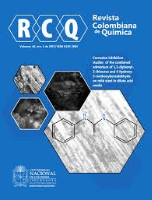
Revista Colombiana de Quimica
Catalyzing Innovation in Chemistry Since 1971.Revista Colombiana de Quimica, published by the Universidad Nacional de Colombia, Departamento de Química, is a distinguished open access journal that has been serving the chemistry community since 1971. With an ISSN of 0120-2804 and an E-ISSN of 2357-3791, this journal presents a platform for researchers, professionals, and students to share and disseminate their findings in the field of chemical sciences. Positioned in the Q4 quartile in the 2023 rankings, this journal focuses on a diverse spectrum of topics within general chemistry, cultivating a rich discourse among scholars and practitioners in Colombia and beyond. Although the journal currently ranks 294 out of 408 in the field, its commitment to open access research ensures that valuable scientific knowledge is accessible to a wider audience, thus facilitating collaboration and advancement in the chemical sciences. As it converges from 2008 to 2022, the Revista Colombiana de Quimica remains a vital resource for anyone looking to contribute to or stay abreast of developments in chemistry.
Separation Science Plus
Connecting scholars to the forefront of separation innovation.Separation Science Plus is an emerging academic journal dedicated to advancing the field of analytical chemistry and separation science. Published by WILEY-VCH Verlag GmbH, this journal provides a platform for researchers to disseminate high-quality studies and reviews that address innovative techniques and breakthroughs in separation methodologies. With its ISSN 2573-1815, the journal has made significant inroads since its inception in 2018, encompassing a convergence period until 2024. Despite currently holding a Q3 ranking in Analytical Chemistry and a Q4 ranking in Filtration and Separation, its dedication to publishing impactful research makes it a vital resource for professionals and students alike. The journal operates under the robust scholarly reputation of WILEY, which is known for its commitment to excellence in scientific communication. Researchers interested in the latest advancements in separation techniques will find Separation Science Plus an essential read, fostering the exchange of knowledge and facilitating greater understanding within this specialized field.