
APPLIED COMPUTATIONAL ELECTROMAGNETICS SOCIETY JOURNAL
Scope & Guideline
Pioneering research for a new era of computational electromagnetics.
Introduction
Aims and Scopes
- Computational Electromagnetics:
Research focusing on numerical methods and algorithms for solving electromagnetic problems, including finite difference time domain (FDTD), finite element methods (FEM), and integral equation techniques. - Antenna Design and Analysis:
Studies involving the design, optimization, and performance analysis of antennas for various applications, including 5G, IoT, and biomedical devices. - Metamaterials and Metasurfaces:
Exploration of new materials with engineered electromagnetic properties, including their applications in antenna technology and electromagnetic shielding. - Wireless Communication Technologies:
Research on advanced techniques and systems for wireless communication, including MIMO systems, beamforming, and energy harvesting. - Electromagnetic Interference and Compatibility:
Investigations into the effects of electromagnetic interference (EMI) on electronic devices and systems, with a focus on mitigation techniques. - Machine Learning and AI in Electromagnetics:
Application of machine learning and artificial intelligence techniques for optimization and predictive modeling in electromagnetics.
Trending and Emerging
- 5G and Beyond Technologies:
A significant increase in research related to 5G communication systems and technologies, including antenna design, MIMO systems, and network optimization, reflects the urgency and relevance of these topics in current research. - AI and Machine Learning Applications:
There is a growing trend towards integrating artificial intelligence and machine learning techniques in electromagnetics for optimization, predictive modeling, and data analysis, highlighting the interdisciplinary nature of modern research. - Energy Harvesting and Wireless Power Transfer:
Emerging research focusing on energy harvesting technologies and wireless power transfer systems showcases the push towards sustainable and efficient energy solutions in the field of electromagnetics. - Biomedical Applications of Electromagnetics:
An increase in studies exploring the application of electromagnetic principles in biomedical technologies, such as imaging and therapeutic devices, underscores the expanding role of electromagnetics in healthcare. - Advanced Metamaterials and Metasurfaces:
Research on innovative metamaterials and metasurfaces is on the rise, particularly in their applications for enhancing antenna performance and electromagnetic manipulation, indicating a vibrant area of exploration.
Declining or Waning
- Traditional Circuit-Based Modeling:
Research that primarily focuses on conventional circuit modeling techniques has decreased, likely due to the increasing complexity of modern systems requiring more sophisticated computational methods. - Low-Frequency Applications:
There is a noticeable decline in studies related to low-frequency electromagnetic applications, as the focus has shifted towards high-frequency and microwave technologies, particularly in relation to 5G and beyond. - Passive Components Design:
Research on passive components like filters and couplers has seen a reduction, potentially due to the growing emphasis on active and reconfigurable components that enable more versatile applications in modern communication systems. - Classical Electromagnetic Theory:
Papers strictly adhering to classical electromagnetic theory without computational advancements are becoming less frequent, indicating a shift towards more applied and computationally intensive research.
Similar Journals
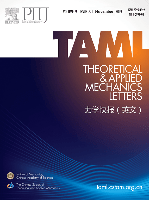
Theoretical and Applied Mechanics Letters
Championing Open Access to Transformative Engineering DiscoveriesTheoretical and Applied Mechanics Letters, published by ELSEVIER, stands as a premier journal in the field of engineering and applied mechanics, recognized for its rigorous peer-reviewed articles that advance theoretical and practical frameworks. With an impressive open access policy established in 2015, the journal enhances global accessibility to cutting-edge research across a range of disciplines including Aerospace, Civil, Mechanical, and Biomedical Engineering, along with Computational Mechanics and Ocean Engineering. The journal boasts an enviable position in the academic landscape, achieving a Q1 rank in several categories as of 2023, while being cited among the top percentiles in Scopus Ranks, specifically ranking #25 in Aerospace Engineering and #15 in Computational Mechanics. The journal aims to foster innovation by providing a platform for scholars and professionals to disseminate their findings, thereby bridging the gap between theoretical research and practical applications. By promoting a diverse range of topics and methodologies, Theoretical and Applied Mechanics Letters not only contributes to the advancement of engineering disciplines but also supports the global academic community in exploring sustainable and impactful engineering solutions.

NUMERICAL HEAT TRANSFER PART B-FUNDAMENTALS
Advancing the Frontiers of Thermal Science.NUMERICAL HEAT TRANSFER PART B-FUNDAMENTALS, published by Taylor & Francis Inc, stands as a pivotal journal in the field of thermal sciences, focusing on the latest research in heat transfer methodologies and numerical simulation techniques. With an ISSN of 1040-7790 and an E-ISSN of 1521-0626, this journal has contributed significantly to advancing knowledge in various specialized areas, including numerical analysis, mechanics of materials, and condensed matter physics, evidenced by its diverse quartile rankings in 2023 across multiple categories. Although it operates under a traditional subscription model, its expansive influence is underscored by its convergence from 1989 to 2024, providing a rich historical context for contemporary research. Researchers, professionals, and graduate students will find this journal an invaluable resource for sharing and accessing critical developments in modeling and simulation techniques and their practical applications in engineering and applied sciences. Continuous engagement with innovative studies published in NUMERICAL HEAT TRANSFER PART B-FUNDAMENTALS ensures that readers remain at the cutting edge of their field.
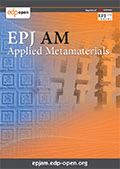
EPJ Applied Metamaterials
Bridging Theory and Application in Metamaterials ScienceEPJ Applied Metamaterials, published by EDP SCIENCES S A, is a leading open-access journal dedicated to the dynamic field of metamaterials and their applications in various domains of physics and engineering. Since its inception in 2014, this journal has provided a vital platform for researchers to share innovative findings and advancements, facilitating the widespread dissemination of knowledge in Condensed Matter Physics, Materials Science, and Mechanics of Materials. With an impressive trajectory towards becoming a significant resource for academia and industry alike, EPJ Applied Metamaterials has achieved a commendable Q3 ranking in relevant categories according to the 2023 metrics, indicating its increasing impact within the scientific community. The journal is committed to fostering open dialogue and collaboration through its open-access model, ensuring that all research is freely accessible to a global audience. Scholars, professionals, and students alike are invited to contribute to this evolving field, harnessing the journal as a means to influence both theoretical and applied metamaterial research.

IEEE Journal of Electromagnetics RF and Microwaves in Medicine and Biology
Exploring the future of RF and microwave applications in health.IEEE Journal of Electromagnetics RF and Microwaves in Medicine and Biology is a premier journal dedicated to advancing the frontiers of research in the interdisciplinary domains of electromagnetics and biomedical applications. Published by the renowned IEEE-INST ELECTRICAL ELECTRONICS ENGINEERS INC in the United States, this journal holds a distinguished reputation, exemplified by its Q1 rankings in the fields of Instrumentation and Radiation, as well as a solid Q2 ranking in Radiology, Nuclear Medicine, and Imaging for 2023. Covering a wide spectrum of topics—from RF and microwave technologies to their applications in medical diagnostics and treatment—the journal aims to foster collaboration among researchers, practitioners, and educators. With a commitment to high-quality peer-reviewed content and a strong impact factor reflecting its extensive reach in the field, the IEEE Journal of Electromagnetics RF and Microwaves in Medicine and Biology serves as an essential resource for professionals and scholars who seek to bridge the gap between engineering and medical sciences. Researchers looking to access cutting-edge findings can benefit from the journal's engagement with contemporary issues in health technology, enhancing both academic and practical knowledge in the evolving landscape of medical electromagnetics.

Progress in Electromagnetics Research M
Connecting Scholars to Shape the Future of ElectromagneticsProgress in Electromagnetics Research M is a prominent journal published by ELECTROMAGNETICS ACADEMY, dedicated to advancing the field of electromagnetics through innovative research, theoretical exploration, and practical applications. With a focus on condensed matter physics and electronic, optical, and magnetic materials, this journal serves as a vital platform for scholars and practitioners seeking to disseminate new findings and methodologies. While it currently holds a Q3 ranking in both aforementioned fields, it offers a valuable contribution to the understanding and development of contemporary technologies. The journal's ISSN is N/A, but its E-ISSN is 1937-8726, ensuring that research is accessible to a global audience. Progress in Electromagnetics Research M aims to foster collaboration and knowledge sharing among researchers, making it an essential resource for anyone interested in the dynamic and evolving area of electromagnetics.
INTERNATIONAL JOURNAL OF RF AND MICROWAVE COMPUTER-AIDED ENGINEERING
Innovating Computer-Aided Design for Tomorrow's TechnologiesInternational Journal of RF and Microwave Computer-Aided Engineering, published by Wiley, is a leading peer-reviewed journal dedicated to advancing research in the realms of radio frequency, microwave engineering, and computer-aided design. With an ISSN of 1096-4290 and an E-ISSN of 1099-047X, this journal plays a pivotal role in the dissemination of innovative methodologies and state-of-the-art developments within these dynamic fields. Recognized within the Q3 category across three engineering and computer science domains as of 2023, it garners attention for its substantial contributions, ranking 40th among 106 in Computer Graphics and Computer-Aided Design and 327th among 797 in Electrical and Electronic Engineering according to Scopus metrics. Emphasizing its commitment to knowledge sharing, the journal provides a range of access options, including Open Access, to ensure the research is readily available to a global audience. Covering years from 1996 to 2024, the International Journal of RF and Microwave Computer-Aided Engineering continues to be an indispensable resource for researchers, professionals, and students in pursuit of excellence in engineering and applied sciences.
INTERNATIONAL JOURNAL OF APPLIED ELECTROMAGNETICS AND MECHANICS
Pioneering Research in Applied Electromagnetics and MechanicsINTERNATIONAL JOURNAL OF APPLIED ELECTROMAGNETICS AND MECHANICS (ISSN: 1383-5416, E-ISSN: 1875-8800) is a prominent peer-reviewed journal published by IOS PRESS, based in the Netherlands. Since its inception in 1996, the journal has established itself as a vital resource for researchers, professionals, and students in the interdisciplinary fields of applied electromagnetics and mechanics, covering a broad spectrum of topics including mechanical engineering, electrical and electronic engineering, as well as condensed matter physics. Although it currently operates under a subscription model, its accessibility and relevance are underscored by its rankings in Scopus across several categories: notably, it ranks in the 34th percentile in Mechanical Engineering and 31st in Electrical and Electronic Engineering. With convergence anticipated until 2024, the journal aims to foster innovative research, promote interdisciplinary collaboration, and provide a platform for the latest advancements in electromagnetics and mechanics, thereby contributing significantly to the academic community and industry practices.

Journal of Electromagnetic Engineering and Science
Exploring New Horizons in Electromagnetic EngineeringThe Journal of Electromagnetic Engineering and Science (ISSN: 2671-7255, E-ISSN: 2671-7263) is a premier Open Access journal published by the Korean Institute of Electromagnetic Engineering & Science. Since its establishment in 2001, it has been dedicated to advancing knowledge in the fields of Electrical Engineering, Electromagnetic Theory, and Communications, making significant contributions to both academia and industry. The journal holds an impressive Q2 quartile ranking in notable categories such as Computer Networks and Communications and Electrical and Electronic Engineering as of 2023, reflecting its robust scientific impact and reputation. It is indexed in Scopus, with commendable rankings in multiple fields, enhancing its visibility and reach among researchers. The journal's open-access model ensures that cutting-edge research is accessible to a global audience, fostering collaboration and innovation. Researchers, professionals, and students in the domain are encouraged to contribute and engage with high-quality articles that cover the latest advancements and trends in electromagnetic engineering and associated sciences.
Revista Internacional de Metodos Numericos para Calculo y Diseno en Ingenieria
Pioneering Research for Tomorrow's Engineering ChallengesRevista Internacional de Metodos Numericos para Calculo y Diseno en Ingenieria is a prominent academic journal dedicated to the dissemination of innovative research and methodologies in the fields of applied mathematics and engineering. Published by SCIPEDIA S L in Spain, this journal has been an essential resource for researchers since its inception in 1987, transitioning to an Open Access model in 2016 to enhance accessibility and foster collaboration among professionals and academics globally. Currently indexed in Scopus, it holds a Q4 category designation in both applied mathematics and miscellaneous engineering fields for 2023, reflecting its focus on advancing numerical methods to solve engineering problems. Despite ranking at the lower percentile, it serves as a vital platform for emerging scholars and practitioners aiming to contribute to cutting-edge developments in numerical techniques and engineering design. The journal's commitment to providing a forum for new ideas makes it an invaluable asset for students, researchers, and industry professionals seeking to stay abreast of advancements in the discipline.

Computational Methods in Applied Mathematics
Advancing Solutions Through Applied MathematicsComputational Methods in Applied Mathematics is a premier academic journal published by WALTER DE GRUYTER GMBH, based in Germany. With its ISSN 1609-4840 and E-ISSN 1609-9389, this journal serves as a crucial platform for the dissemination of cutting-edge research and innovations in the fields of Applied Mathematics, Computational Mathematics, and Numerical Analysis. Notably, it has been recognized in 2023 with a Q2 ranking in its category quartiles, marking it as a significant contributor in its discipline. Spanning from 2001 to 2024, it fosters interdisciplinary collaboration and exploration of computational methodologies that solve complex mathematical problems. Though it operates on a traditional access model, its relevance is underscored by its Scopus rankings, which place it among the notable leaders in its area. As a trusted source of scholarly articles, Computational Methods in Applied Mathematics is an essential resource for researchers, professionals, and students aiming to stay abreast of advancements and discussions that shape the future of applied mathematics.