Bulletin of Mathematical Sciences
Scope & Guideline
Exploring the Frontiers of Mathematics Since 2011
Introduction
Aims and Scopes
- Nonlinear Differential Equations:
The journal frequently publishes research on existence, multiplicity, and stability of solutions in nonlinear differential equations, showcasing techniques that address complex boundary conditions and nonlocal effects. - Functional Analysis and Inequalities:
There is significant coverage of functional inequalities, including Sobolev and Hardy inequalities, which are essential for understanding the behavior of solutions to partial differential equations. - Mathematical Physics:
The journal explores connections between mathematics and physics, particularly through the lens of differential equations, variational methods, and dynamical systems. - Algebraic Structures:
Research on algebraic structures, including groups and algebras, is also prominent, with studies focusing on their properties and applications in various mathematical contexts. - Geometric Analysis:
The journal includes papers on geometric analysis, particularly involving curvature, minimal surfaces, and the study of manifolds, contributing to the understanding of geometric structures through analytical techniques.
Trending and Emerging
- Fractional Differential Equations:
There has been a notable increase in studies related to fractional differential equations, highlighting their applications in various fields, including physics and engineering, as well as their theoretical implications. - Nonlocal Problems:
Research focusing on nonlocal boundary value problems is gaining traction, illustrating the journal's commitment to addressing increasingly complex boundary interactions and their mathematical modeling. - Variational Methods and Bifurcation Theory:
An uptick in the exploration of variational methods and bifurcation theory signifies a growing interest in understanding the stability and existence of solutions in nonlinear systems. - Geometric and Topological Analysis:
Emerging themes in geometric and topological analysis indicate a shift towards understanding the interplay between geometry, topology, and analysis, reflecting broader trends in mathematical research. - Applications of Mathematical Theory to Real-World Problems:
There is a rising trend in applying advanced mathematical theories to real-world problems, such as those found in biological systems, materials science, and complex dynamical systems, emphasizing the journal's relevance to interdisciplinary research.
Declining or Waning
- Classical Analysis:
There seems to be a decrease in papers focusing on classical analysis topics, such as traditional methods of calculus or elementary function theory, as the journal increasingly embraces more complex and abstract mathematical frameworks. - Elementary Number Theory:
Research in elementary number theory has been less frequently addressed in recent issues, indicating a potential shift away from foundational number-theoretic questions towards more advanced and applied mathematical inquiries. - Combinatorial Mathematics:
Papers dealing with combinatorial mathematics and discrete structures appear to be waning, suggesting that the journal is prioritizing continuous and differential approaches over combinatorial techniques.
Similar Journals
CHINESE ANNALS OF MATHEMATICS SERIES B
Exploring Innovative Theories in MathematicsCHINESE ANNALS OF MATHEMATICS SERIES B, published by Shanghai Scientific Technology Literature Publishing House, is a prominent journal dedicated to fostering research and development in the field of mathematics. With an ISSN of 0252-9599 and an E-ISSN of 1860-6261, this journal provides a platform for the dissemination of innovative mathematical theories and methodologies. As of 2023, it is categorized within the Q4 quartile in *Applied Mathematics* and has achieved a commendable Q3 rank in *Mathematics (miscellaneous)*, emphasizing its growing influence in academia. Despite not being an open-access publication, it serves as a valuable resource for researchers, professionals, and students seeking to explore diverse mathematical topics, particularly from a unique regional perspective. The journal's extensive publication history—from 1980 and continuing to 2024—demonstrates a longstanding commitment to advancing mathematical knowledge and providing insights into various disciplines related to mathematics.
Revista Matematica Complutense
Elevating Academic Dialogue in MathematicsRevista Matematica Complutense is a prestigious peer-reviewed journal published by SPRINGER-VERLAG ITALIA SRL, specializing in the field of mathematics. With its ISSN 1139-1138 and E-ISSN 1988-2807, the journal plays a vital role in disseminating high-quality research and fostering academic discussion within the mathematics community. Recognized for its rigorous selection process, the journal has achieved impressive rankings, holding a Q1 quartile status in the miscellaneous mathematics category as of 2023 and ranking #94 out of 399 in general mathematics according to Scopus, placing it within the 76th percentile. With a publication timeline spanning from 2008 to 2024, the Revista Matematica Complutense continues to serve as an essential resource for researchers, professionals, and students alike. Although it does not currently offer open access, the journal remains committed to advancing mathematical knowledge and providing a platform for innovative research across various mathematical disciplines.

JOURNAL OF THE KOREAN MATHEMATICAL SOCIETY
Connecting scholars through groundbreaking research.JOURNAL OF THE KOREAN MATHEMATICAL SOCIETY is a premier academic publication dedicated to advancing the field of mathematics through rigorous research and scholarly discourse. Published by the esteemed Korean Mathematical Society, this journal provides a platform for mathematicians and researchers to disseminate their findings, engage in innovative ideas, and connect with the global mathematical community. With an ISSN of 0304-9914 and E-ISSN 2234-3008, the journal has established itself as an important resource in the mathematical landscape, currently holding a Q3 classification in the ‘Mathematics (miscellaneous)’ category as per the 2023 rankings. Though not open access, the journal is committed to promoting high-quality contributions that span various mathematical disciplines, making it indispensable for students, researchers, and professionals alike. Operating from its base in Seoul, South Korea, it contributes to the international mathematics community by publishing cutting-edge research from 1997 to 2024 and beyond, facilitating an avenue for knowledge sharing and innovation in mathematics.

Tamkang Journal of Mathematics
Empowering Scholars to Transform Mathematical Ideas into ApplicationsTamkang Journal of Mathematics, published by TAMKANG UNIVERSITY, serves as a vital platform for researchers and professionals in the fields of applied mathematics, general mathematics, and materials science. With an ISSN of 0049-2930 and an E-ISSN of 2073-9826, this journal has established itself within the academic community, particularly noted for its contributions from Taiwan. Although categorized as Q4 in Applied Mathematics and Q3 in multiple related fields according to the 2023 ranking, it maintains a solid reputation for disseminating significant research findings and innovative methodologies. Researchers can explore an array of topics within its pages, making it an excellent resource for enhancing mathematical knowledge and applications. As it converges from 2005 to 2024, the journal invites academics, professionals, and students to engage with its content and contribute to the ongoing dialogue in mathematics and its interdisciplinary applications.
Georgian Mathematical Journal
Championing excellence in mathematical exploration.Georgian Mathematical Journal, published by Walter de Gruyter GmbH, is a prestigious academic journal dedicated to the field of mathematics, particularly in its multifaceted applications and theoretical explorations. With an ISSN of 1072-947X and an E-ISSN of 1572-9176, this journal is indexed within notable databases and holds a strong position as evidenced by its Q2 ranking in the Mathematics (miscellaneous) category as of 2023 and a ranking of #140 out of 399 in the general mathematics Scopus category, placing it in the 65th percentile for research visibility. Since its inception in 1994, the journal has continued to evolve, aiming to foster innovative research and scholarly communication among mathematicians worldwide. Although it does not offer Open Access, the journal’s commitment to quality and rigor ensures that published works are of high relevance, appealing to researchers, educators, and students who are dedicated to advancing mathematical knowledge across diverse domains.

ANNALES DE L INSTITUT FOURIER
Exploring the Depths of Number Theory and TopologyANNALES DE L INSTITUT FOURIER is a premier academic journal published by ANNALES INST FOURIER, specializing in the fields of Algebra and Number Theory as well as Geometry and Topology. Since its establishment, the journal has garnered a distinguished reputation, evidenced by its Q1 quartile ranking in the 2023 category assessments and its Scopus Rank of #37 out of 119 in Algebra and Number Theory, and #34 out of 106 in Geometry and Topology, placing it within the top percentile of its field. The journal serves as a vital platform for disseminating groundbreaking research and innovative methodologies, catering to a global audience of researchers, professionals, and students. With a commitment to the advancement of mathematical sciences, ANNALES DE L INSTITUT FOURIER invites contributions that push the boundaries of knowledge and foster collaboration across disciplines. Although it does not offer open access, the rigorous peer-review process ensures that published papers meet the highest academic standards, making it a critical resource for anyone engaged in advanced mathematical research.
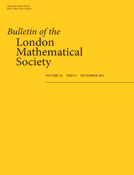
BULLETIN OF THE LONDON MATHEMATICAL SOCIETY
Empowering the Mathematical Community with Quality ResearchThe BULLETIN OF THE LONDON MATHEMATICAL SOCIETY, published by Wiley, is a distinguished journal that serves as a vital resource in the field of mathematics. With its ISSN 0024-6093 and E-ISSN 1469-2120, this journal has consistently provided a platform for innovative research and scholarly discourse since its inception in 1969. Recognized for its quality, it currently holds an impressive Q1 ranking in the mathematics category, a testament to its significance in disseminating influential findings and trends in the mathematical sciences. Researchers and practitioners can rely on the BULLETIN for its comprehensive coverage of both theoretical and applied mathematics, which caters to a diverse audience ranging from professionals to students alike. Though it does not currently offer Open Access options, its articles can be accessed through institutional subscriptions, ensuring that significant works reach the academic community effectively. With contributions that span over five decades, the journal continues to shape mathematical research and inspire future advancements in the discipline.
JOURNAL OF GEOMETRIC ANALYSIS
Bridging Theory and Application in GeometryJOURNAL OF GEOMETRIC ANALYSIS, published by SPRINGER, stands as a premier platform for the dissemination of high-quality research in the field of geometric analysis. With its ISSN 1050-6926 and E-ISSN 1559-002X, this prestigious journal has maintained a robust academic reputation since its inception in 1991, boasting a convergence of ideas and research that will continue through 2024. It is categorized in the top quartile (Q1) of Geometry and Topology, highlighting its significance and influence in the mathematical community. Ranking 23rd out of 106 in its field, and placing in the 78th percentile according to Scopus metrics, this publication is essential for researchers, professionals, and students who seek to deepen their understanding of geometric structures and their applications. Though it operates under a subscription model rather than Open Access, the journal consistently aims to advance knowledge through rigorous peer-reviewed articles that explore the latest developments and methodologies in geometric analysis, making it a pivotal resource for anyone involved in mathematical research.
Hokkaido Mathematical Journal
Advancing mathematical frontiers through rigorous research.Hokkaido Mathematical Journal, published by Hokkaido University, Department of Mathematics, stands as a pivotal platform for scholarly discourse in the field of mathematics. Established in 1972, this peer-reviewed journal has consistently contributed to the advancement of mathematical research, covering a wide spectrum of topics within the discipline. With its current ranking in the third quartile (Q3) among miscellaneous mathematics journals, it offers valuable insights and findings that cater to both established researchers and budding mathematicians alike. The journal is accessible through traditional subscription, fostering a community that values rigorous theoretical exploration and applied mathematical methods. As it approaches its convergence year in 2024, Hokkaido Mathematical Journal remains essential for those dedicated to pushing the boundaries of mathematical knowledge and innovation in Japan and beyond.
Tsukuba Journal of Mathematics
Fostering Innovation in Mathematics through Scholarly ExchangeTsukuba Journal of Mathematics is a distinguished publication dedicated to advancing the field of mathematics through the dissemination of innovative research and comprehensive studies. Published by the University of Tsukuba, Department of Mathematics, this journal serves as a vital platform for mathematicians, researchers, and students to engage with cutting-edge mathematical theories and methodologies. Although currently not available as an open-access journal, it maintains a strong academic presence, contributing significantly to the global mathematical landscape. The journal invites submissions across various branches of mathematics, aiming to foster scholarly communication and collaboration. The ISSN 0387-4982 and the E-ISSN 2423-821X further establish its credibility and accessibility among the academic community, supporting its critical objective of facilitating high-quality research output. Situated in Tsukuba, Japan, a hub for scientific research and development, the Tsukuba Journal of Mathematics is committed to bridging gaps in mathematical knowledge and encouraging exploration of novel ideas.