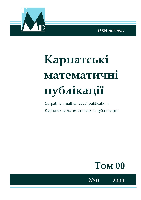
Carpathian Mathematical Publications
Scope & Guideline
Pioneering Open Access to Mathematical Excellence.
Introduction
Aims and Scopes
- Mathematical Analysis and Approximation Theory:
This area includes research on convergence properties, approximation techniques, and inequalities, often exploring the behavior of various mathematical functions and operators. - Functional Analysis and Operator Theory:
The journal publishes works that delve into the properties of linear and nonlinear operators, spectral theory, and functional spaces, contributing to the understanding of operator behavior in different contexts. - Stochastic Processes and Probability Theory:
Research in this area covers stochastic calculus, random variables, and their applications in various mathematical frameworks, reflecting an interest in both theoretical and applied stochastic analysis. - Differential Equations and Dynamic Systems:
The journal includes studies on differential equations, both ordinary and partial, as well as dynamical systems, focusing on their solutions, stability, and applications in real-world scenarios. - Algebra and Discrete Mathematics:
Papers often explore algebraic structures, including polynomial algebras, group theory, and combinatorial mathematics, contributing to the foundational aspects of modern mathematics. - Geometry and Topology:
Research in this domain focuses on geometric structures, including manifolds and their properties, contributing to the understanding of spatial relationships and topological spaces.
Trending and Emerging
- Fractional Calculus and Differential Equations:
There has been a notable increase in research dedicated to fractional calculus and its applications in differential equations, indicating a growing interest in non-integer order derivatives and their implications. - Stochastic Analysis and Applications:
Recent papers highlight a rising trend in stochastic processes, particularly in their application to real-world problems, showcasing the relevance of randomness in mathematical modeling. - Advanced Approximation Theory:
The journal has seen a surge in studies focusing on advanced approximation techniques, particularly in the context of multivariate functions and complex systems, reflecting ongoing developments in this area. - Geometric Analysis:
Emerging research on geometric structures, especially in relation to manifolds and solitons, indicates a trend towards integrating geometric concepts with analytical methods. - Algebraic Structures and Nonlinear Dynamics:
Papers exploring complex algebraic structures and their interactions with nonlinear dynamics are becoming more common, revealing a growing intersection between algebra and dynamic systems.
Declining or Waning
- Classical Numerical Methods:
Research focusing on traditional numerical methods for solving equations and approximations has become less prevalent, possibly due to the rise of more advanced computational techniques and algorithms. - Elementary Number Theory:
Papers on basic number theory concepts and classical results appear to be declining, as the journal seems to be shifting towards more complex and applied mathematical theories. - Basic Graph Theory:
While still a relevant field, fundamental studies in graph theory are less frequent, suggesting a transition towards more intricate applications and combinatorial mathematics.
Similar Journals

Journal of Analysis
Advancing Mathematical FrontiersThe Journal of Analysis, published by SPRINGERNATURE, serves as a crucial platform for disseminating advanced research in the fields of mathematics, particularly focusing on Algebra, Number Theory, Analysis, Applied Mathematics, Geometry, Topology, and Numerical Analysis. Since its inception in 2016, this journal has aimed to foster knowledge-sharing and innovation among researchers, professionals, and students. Boasting a diverse scope and a commitment to high-quality research, the journal is indexed in various categories with rankings that reflect its growing influence, particularly in Algebra and Number Theory (Q4), Analysis (Q3), and Applied Mathematics (Q3), among others. With an ISSN of 0971-3611 and E-ISSN of 2367-2501, it offers insightful articles that contribute to the ongoing discourse in mathematics. The journal is located in Germany, ensuring a European perspective while also welcoming global contributions. Researchers seeking to enhance their understanding and impact in their respective fields will find this journal an invaluable resource.
Asian Journal of Mathematics
Pioneering Insights in Mathematical DomainsAsian Journal of Mathematics, published by INT PRESS BOSTON, INC, is a premier scholarly journal dedicated to the expansive field of mathematics. With an ISSN of 1093-6106 and E-ISSN 1945-0036, it serves as a crucial platform for disseminating innovative research and methodologies in various mathematical domains. Established in 2005, the journal has garnered a significant reputation, currently holding Q2 rankings in both Applied Mathematics and Mathematics (miscellaneous) categories as of 2023. The journal aims to bridge theoretical research with practical application, making it an essential resource for researchers, professionals, and students seeking to advance their understanding and application of mathematical principles. Although it currently does not offer open access options, the journal's commitment to quality and rigor ensures its place as an influential reference within the mathematical community. Its office is located at PO BOX 43502, SOMERVILLE, MA 02143, United States, strategically positioning it as a key contributor to global mathematical discourse.

Glasnik Matematicki
Advancing Mathematical Frontiers with Every IssueGlasnik Matematicki is a prestigious academic journal published by the Croatian Mathematical Society, focusing on a broad spectrum of topics within the field of mathematics. Established in Croatia, this journal has gained recognition for its contributions to the mathematical community, providing a platform for researchers and scholars to share their groundbreaking findings and innovative theories. The journal operates without an open access model, encouraging traditional subscription-based readership, which enhances its standing among journals in the field. With a respectable impact factor and categorized in the Q3 quartile for mathematics (miscellaneous) as of 2023, Glasnik Matematicki is vital for those engaged in advanced mathematical research and education. It aims to disseminate significant mathematical advancements and facilitate scholarly exchange, making it an essential resource for students, professionals, and researchers alike. The journal’s convergence period from 2006 to 2024 marks its ongoing commitment to academic excellence and its relevance in contemporary mathematical discourse.
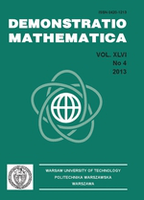
Demonstratio Mathematica
Elevating the Standards of Mathematical InquiryDemonstratio Mathematica, published by DE GRUYTER POLAND SP Z O O, is an esteemed open-access journal in the field of mathematics, with an ISSN of 0420-1213 and E-ISSN 2391-4661. Established in 1996 and providing open access since 2009, it has become a vital platform for disseminating innovative research and advancements in various areas of mathematics. With a commendable Scopus ranking of 85/399 in General Mathematics and a 2023 Category Quartile of Q2, it stands at the forefront of the mathematical community, demonstrating a significant impact within the top 78th percentile. The journal aims to foster a deeper understanding and appreciation of mathematical concepts and their applications, catering to both seasoned researchers and emerging scholars. Located in Warsaw, Poland, Demonstratio Mathematica not only enriches the academic discourse but also strengthens collaborative efforts within the international mathematics community, making it an essential resource for those seeking to expand their knowledge and research output.
Acta Mathematica Vietnamica
Bridging Knowledge and Innovation in MathematicsActa Mathematica Vietnamica is a reputable journal in the field of mathematics, published by Springer Singapore Pte Ltd. With an ISSN of 0251-4184 and an E-ISSN of 2315-4144, this journal has been a significant platform for disseminating research findings and advancements in mathematical theories and applications since its inception. It currently holds a Q3 ranking in Mathematics (miscellaneous) for the year 2023, reflecting its growing influence within the academic community. Despite being based in Singapore, Acta Mathematica Vietnamica resonates globally, attracting contributions from researchers and professionals worldwide. While the journal operates under a subscription model, it offers robust access options, ensuring that critical research is accessible to a diverse audience. Researchers and students will find invaluable insights within its pages, facilitating a deeper understanding and exploration of advanced mathematical concepts. As it continues to converge from 2011 to 2024, this journal remains dedicated to fostering innovation and collaboration in the mathematical sciences.
FORUM MATHEMATICUM
Unraveling Complexities: Where Mathematics Meets InsightFORUM MATHEMATICUM, published by WALTER DE GRUYTER GMBH, is a distinguished academic journal based in Germany, known for its significant contributions to the field of mathematics. With an ISSN of 0933-7741 and an E-ISSN of 1435-5337, the journal features comprehensive studies ranging from applied mathematics to diverse mathematical disciplines. Having maintained a commendable presence since 1989, FORUM MATHEMATICUM has achieved notable classification rankings, including Q2 in Applied Mathematics and Q1 in miscellaneous Mathematics as of 2023. Additionally, it holds a Scopus rank within the top 60th percentile in General Mathematics, making it a prominent platform for researchers and professionals seeking rigorous analysis and innovative methodologies in mathematics. While the journal does not currently offer open access, its rich content is pivotal for advancing mathematical theory and applications, appealing to students and seasoned academics alike.
REVISTA MATEMATICA IBEROAMERICANA
Exploring the frontiers of mathematics since 1996.REVISTA MATEMATICA IBEROAMERICANA, published by the EUROPEAN MATHEMATICAL SOCIETY, is a leading open-access journal dedicated to advancing the field of mathematics. Since its inception in 1996, the journal has provided a platform for high-quality research up to 2024, achieving a prestigious Q1 ranking in the miscellaneous mathematics category and placing it within the top 77th percentile of the Scopus rankings. Based in Spain, this journal fosters a vibrant academic community by disseminating innovative research, theoretical insights, and applications within the broad scope of mathematics. With its commitment to open access established in 2022, REVISTA MATEMATICA IBEROAMERICANA ensures that groundbreaking research is accessible to scholars, practitioners, and students worldwide, emphasizing the importance of collaboration and knowledge sharing in the mathematical sciences. The journal is a vital resource for anyone invested in the evolution of mathematics, providing a rich array of articles that contribute to both the theoretical and applied landscapes of the discipline.
Revista Matematica Complutense
Championing High-Impact Research in MathematicsRevista Matematica Complutense is a prestigious peer-reviewed journal published by SPRINGER-VERLAG ITALIA SRL, specializing in the field of mathematics. With its ISSN 1139-1138 and E-ISSN 1988-2807, the journal plays a vital role in disseminating high-quality research and fostering academic discussion within the mathematics community. Recognized for its rigorous selection process, the journal has achieved impressive rankings, holding a Q1 quartile status in the miscellaneous mathematics category as of 2023 and ranking #94 out of 399 in general mathematics according to Scopus, placing it within the 76th percentile. With a publication timeline spanning from 2008 to 2024, the Revista Matematica Complutense continues to serve as an essential resource for researchers, professionals, and students alike. Although it does not currently offer open access, the journal remains committed to advancing mathematical knowledge and providing a platform for innovative research across various mathematical disciplines.
ROCKY MOUNTAIN JOURNAL OF MATHEMATICS
Connecting Theoretical Insights with Practical ApplicationsROCKY MOUNTAIN JOURNAL OF MATHEMATICS, published by the Rocky Mountain Math Consortium, serves as a critical platform for researchers and practitioners in the field of mathematics since its inception in 1971. With a notable presence in the academic community, this journal covers a broad spectrum of mathematical disciplines, positioning itself in the Q2 category for Mathematics (miscellaneous) as of 2023. Despite being a subscription-based journal, it is recognized for its rigorous peer-review process and contributions to theoretical and applied mathematics, helping to advance knowledge and foster collaboration among mathematicians. The journal's ISSN number is 0035-7596 and its E-ISSN is 1945-3795, reflecting its commitment to accessibility and dissemination of high-quality research. Based in Tempe, Arizona, at Arizona State University, the journal continues to play an important role in shaping contemporary mathematical discourse through well-researched articles and innovative studies, aiming to bridge gaps between various mathematical subfields and engage a diverse audience, including students and established researchers alike.
Proceedings of the Steklov Institute of Mathematics
Championing Quality Research in the Mathematical RealmProceedings of the Steklov Institute of Mathematics is a reputable journal published by MAIK NAUKA/INTERPERIODICA/SPRINGER, specializing in the diverse and dynamic field of mathematics. With an ISSN of 0081-5438 and an E-ISSN of 1531-8605, this journal serves as a vital platform for disseminating high-quality research, particularly in the area of miscellaneous mathematics. The journal's standing is reflected in its placement in Q3 of the 2023 Mathematics category, ranking 61st out of 90 in Scopus, placing it in the 32nd percentile among its peers. Spanning a convergence period from 2006 to 2024, the Proceedings of the Steklov Institute of Mathematics aims to foster scholarly dialogue and advance mathematical research, making it essential reading for researchers, professionals, and students looking to stay at the forefront of mathematical innovation.