Revista de la Real Academia de Ciencias Exactas Fisicas y Naturales Serie A-Matematicas
Scope & Guideline
Pioneering Insights in Core Mathematical Disciplines
Introduction
Aims and Scopes
- Algebra and Number Theory:
Research in this area includes studies on algebraic structures, ring theory, and number theoretic properties, addressing both classical and contemporary problems. - Functional Analysis:
The journal publishes papers on various aspects of functional analysis, including operator theory, Banach spaces, and applications to differential equations. - Geometry and Topology:
Contributions in this scope involve differential geometry, algebraic topology, and geometric analysis, exploring the intrinsic properties of spaces and their mappings. - Mathematical Physics:
Papers related to mathematical formulations of physical theories, including topics like quantum mechanics, relativity, and mathematical modeling of physical systems. - Numerical Analysis and Approximation Theory:
This area encompasses computational methods for solving mathematical problems, including approximation techniques and numerical solutions to differential equations. - Combinatorics and Discrete Mathematics:
Research in combinatorial structures, graph theory, and discrete optimization, focusing on theoretical foundations and practical applications. - Probability and Statistics:
Studies in this domain include stochastic processes, statistical inference, and applications of probability theory in various fields. - Differential Equations:
The journal covers both ordinary and partial differential equations, emphasizing analytical and numerical methods for solving these equations.
Trending and Emerging
- Applied Mathematics and Modeling:
There is a growing trend in the application of mathematical theories to real-world problems, particularly in fields like physics, biology, and engineering, illustrating the relevance of mathematics in practical scenarios. - Data Science and Computational Mathematics:
Research related to data analysis, machine learning, and computational methods is increasingly prevalent, highlighting the importance of mathematical foundations in technology and data-driven fields. - Nonlinear Dynamics and Chaos Theory:
Emerging interest in nonlinear systems and chaos theory reflects a broader understanding of complex systems in various scientific domains. - Operator Theory and Functional Analysis:
There has been a resurgence in interest in operator theory, particularly in its applications to quantum mechanics and functional spaces, indicating a vibrant area of research. - Fractional Calculus and Its Applications:
The study of fractional calculus is gaining traction, with applications across various scientific fields, showcasing the versatility and depth of mathematical analysis. - Mathematical Biology:
An increase in interdisciplinary research involving mathematical applications in biology, particularly in modeling biological systems and processes, signifies a growing intersection between these fields.
Declining or Waning
- Classical Geometry:
Research in classical geometry has seen a reduction in focus, possibly due to the increased interest in more abstract and computational aspects of geometry. - Elementary Number Theory:
Although still relevant, the frequency of publications in elementary number theory has decreased, as researchers gravitate towards more complex or applied problems. - Discrete Geometry:
The field of discrete geometry has waned, with fewer submissions addressing purely combinatorial or geometric properties compared to previous years. - Mathematical History and Education:
Papers discussing the history of mathematics and pedagogical approaches have become less common, indicating a potential shift towards more research-focused contributions. - Real Analysis:
While still a foundational area, traditional topics in real analysis have seen fewer new contributions, as the field evolves towards more applied or computational perspectives.
Similar Journals

RENDICONTI DEL SEMINARIO MATEMATICO DELLA UNIVERSITA DI PADOVA
Exploring the frontiers of mathematics with open access insights.RENDICONTI DEL SEMINARIO MATEMATICO DELLA UNIVERSITA DI PADOVA, published by the European Mathematical Society, stands as a notable open-access journal with a rich history in disseminating research across various domains of mathematics. With an ISSN of 0041-8994 and E-ISSN 2240-2926, this journal has embraced open access since 2023, significantly enhancing its visibility and accessibility to a global audience. Situated in Germany, its publishing house is based at Technical University Berlin, which emphasizes its academic roots and dedication to fostering mathematical research. The journal features a quartile ranking of Q3 across multiple categories including Algebra and Number Theory, Analysis, Geometry and Topology, and Mathematical Physics as of 2023, indicating a vibrant contribution to the field, despite its challenge in specific rankings. Researchers, professionals, and students alike will find in this journal a platform for innovative ideas and significant findings that are crucial to the evolution of modern mathematics.

Portugaliae Mathematica
Empowering Global Mathematics Through Open AccessPortugaliae Mathematica is a distinguished open-access journal published by the European Mathematical Society (EMS), dedicated to the field of mathematics. With its ISSN 0032-5155 and E-ISSN 1662-2758, this journal aims to disseminate high-quality research papers, reviews, and notable contributions in various domains of mathematics. Located in Germany, it has been actively publishing since 2011 and operates under the address Publishing House GmbH, Inst Mathematik, Technische Universität Berlin, Straße 17, Juni 136, Berlin 10623, Germany. The journal has embraced an open-access model since 2022, enhancing the accessibility of mathematical research to a global audience. With a current Scopus rank placing it in the 29th percentile in the miscellaneous mathematics category, it provides a platform for both emerging and well-established researchers to share their findings. Despite its Q4 ranking, the journal plays a crucial role in fostering mathematical inquiry and collaboration. Researchers, professionals, and students alike will find Portugaliae Mathematica an invaluable resource for enriching their expertise and staying abreast of developments in the mathematical sciences.
TRANSACTIONS OF THE AMERICAN MATHEMATICAL SOCIETY
Fostering Innovation in Mathematical Theory and ApplicationsTRANSACTIONS OF THE AMERICAN MATHEMATICAL SOCIETY, published by the American Mathematical Society, is a premier journal in the field of mathematics that has been contributing to the advancement of mathematical knowledge since 1900. With an ISSN of 0002-9947 and an E-ISSN of 1088-6850, this journal holds a prestigious position in the academic landscape, evidenced by its Q1 rankings in both Applied Mathematics and Miscellaneous Mathematics categories as of 2023. With a Scopus ranking of #97 in General Mathematics and a percentile standing of 75th, the journal is recognized for its rigorous peer-review process and the quality of the research it publishes. Though it does not currently offer open access options, it essentially serves as a vital resource for researchers, professionals, and students seeking critical insights and developments in mathematical theory and applications. The Transactions aim to publish high-quality research articles that foster the exchange and dissemination of ideas, supporting the growth of both theoretical and applied mathematics within the global scholarly community.
St Petersburg Mathematical Journal
Cultivating Insights in the Heart of MathematicsSt Petersburg Mathematical Journal, published by the American Mathematical Society, is a distinguished platform that fosters research and discourse in the fields of mathematics, specifically focusing on Algebra and Number Theory, Analysis, and Applied Mathematics. With an ISSN of 1061-0022 and an E-ISSN of 1547-7371, this journal has been a reliable source of cutting-edge mathematical research since its inception in 2003 and continues to publish high-quality content through 2024. Although not open-access, it offers valuable insights and advances the mathematical community's understanding, as indicated by its respectable impact factor and Scopus rankings across various categories—landing in the Q3 quartile across three significant mathematical disciplines. Researchers, professionals, and students are encouraged to contribute and engage with this journal, as it remains a vital resource for promoting collaboration and discovery within the ever-evolving field of mathematics.
ROCKY MOUNTAIN JOURNAL OF MATHEMATICS
Bridging Disciplines, Advancing KnowledgeROCKY MOUNTAIN JOURNAL OF MATHEMATICS, published by the Rocky Mountain Math Consortium, serves as a critical platform for researchers and practitioners in the field of mathematics since its inception in 1971. With a notable presence in the academic community, this journal covers a broad spectrum of mathematical disciplines, positioning itself in the Q2 category for Mathematics (miscellaneous) as of 2023. Despite being a subscription-based journal, it is recognized for its rigorous peer-review process and contributions to theoretical and applied mathematics, helping to advance knowledge and foster collaboration among mathematicians. The journal's ISSN number is 0035-7596 and its E-ISSN is 1945-3795, reflecting its commitment to accessibility and dissemination of high-quality research. Based in Tempe, Arizona, at Arizona State University, the journal continues to play an important role in shaping contemporary mathematical discourse through well-researched articles and innovative studies, aiming to bridge gaps between various mathematical subfields and engage a diverse audience, including students and established researchers alike.
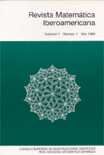
REVISTA MATEMATICA IBEROAMERICANA
Bridging theory and application in mathematical studies.REVISTA MATEMATICA IBEROAMERICANA, published by the EUROPEAN MATHEMATICAL SOCIETY, is a leading open-access journal dedicated to advancing the field of mathematics. Since its inception in 1996, the journal has provided a platform for high-quality research up to 2024, achieving a prestigious Q1 ranking in the miscellaneous mathematics category and placing it within the top 77th percentile of the Scopus rankings. Based in Spain, this journal fosters a vibrant academic community by disseminating innovative research, theoretical insights, and applications within the broad scope of mathematics. With its commitment to open access established in 2022, REVISTA MATEMATICA IBEROAMERICANA ensures that groundbreaking research is accessible to scholars, practitioners, and students worldwide, emphasizing the importance of collaboration and knowledge sharing in the mathematical sciences. The journal is a vital resource for anyone invested in the evolution of mathematics, providing a rich array of articles that contribute to both the theoretical and applied landscapes of the discipline.
Mediterranean Journal of Mathematics
Exploring Innovative Solutions in MathematicsThe Mediterranean Journal of Mathematics, published by SPRINGER BASEL AG, is a prominent platform dedicated to the advancement of mathematical research and education. Since its inception in 2004, this journal has been pivotal in disseminating high-quality research across various fields of mathematics, currently holding a notable Q2 ranking in the miscellaneous mathematics category as of 2023. With its ISSN 1660-5446 and E-ISSN 1660-5454, the journal enjoys a respected position in the academic community, evident by its Scopus rank of 129 out of 399 in General Mathematics, placing it in the 67th percentile. While primarily a subscription-based journal, it remains committed to providing a comprehensive resource for researchers, professionals, and students, fostering dialogue and exploration within the mathematical sciences. The Mediterranean Journal of Mathematics, based in Basel, Switzerland, continues to contribute significantly to the evolution of mathematical theory and practice, marking its relevance as we approach its 20th anniversary in 2024.
Acta Mathematica Vietnamica
Connecting Innovators in the World of MathematicsActa Mathematica Vietnamica is a reputable journal in the field of mathematics, published by Springer Singapore Pte Ltd. With an ISSN of 0251-4184 and an E-ISSN of 2315-4144, this journal has been a significant platform for disseminating research findings and advancements in mathematical theories and applications since its inception. It currently holds a Q3 ranking in Mathematics (miscellaneous) for the year 2023, reflecting its growing influence within the academic community. Despite being based in Singapore, Acta Mathematica Vietnamica resonates globally, attracting contributions from researchers and professionals worldwide. While the journal operates under a subscription model, it offers robust access options, ensuring that critical research is accessible to a diverse audience. Researchers and students will find invaluable insights within its pages, facilitating a deeper understanding and exploration of advanced mathematical concepts. As it continues to converge from 2011 to 2024, this journal remains dedicated to fostering innovation and collaboration in the mathematical sciences.
PROCEEDINGS OF THE INDIAN ACADEMY OF SCIENCES-MATHEMATICAL SCIENCES
Exploring Diverse Mathematical Disciplines for Tomorrow's ChallengesPROCEEDINGS OF THE INDIAN ACADEMY OF SCIENCES-MATHEMATICAL SCIENCES is a premier journal published by Springer India, dedicated to advancing the field of mathematics through the dissemination of high-quality research. With its foundation dating back to 1978, the journal serves as a pivotal platform for researchers, professionals, and students alike, fostering a vibrant academic community focused on the latest developments in mathematical sciences. Although currently positioned in the Q3 category for Mathematics (miscellaneous) with a Scopus rank of #340/399, the journal holds immense potential for growth and wider recognition within the academic sphere. It features articles that span various mathematical disciplines, encouraging innovative ideas and methodologies that contribute significantly to the field. The journal's contributions are especially relevant in the context of expanding mathematical applications in science and technology. Though it operates without an Open Access option, the journal remains an invaluable resource for anyone engaged in mathematical research, offering insights that inspire future studies and collaborations.
INDAGATIONES MATHEMATICAE-NEW SERIES
Cultivating excellence in the mathematical sciences.INDAGATIONES MATHEMATICAE-NEW SERIES is a distinguished academic journal specializing in the field of mathematics, with a focus on both theoretical and applied aspects of the discipline. Published by Elsevier, a leading publisher in the scientific community, this journal has established itself as a crucial platform for the dissemination of high-quality research. With an ISSN of 0019-3577 and an E-ISSN of 1872-6100, it operates out of the Netherlands and has been a vital resource for academics since its inception in 1969. Currently, it holds a Q2 ranking in the mathematics category, signifying its relevance and impact in the field, with a Scopus rank of #222 out of 399 in General Mathematics, placing it in the 44th percentile. Although it does not currently offer Open Access options, INDAGATIONES MATHEMATICAE-NEW SERIES is committed to contributing to the advancement of mathematics by publishing original research articles, reviews, and notes that enrich the academic community. Researchers, students, and professionals alike will find invaluable insights and developments within its pages, making it a cornerstone journal for those keen on exploring the complexities of mathematics.