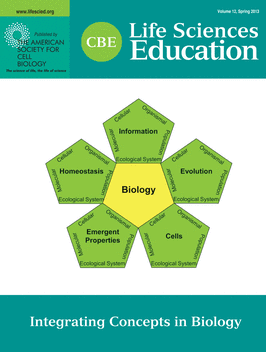
CBE-Life Sciences Education
Scope & Guideline
Empowering Educators and Researchers in Biological Sciences.
Introduction
Aims and Scopes
- Enhancing Teaching Practices:
The journal focuses on research that improves instructional strategies in life sciences education, including evidence-based teaching and innovative course designs. - Promoting Equity and Inclusion:
CBE-Life Sciences Education addresses issues of diversity, equity, and inclusion, emphasizing research that supports underrepresented groups in STEM, including students with disabilities and minority backgrounds. - Investigating Student Learning and Engagement:
Research published in the journal explores how students engage with course material, their learning processes, and factors influencing their academic success. - Course-Based Undergraduate Research Experiences (CUREs):
The journal highlights the importance of CUREs in fostering student learning and research skills, emphasizing the role of authentic research experiences in undergraduate education. - Interdisciplinary Approaches in Education:
CBE-Life Sciences Education encourages research that integrates concepts from various disciplines, promoting a holistic understanding of life sciences education.
Trending and Emerging
- Inclusive Pedagogies and Culturally Responsive Teaching:
A significant trend is the emphasis on inclusive pedagogies that consider the diverse backgrounds of students, fostering environments where all students can thrive. - Mental Health and Well-Being in STEM Education:
Recent research increasingly addresses mental health challenges faced by students in STEM fields, highlighting the need for supportive educational environments. - Integration of Technology and Remote Learning:
The journal is exploring the integration of technology in education, including the effectiveness of remote learning and digital tools in enhancing student engagement. - Student-Centered Learning Approaches:
There is a growing focus on student-centered learning strategies, including collaborative learning and active learning techniques that promote deeper understanding. - Research on Identity and Belonging in STEM:
Emerging studies are examining how students' identities influence their engagement and success in STEM fields, emphasizing the importance of fostering a sense of belonging.
Declining or Waning
- Traditional Lecture-Based Teaching:
Research focusing solely on traditional lecture-based teaching methods has decreased, as the journal increasingly showcases active learning and student-centered approaches. - Narrow Focus on Content Coverage:
There is a waning emphasis on content coverage alone, with a shift towards understanding how students interact with and apply knowledge in meaningful ways. - Gender-Specific Studies without Intersectionality:
Studies focusing exclusively on gender without considering the intersectionality of race, socioeconomic status, and other identities are becoming less prevalent. - Assessment of Basic Science Knowledge:
Research solely assessing basic science knowledge without consideration for skills such as critical thinking and problem-solving is declining, as the focus shifts to more complex educational outcomes. - Isolated Case Studies:
The prevalence of isolated case studies is diminishing in favor of larger, more comprehensive studies that can provide broader insights into life sciences education.
Similar Journals
Canadian Journal for the Scholarship of Teaching and Learning
Advancing Excellence in Higher Education PedagogyThe Canadian Journal for the Scholarship of Teaching and Learning (CJSoTL) is a premier open-access journal dedicated to advancing research and discourse in the field of teaching and learning within higher education. Published by SOC TEACHING & LEARNING HIGHER EDUCATION, CJSoTL serves as a vital resource for educators, researchers, and students alike, promoting evidence-based practices and scholarship in higher education pedagogy. Since its inception in 2010, the journal has provided an inclusive platform for innovative research, case studies, and pedagogical strategies that enhance teaching effectiveness and student learning outcomes. Although specific metrics such as H-index and Scopus ranks are currently unlisted, the journal is committed to fostering a community of practice among scholars dedicated to improving teaching and learning environments. With its open-access policy, CJSoTL ensures that valuable knowledge is freely available, aligning with contemporary trends in academic dissemination and accessibility, thus making significant contributions to the scholarship of teaching and learning in Canada and beyond.
AMERICAN BIOLOGY TEACHER
Fostering Innovation in Biology Education for Tomorrow's LeadersAMERICAN BIOLOGY TEACHER, published by the NATIONAL ASSOCIATION OF BIOLOGY TEACHERS INC, is a vital resource for educators and researchers in the interconnected fields of biology education and agricultural sciences. With an ISSN of 0002-7685 and an E-ISSN of 1938-4211, the journal has been dedicated to promoting innovative teaching practices and enhancing the quality of biology education since its inception in 1970. Currently positioned in the Q3 quartile for both Agricultural and Biological Sciences (miscellaneous) and Education categories, it offers valuable insights and findings that address the pedagogical challenges faced by biology teachers today. Despite its non-open access model, the journal remains a critical platform for disseminating research that contributes to the professional development of biology educators in the United States and beyond. With a focus on practical applications and educational methodologies, AMERICAN BIOLOGY TEACHER aims to foster a deeper understanding of biological concepts among students, thereby shaping the next generation of scientists and informed citizens. Access to this journal continues to be an essential resource for those seeking to enhance teaching effectiveness and student engagement in the sciences.

TEACHING OF PSYCHOLOGY
Empowering Educators with Research-Driven InsightsTEACHING OF PSYCHOLOGY is a distinguished academic journal published by SAGE Publications Ltd, focusing on the field of psychology education. Established in 1975, this journal has carved out a vital niche in the academic landscape, facilitating the dissemination of innovative teaching practices, research outcomes, and pedagogical strategies that enhance the learning experience in psychology. With an impressive H-index indicating its influence, TEACHING OF PSYCHOLOGY is ranked in the second quartile for Education and third quartile for Psychology (Miscellaneous) in 2023, reflecting its pivotal role in these fields. The journal boasts a robust Scopus ranking, placing it within the 55th percentile for Social Sciences - Education and the 42nd percentile for General Psychology, demonstrating its relevance and reach among scholars and practitioners alike. Although it does not offer open access, it remains a crucial resource for educators, researchers, and students seeking to enhance their understanding and application of psychological principles in educational settings. By contributing to the ongoing dialogue about effective teaching methodologies in psychology, the journal aims to inspire and inform educators, fostering an environment of rigorous academic inquiry and practical application.

MEDICAL TEACHER
Fostering a global dialogue on medical education.MEDICAL TEACHER, published by Taylor & Francis Ltd, is an esteemed journal in the fields of Education and Medicine, recognized for its pivotal role in advancing medical education. With an impressive impact factor, this journal has consistently secured a top-tier position, being classified in Q1 for both Education and Miscellaneous Medicine as of 2023. Established in 1979, it offers a platform for innovative research, critical reviews, and insightful discussions that inform and influence pedagogical practices in medical training globally. Researchers and professionals can benefit from the journal’s comprehensive coverage, which includes empirical research, theoretical discussions, and educational strategies aimed at improving the quality of medical education. As a renowned resource for educators, clinicians, and policymakers, MEDICAL TEACHER continues to shape the future of healthcare education, making it an essential reading for anyone involved in the medical training landscape.
COLLEGE & RESEARCH LIBRARIES
Navigating Trends in Academic LibrariesCOLLEGE & RESEARCH LIBRARIES, published by the Association of College & Research Libraries, stands as a pivotal platform in the field of Library and Information Sciences. With an impressive Q1 ranking and a Scopus rank of 78 out of 280, it sits in the 72nd percentile among its peers, reflecting its significant contribution to academic scholarship. The journal, in circulation since 1939 and with *Open Access* status since its inception, is committed to disseminating high-quality research and practical insights for librarians, information professionals, and researchers. Based in the heart of Chicago, the journal provides a comprehensive overview of trends, challenges, and innovations within the library and information sector. Covering a broad spectrum of topics with converged years reflecting a rich historical context (from 1946 to 1947 and from 1987 to 2024), it facilitates discourse among practitioners and scholars aiming to advance the effectiveness of library services. Whether you are a researcher seeking to explore new methodologies or a student striving to stay informed of the latest industry developments, COLLEGE & RESEARCH LIBRARIES is your essential resource.
ASSESSMENT FOR EFFECTIVE INTERVENTION
Transforming assessments into impactful interventions.ASSESSMENT FOR EFFECTIVE INTERVENTION, published by SAGE Publications Inc, serves as a pivotal journal in the realms of Developmental and Educational Psychology, Education, and Health Professions. With its ISSN 1534-5084 and E-ISSN 1938-7458, the journal contributes significantly to advancing knowledge and practice in these interdisciplinary areas by providing a platform for rigorous evaluation and insightful research. Recognized for its quality with a Q3 quartile ranking in Developmental and Educational Psychology and a Q2 ranking in both Education and Health Professions, ASSESSMENT FOR EFFECTIVE INTERVENTION is a respected source among its peers, ranking 507 out of 1543 in the Social Sciences Education category according to Scopus. Researchers, practitioners, and students alike can benefit from the journal's comprehensive articles, which aim to enhance intervention strategies and foster effective assessment practices. Although the journal does not currently offer open access, its enduring legacy since 1988 ensures a wealth of knowledge spanning over three decades, making it an essential read for anyone invested in improving educational and psychological outcomes.
PHARMACY EDUCATION
Pioneering advancements in pharmacy education worldwide.PHARMACY EDUCATION, an esteemed journal published by the INTERNATIONAL PHARMACEUTICAL FEDERATION, is dedicated to advancing the field of pharmacy education through high-quality research, reviews, and innovative practices. With an ISSN of 1560-2214 and an E-ISSN of 1477-2701, this journal provides a vital platform for educators, researchers, and professionals to discuss contemporary issues and opportunities within pharmaceutical education. Recognized for its relevance, it holds a Q4 ranking in Education and Q3 in both Pharmaceutical Science and Pharmacy as of 2023. Despite its Scopus rankings reflecting a growing niche, with positions such as 30/45 for Pharmacy in Health Professions, it showcases a commitment to nurturing the next generation of pharmacy practitioners. As a crucial resource for enhancing pharmacy curricula and pedagogical strategies, PHARMACY EDUCATION invites contributions from those dedicated to enriching educational methodologies and promoting excellence in pharmaceutical training. This journal plays an essential role in bridging academic research and practical application, encouraging the ongoing evolution in pharmacy education across the globe.
INTERNATIONAL JOURNAL OF SCIENCE EDUCATION
Inspiring Change in Science Teaching and LearningINTERNATIONAL JOURNAL OF SCIENCE EDUCATION, published by Routledge Journals, Taylor & Francis Ltd, is a leading academic journal that plays a pivotal role in the field of science education. Established in 1987, this esteemed journal aims to advance the understanding of educational processes and practices in the sciences, showcasing innovative research that intersects pedagogy, curriculum development, and educational policy. With a prestigious Q1 ranking in Education for 2023 and an impressive Scopus rank of 304 out of 1543 in the Social Sciences Education category, the journal represents the top tier of scholarly impact and influence. Although it is not an open-access journal, the findings and insights shared within its pages are of paramount importance for researchers, educators, and policymakers striving to enhance science learning in diverse educational contexts. With a commitment to excellence and a vision to inform and inspire, the INTERNATIONAL JOURNAL OF SCIENCE EDUCATION is a vital resource for anyone dedicated to the future of science education.
TEACHING AND LEARNING IN MEDICINE
Transforming healthcare training with cutting-edge insights.TEACHING AND LEARNING IN MEDICINE is a distinguished academic journal, published by Routledge Journals, Taylor & Francis Ltd, focusing on the critical intersection of education and medical training. Since its inception in 1989, this journal has become a vital resource for researchers, practitioners, and educators, showcasing cutting-edge research and innovative practices that enhance pedagogical approaches in medicine. With an impact factor reflective of its high influence in the field, it has earned a notable Q1 ranking in both the Education and Miscellaneous Medicine categories for 2023. Additionally, its impressive Scopus rankings highlight its significance within the medical and educational research communities. Although not an open access journal, TEACHING AND LEARNING IN MEDICINE provides valuable insights that contribute to the advancement of medical education and the improvement of learning outcomes, ensuring that readers stay at the forefront of pedagogical developments. With a commitment to scholarly rigor and practical relevance, this journal is an essential reading for anyone dedicated to elevating educational standards in the healthcare profession.
JOURNAL OF COLLEGE STUDENT DEVELOPMENT
Advancing Student Success Through Research and InsightJOURNAL OF COLLEGE STUDENT DEVELOPMENT is a premier academic publication dedicated to advancing the field of higher education and student affairs. Published by Johns Hopkins University Press, this journal holds a distinguished Q1 ranking in Education for 2023 and ranks 582nd out of 1543 in the Scopus database, placing it in the 62nd percentile among social sciences education journals. The journal aims to provide contemporaneous insights and empirical research that foster the development of college students, with a focus on enhancing student experiences, promoting well-being, and advocating for effective educational policies. Though it does not offer open access options, it remains a vital resource for researchers, professionals, and students alike, who are invested in exploring innovative approaches to student success and engagement. With a continuous publication span from 1996 to 2024, JOURNAL OF COLLEGE STUDENT DEVELOPMENT serves as a cornerstone for scholarly discourse in the dynamic landscape of higher education.