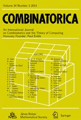
COMBINATORICA
metrics 2024
Pioneering Insights in Combinatorics and Beyond
Introduction
COMBINATORICA, published by Springer Heidelberg, is a leading international journal dedicated to advancing the fields of Discrete Mathematics and Combinatorics. With an illustrious history dating back to 1981 and a remarkable commitment to excellence, this journal has earned its place in the highest echelons of academic publishing, currently ranked in the Q1 category for both Computational Mathematics and Discrete Mathematics and Combinatorics. Located in Germany and recognized for its high-quality research contributions, COMBINATORICA fosters innovative discussions and disseminates significant findings that shape contemporary mathematical theory. Although it does not offer Open Access options, its rigorous peer-review process ensures that each publication meets the highest scholarly standards, making it an essential resource for researchers, professionals, and students engaged in mathematical sciences. With an impactful H-Index reflecting its citation influence, COMBINATORICA continues to be a pivotal platform for groundbreaking research in combinatorics and its applications.
Metrics 2024
 1.241.001.2059
Metrics History
Rank 2024
Scopus
IF (Web Of Science)
JCI (Web Of Science)
Quartile History
Similar Journals
Annals of Combinatorics
Unveiling Breakthroughs in Discrete MathematicsAnnals of Combinatorics, published by Springer Basel AG, serves as a premier platform for innovation and research in the field of discrete mathematics and combinatorics. With an ISSN of 0218-0006 and an E-ISSN of 0219-3094, the journal captures the ongoing developments and breakthroughs that characterize this dynamic discipline, which plays a crucial role in various applications such as computer science, optimization, and statistical mechanics. The journal has been recognized as part of the Q2 category in the 2023 rankings for discrete mathematics and combinatorics, reflecting its significant contribution to the academic community. Researchers and educators alike benefit from its insightful articles that not only cover theoretical advancements but also practical implications. With convergence years spanning from 2005 to 2024, the Annals of Combinatorics continues to be an essential resource for anyone looking to deepen their understanding and explore new frontiers in combinatorial research.
JOURNAL OF COMBINATORIAL THEORY SERIES A
Championing Excellence in Combinatorial Research.JOURNAL OF COMBINATORIAL THEORY SERIES A, published by Academic Press Inc. Elsevier Science, stands as a pivotal platform for researchers in the realm of combinatorial mathematics and theoretical computer science. With an impact factor that underscores its influence and a well-respected reputation reflected in its rapid ascent to Q1 rankings in discrete mathematics and computational theory, this journal serves as a critical resource for academics seeking to advance their understanding of complex combinatorial structures and algorithms.
Founded in 1971, the journal covers a wide spectrum of topics within combinatorial theory, providing a robust forum for innovative research and theoretical advancements until 2025. Including a strong position in the Scopus rankings—notably, it ranks #10 out of 92 in discrete mathematics—the journal is essential for both emerging scholars and established professionals committed to pushing the boundaries of mathematical and computational inquiry. Researchers are encouraged to submit their findings to this esteemed publication, as it offers a non-open-access model that ensures rigorous peer review and high visibility within the academic community.

Transactions on Combinatorics
Empowering Researchers with Cutting-edge FindingsTransactions on Combinatorics is an esteemed academic journal dedicated to advancing the field of combinatorial mathematics. Published by UNIV ISFAHAN, VICE PRESIDENT RESEARCH & TECHNOLOGY, this journal has been an Open Access platform since 2012, ensuring that innovative research is freely available to scholars across the globe. With an ISSN of 2251-8657 and an E-ISSN of 2251-8665, it fosters a community for researchers to disseminate their findings within the realms of Computational Theory and Discrete Mathematics. The journal has been classified in the Q4 category for both its major fields in 2023 and holds notable Scopus rankings that reflect its growing influence in the academic community, despite currently being in the lower quartiles. The journal covers a diverse range of topics from theoretical frameworks to practical applications, making it a valuable resource for researchers, professionals, and students who are passionate about combinatorics. Addressed from DEPT PRINTING & PUBLISHING MAGAZINES, HEZAR-JARIB AVE, ISAFAHAN 81746-73441, IRAN, it stands as a beacon for collaborative research and knowledge sharing in this essential field.
ADVANCES IN APPLIED MATHEMATICS
Advancing Knowledge, Transforming ApplicationsADVANCES IN APPLIED MATHEMATICS, published by ACADEMIC PRESS INC ELSEVIER SCIENCE, is a prestigious journal that has served the mathematical community since 1980. With its ISSN 0196-8858 and E-ISSN 1090-2074, the journal is based in the United States, specifically in San Diego, CA. As a leading periodical in the field, it holds a notable Q2 ranking in Applied Mathematics and has been consistently ranked in the 43rd percentile among similar journals, illustrating its relevance and impact within the discipline. Although not an Open Access journal, ADVANCES IN APPLIED MATHEMATICS plays a crucial role in disseminating significant research findings, theoretical studies, and innovative applications of mathematics that address real-world problems. Researchers, professionals, and students alike will find valuable insights in its carefully curated publications, making it an essential resource for those looking to advance their understanding and application of mathematics.
JOURNAL OF COMBINATORIAL DESIGNS
Exploring Innovative Designs in Discrete MathematicsJOURNAL OF COMBINATORIAL DESIGNS, published by Wiley, is a leading peer-reviewed journal that serves as a vital platform for researchers in the field of discrete mathematics and combinatorics. With an impressive Q1 ranking in the 2023 category, it stands at the forefront of academic discourse, showcasing significant developments and innovative research from 1993 to 2024. The journal is dedicated to the study of combinatorial designs, including their applications in various scientific disciplines, which enhances its relevance among mathematicians and applied scientists alike. Although it operates on a traditional subscription model, the journal continues to attract high-quality submissions, as evidenced by its Scopus rank of #40 out of 92 in Discrete Mathematics and Combinatorics, placing it in the 57th percentile. Its commitment to advancing knowledge in combinatorial theory and applications makes it an essential resource for professionals, researchers, and students seeking to deepen their understanding and contribute to this dynamic field.

DISCRETE APPLIED MATHEMATICS
Empowering Researchers with Cutting-Edge Findings in Discrete Mathematics.DISCRETE APPLIED MATHEMATICS, published by ELSEVIER, is a premier journal dedicated to advancing the fields of Applied Mathematics, particularly focusing on Discrete Mathematics and Combinatorics. Since its inception in 1979, the journal has established itself as a vital resource for researchers and practitioners alike, achieving a commendable Q2 ranking in both applied and discrete mathematics categories as of 2023. With an ISSN of 0166-218X and an E-ISSN of 1872-6771, the journal serves an international audience by disseminating significant findings and fostering innovation in mathematical applications. Its Scopus ranking positions it notably within the top tier, ranking #23 out of 92 in Discrete Mathematics and Combinatorics, highlighting its impact in the academic community. Although the journal is not open access, it remains accessible through institutional subscriptions. Researchers, professionals, and students are encouraged to engage with the relevant and rigorous research published in this esteemed journal, as it plays a crucial role in shaping the future of mathematical sciences.
AKCE International Journal of Graphs and Combinatorics
Connecting Ideas through Innovative Mathematical Research.AKCE International Journal of Graphs and Combinatorics, published by TAYLOR & FRANCIS LTD, serves as a significant platform in the field of Discrete Mathematics and Combinatorics. With its commitment to open access since 2015, the journal ensures that cutting-edge research is readily available to a global audience, promoting the dissemination of knowledge and high-quality scholarship. Recognized for its impact in the discipline, the journal is currently ranked Q3 in its category for 2023 and holds a commendable Scopus ranking, falling within the 69th percentile. Researchers, professionals, and students alike will find invaluable insights and contributions in this journal, which spans a wide range of topics related to graph theory and combinatorial structures. Operating from its base in India, and converging from 2011 to 2024, the AKCE International Journal invites submissions that push the boundaries of mathematical exploration and foster innovative methodologies in a rapidly evolving field.

Journal of Combinatorics
Championing High-Quality Research in Combinatorial TheoryJournal of Combinatorics is a premier academic journal dedicated to advancing the field of combinatorial theory and its applications. Published by INT PRESS BOSTON, INC, it aims to provide a robust platform for researchers, professionals, and students to disseminate their findings and engage with cutting-edge developments in combinatorics. With a focus on high-quality, peer-reviewed articles, the journal fosters rigorous mathematical discussions surrounding various facets of combinatorial structures, graph theory, design theory, and combinatorial optimization. Although currently not available as an Open Access journal, the Journal of Combinatorics plays a vital role in enriching the mathematical sciences and serves as an essential resource for academics seeking to stay updated with the latest trends in combinatorial research. By maintaining a commitment to excellence and innovation, this journal is indispensable for anyone looking to deepen their understanding in this critical area of study.

Contributions to Discrete Mathematics
Connecting theory and application in combinatorics.Contributions to Discrete Mathematics, published by the Department of Mathematics and Statistics at the University of Calgary, serves as a vital platform for disseminating innovative research within the dynamic field of discrete mathematics and combinatorics. Established in 2008, this journal has rapidly gained recognition, currently holding a Q3 classification in discrete mathematics and combinatorics for 2023. As it aims to foster academic dialogue and share groundbreaking discoveries, the journal showcases high-quality peer-reviewed articles that cover a range of topics, from theoretical explorations to practical applications. Although it currently operates under a traditional subscription model, there is a growing commitment to enhancing access options, ensuring that critical knowledge is available to researchers and practitioners alike. With its notable Scopus ranking of #50 out of 92 within its category, this journal is positioned as an important resource for students, academics, and industry professionals who seek to stay at the forefront of discrete mathematics research.

ARS Mathematica Contemporanea
Connecting Scholars Through Open Access ResearchARS Mathematica Contemporanea, published by UP FAMNIT in Slovenia, stands as a pivotal journal within the fields of algebra, number theory, discrete mathematics, geometric topology, and theoretical computer science. Since its inception in 2011, this journal has consistently provided a rich platform for innovative research, garnering a commendable Q2 category ranking in various mathematical domains, including Algebra and Number Theory, and Geometry and Topology, showcasing its growing influence and prestige in the academic community. With an increasing Scopus rank—particularly notable in Algebra and Number Theory at the 71st percentile—ARS Mathematica Contemporanea is dedicated to publishing high-quality, peer-reviewed content that advances the frontiers of mathematical knowledge. The journal’s commitment to open access ensures that valuable research is readily available to scholars, practitioners, and students alike, fostering collaboration and dissemination of ideas across the globe. As it converges towards its dedicated timeline extending to 2024, ARS Mathematica Contemporanea remains a crucial resource for those engaged in mathematical research, presenting an array of theoretical and practical insights that define contemporary mathematical discourse.