COMITATUS-A JOURNAL OF MEDIEVAL AND RENAISSANCE STUDIES
Scope & Guideline
Exploring the Rich Tapestry of Medieval and Renaissance Eras
Introduction
Aims and Scopes
- Interdisciplinary Approaches to Medieval and Renaissance Studies:
The journal emphasizes the integration of various disciplines, including literature, history, art history, and cultural studies, to provide a holistic understanding of the medieval and early modern periods. - Exploration of Gender and Identity:
A consistent focus on gender studies and identity politics is evident, with papers examining the roles and representations of women, race, and sexuality in medieval and early modern contexts. - Cultural and Historical Contextualization:
The journal frequently situates medieval and renaissance texts within broader socio-political and cultural frameworks, investigating how historical narratives shape literary and artistic expressions. - Engagement with Modern Relevance:
Research often draws connections between historical themes and contemporary issues, exploring how medieval and renaissance studies can inform current discussions on identity, ethics, and cultural memory. - Innovative Literary Analyses:
The journal showcases innovative readings of classical texts, employing contemporary theoretical frameworks to reinterpret well-known works and challenge traditional narratives.
Trending and Emerging
- Digital Humanities and Medieval Studies:
An increasing number of papers explore the intersection of digital technologies with medieval studies, highlighting how digital platforms can enhance the accessibility and understanding of historical texts and artifacts. - Race, Ethnicity, and Cultural Exchange:
There is a growing focus on race, ethnicity, and cultural interactions, particularly in the context of colonialism and globalization, which reflects contemporary discussions about diversity and representation. - Environmental and Ecological Perspectives:
Emerging themes related to ecology and the environment are becoming more prominent, with scholars examining how medieval texts and practices can inform modern ecological concerns. - Emotional and Affective Turn:
The journal is witnessing an uptick in research that investigates emotions and affect in medieval and early modern contexts, emphasizing how feelings influenced social and cultural dynamics. - Feminist and Queer Readings:
A notable trend includes feminist and queer theoretical frameworks applied to historical texts, which challenge traditional narratives and seek to recover marginalized voices and experiences.
Declining or Waning
- Traditional Historical Narratives:
There has been a noticeable decline in papers that strictly adhere to traditional historical narratives, as the journal increasingly favors interdisciplinary and critical approaches that challenge established historiography. - Purely Textual Analyses:
The focus on purely textual analyses without contextual or interdisciplinary perspectives seems to be waning, as recent publications favor broader cultural and historical contexts. - Conventional Art Historical Studies:
There is a shift away from conventional methodologies in art history, with fewer papers concentrating solely on stylistic analysis or formalism, indicating a move towards more integrated studies that connect art with social and political issues.
Similar Journals

De Medio Aevo
Fostering Interdisciplinary Dialogue Across CulturesDe Medio Aevo is a distinguished academic journal published by UNIV COMPLUTENSE MADRID, SERVICIO PUBLICACIONES, dedicated to enriching the fields of Cultural Studies, History, Literature and Literary Theory, Philosophy, Religious Studies, and Visual Arts and Performing Arts. Since its inception in 2012 as an Open Access platform, this Spanish journal has rapidly established its reputation, achieving impressive rankings in various categories with a Q1 classification in Literature and Literary Theory and notable positions in Q2 across other fields as per the 2023 metrics. With an emphasis on rigorous scholarly research, De Medio Aevo seeks to foster the exchange of ideas and insights that reflect the rich tapestry of medieval studies and its ongoing impact on contemporary society. It is an essential resource for researchers, professionals, and students alike, encouraging interdisciplinary dialogue and exploration of the cultural narratives that shape our understanding of history and the arts. Located in Madrid, Spain, the journal is committed to making significant contributions to its fields, with a global reach and a focus on academic excellence.
CLASSICAL ANTIQUITY
Celebrating the Enduring Influence of the AncientsCLASSICAL ANTIQUITY, published by the University of California Press, is a premier journal dedicated to the rigorous exploration of ancient history, literature, and culture. With an impressive impact factor and ranked #10 out of 170 in the category of Classics within Scopus, this journal stands in the top 94th percentile, signaling its vital role in advancing scholarly conversations in the field. Since its inception in 1982, CLASSICAL ANTIQUITY has fostered in-depth research and critical analysis, making it a cornerstone for scholars, professionals, and students alike. Though it operates on a subscription basis, the journal aims to disseminate comprehensive studies that bridge contemporary perspectives with classical heritage. With a Q1 ranking in the Classics category, it serves as an essential resource for anyone seeking to deepen their understanding of ancient civilizations and their lasting impacts on modern society.
REVUE D HISTOIRE LITTERAIRE DE LA FRANCE
Charting the Evolution of French Literary TheoryREVUE D'HISTOIRE LITTERAIRE DE LA FRANCE, published by Classiques Garnier, is a distinguished academic journal dedicated to the exploration and analysis of French literary history and theory. With an ISSN of 0035-2411 and an E-ISSN of 2105-2689, this journal serves as an essential resource for researchers, professionals, and students in the fields of literature and the humanities. Though it does not currently offer open access, its rigorous scholarship contributes significantly to the understanding of historical literary movements and their cultural contexts. Despite its discontinuation in Scopus after 2016, the journal has a notable academic pedigree, providing critical perspectives on literature from the past to the contemporary era. Situated at 6 Rue de la Sorbonne, Paris 75005, France, the journal aims to enrich the discourse surrounding literary theory and history, highlighting its enduring relevance in today's scholarly landscape.

Magnificat Cultura i Literatura Medievals
Unveiling the Rich Tapestry of Medieval ScholarshipMagnificat Cultura i Literatura Medievals, published by UNIV VALENCIA, SERVICIO PUBLICACIONS, is an esteemed academic journal that has been at the forefront of medieval studies since its inception in 2014. With its Open Access model, this journal ensures that cutting-edge research is readily available to scholars and enthusiasts alike, fostering an inclusive academic environment. Based in Spain, it boasts impressive rankings with a Q2 designation in History and a Q1 in Literature and Literary Theory for 2023, indicating its significant contribution to these fields. The journal is indexed by Scopus, achieving top-tier rankings in both Literature and History, and is recognized in the 87th and 72nd percentiles of their respective categories. With a focus on the complexities of medieval culture and literature, Magnificat serves as a vital resource for researchers, professionals, and students dedicated to exploring the rich tapestry of medieval scholarship.
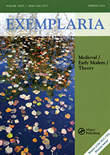
Exemplaria-Medieval Early Modern Theory
Engaging with the Rich Tapestry of Literary HeritageExemplaria: Medieval Early Modern Theory is a distinguished journal within the fields of Cultural Studies, Linguistics and Language, and Literature and Literary Theory, published by Routledge Journals, Taylor & Francis Ltd. With an impressive Q1 ranking in Literature and Literary Theory and notable placements in associated disciplines, this journal serves as an essential platform for scholars dedicated to exploring the complexities of medieval and early modern texts and contexts. Established with a vision to stimulate interdisciplinary dialogue, Exemplaria has evolved from its initial years (1989-1995) to a renewed focus (2002-2024), consistently fostering significant contributions that shape contemporary literary discourse. Although currently not open access, the journal ensures broad reach and engagement through its meticulously curated articles, reviews, and critical essays that challenge traditional narratives and advocate for innovative methodologies. With the journal's ISSN 1041-2573 and E-ISSN 1753-3074, researchers, professionals, and students interested in advancing their understanding of literary traditions are encouraged to explore its rich repository of knowledge, which reflects the dynamic interplay between historical texts and modern interpretations.
JAHRBUCHER FUR GESCHICHTE OSTEUROPAS
Connecting the Dots of Eastern Europe's Historical LandscapeJAHRBUCHER FUR GESCHICHTE OSTEUROPAS, published by FRANZ STEINER VERLAG GMBH, is a prominent academic journal dedicated to the exploration of Eastern European history. With its inception dating back to 1978, this journal has consistently provided a platform for scholarly discourse, contributing significantly to the understanding of the region's complex historical narratives. While the journal is not open access, it holds a solid reputation within the academic community, positioned in the Q4 quartile in history as per the 2023 category rankings, and stands at Rank #1636 within the Scopus Arts and Humanities History ranking. The convergence of its publication years throughout the decades emphasizes a long-standing commitment to historical research, thereby making it an essential resource for researchers, professionals, and students interested in Eastern European studies. Explore the intricate dynamics of historical events and cultural developments that shape Eastern Europe through this invaluable periodical.
AMERASIA JOURNAL
Exploring the Intersections of Culture and HistoryAMERASIA JOURNAL, published by Taylor & Francis Inc, serves as a vital platform for interdisciplinary discourse in the fields of Cultural Studies and History. With an ISSN of 0044-7471, this esteemed journal has established a presence since its inception in 1971, reflecting on the dynamic interplay of cultural narratives and historical contexts, particularly in the Asian American experience. Despite operating under a non-open access model, the journal boasts significant academic rigor, positioned within the Q3 quartile of its categories according to 2023 metrics. Aimed at researchers, professionals, and students engaged in exploring cultural dynamics, social history, and identity formation, AMERASIA JOURNAL features scholarly articles that respond to contemporary issues while informing both academic and public discourse. With its multidisciplinary focus and robust impact, it remains a noteworthy resource for those looking to enrich their understanding of the complex narratives that shape our world today.
MOYEN AGE
Fostering Insight into Historical Linguistics and Literary TheoryMOYEN AGE is a distinguished academic journal published by LE MOYEN AGE BOECK & LARCIER S A in Belgium, focused on the multifaceted disciplines of History, Linguistics, and Literature. With its ISSN 0027-2841 and E-ISSN 1782-1436, this journal serves as a platform for researchers, professionals, and students alike to engage with scholarly articles that contribute to the understanding of medieval studies. Although currently categorized in the fourth quartile across various fields as of 2023, MOYEN AGE demonstrates a commitment to fostering academic dialogue and exploration around historical linguistics and literary theory. The journal is available via subscription, making it an essential resource for those looking to deepen their knowledge in its scope, which spans from 2001 through 2024. As it continues to evolve, MOYEN AGE remains a relevant source for emerging thinkers and established scholars drawn to the complexities of the medieval era.

Caietele Echinox
Advancing Open Access Scholarship in Imagination ResearchCaietele Echinox is an esteemed open-access journal dedicated to the fields of literature, cultural studies, and imagination research, published by the University Babeș-Bolyai in Romania. Inaugurated in 2023 as an open-access platform, this journal strives to foster interdisciplinary dialogue and scholarly exploration, making its rich content accessible to a global audience. Housed within the Phantasma Center for Imagination Studies, Caietele Echinox aims to publish innovative research that examines the intersections of culture, imagination, and literature, thereby contributing to the broader understanding of human thought and artistic expression. With a commitment to high-quality scholarship, it invites contributions from researchers, professionals, and students, ensuring that vital discussions in these dynamic fields remain at the forefront of academic inquiry. By leveraging the latest in open-access publishing, Caietele Echinox stands as a crucial resource for those looking to engage with contemporary issues and themes in literary and cultural studies.
Italian Culture
Challenging Narratives, Celebrating Diversity in Italian CultureItalian Culture is a critical scholarly journal published by Routledge Journals, Taylor & Francis Ltd, focusing on the multifaceted nature of Italian cultural expressions from the 1970s to the present day. With an ISSN of 0161-4622 and an E-ISSN of 1559-0909, this journal serves as an essential platform for researchers and scholars interested in the nuanced dynamics of Italian cultural heritage, sociopolitical contexts, literature, and the visual and performing arts. Despite its current categorization in the Q4 quartile in various fields such as Cultural Studies and Literature, it remains committed to publishing insightful interdisciplinary studies that challenge conventional narratives and contribute to ongoing scholarly discourse. Notably positioned in the United Kingdom, it offers unique perspectives on Italian identity and cultural production, making it a crucial resource for students, professionals, and academics alike. The journal's scope and its convergence of cultural studies will undoubtedly stimulate academic engagement and exploration within and beyond its established readership.