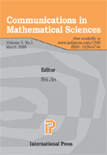
Communications in Mathematical Sciences
Scope & Guideline
Illuminating the Path of Mathematical Advancement
Introduction
Aims and Scopes
- Mathematical Analysis and PDEs:
A core focus on the existence, uniqueness, and regularity of solutions to partial differential equations (PDEs) across various applications, including fluid dynamics, magnetohydrodynamics, and biological systems. - Numerical Methods and Algorithms:
Development and analysis of numerical techniques for solving complex mathematical models, including finite element methods, spectral methods, and optimization algorithms. - Stochastic Processes and Control Theory:
Research on stochastic models and their applications in control theory, including the analysis of stochastic differential equations and their implications in various fields. - Mathematical Modeling in Applied Sciences:
Emphasis on mathematical modeling for real-world phenomena, particularly in physics, biology, and engineering, highlighting the interplay between theory and practical applications. - Emerging Mathematical Techniques:
Investigation of novel mathematical frameworks and techniques, such as machine learning applications, variational methods, and chaos theory, to address contemporary challenges in mathematical sciences.
Trending and Emerging
- Machine Learning and Data Science:
An increasing number of publications are exploring the intersection of mathematical sciences and machine learning, particularly in developing algorithms for data-driven decision-making and predictive modeling. - Nonlinear Dynamics and Chaos Theory:
A growing interest in nonlinear systems and chaos theory is evident, with research focusing on stability analysis, bifurcation theory, and applications in various scientific fields. - Multi-Scale Modeling and Analysis:
There is a marked trend towards multi-scale modeling approaches that integrate various scales of phenomena, particularly in fluid dynamics and biological systems, reflecting the complexity of real-world applications. - Stochastic Modeling in Biological and Physical Systems:
An increase in studies applying stochastic methods to biological and physical systems signifies the importance of randomness in modeling and understanding complex behaviors. - Variational Methods and Optimal Control:
Emerging research in variational methods and optimal control theory highlights the growing relevance of optimization techniques in solving complex problems across various disciplines.
Declining or Waning
- Classical Fluid Dynamics:
Research specifically focused on classical fluid dynamics models has seen a decrease, with fewer papers addressing traditional problems, possibly due to the growing interest in more complex, multi-scale models. - Static Mathematical Models:
There appears to be a reduction in studies focusing solely on static models, as the trend shifts towards dynamic, time-dependent systems that better reflect real-world applications. - Deterministic Systems without Stochastic Elements:
A waning interest in purely deterministic mathematical systems suggests a broader trend towards incorporating randomness and uncertainty into mathematical modeling.
Similar Journals
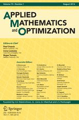
APPLIED MATHEMATICS AND OPTIMIZATION
Pioneering Applied Mathematics for Practical SolutionsApplied Mathematics and Optimization, published by Springer, is a prestigious journal dedicated to the rigorous exploration of applied mathematics, optimization techniques, and their multifaceted applications. Since its inception in 1974, the journal has maintained a robust reputation within the academic community, achieving a commendable Q1 ranking in both Applied Mathematics and Control and Optimization categories as of 2023. With an impact factor that underscores its influence in the field, the journal provides a platform for researchers and practitioners to disseminate innovative methodologies and significant advancements. While it does not offer Open Access, the journal’s esteemed peer-reviewed articles serve as invaluable resources for the advancement of theoretical knowledge and practical applications. Researchers, professionals, and students alike will find Applied Mathematics and Optimization an essential source for staying at the forefront of mathematical sciences, particularly in optimizing real-world systems and processes.
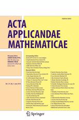
ACTA APPLICANDAE MATHEMATICAE
Exploring Innovative Solutions through Applied MathACTA APPLICANDAE MATHEMATICAE is a prestigious journal in the field of Applied Mathematics, published by Springer in the Netherlands. Since its inception in 1983, it has consistently contributed to the advancement of mathematical theory and its applications across various domains, fostering a dialogue between theoretical foundations and practical implementations. The journal holds a commendable position in the academic community, being ranked in the Q2 category and achieving a Scopus rank of 246 out of 635 in Applied Mathematics, which places it in the 61st percentile, reflecting its significant impact and relevance. ACTA APPLICANDAE MATHEMATICAE seeks to disseminate high-quality research articles, review papers, and case studies that address contemporary challenges in applied mathematics, thus inviting submissions that enhance the understanding of both foundational concepts and innovative applications. While it retains a traditional subscription-based access model, the journal emphasizes the importance of broadening the reach of mathematical research. It serves as an invaluable resource for researchers, professionals, and students eager to engage with current advancements and contribute to this dynamic field.

AIMS Mathematics
Empowering researchers with high-quality studies in mathematics.AIMS Mathematics, published by the American Institute of Mathematical Sciences (AIMS), is a premier open-access journal that has been providing a platform for innovative research since its inception in 2016. With a keen focus on diverse areas within the field of mathematics, this journal aims to disseminate high-quality studies that cater to both theoretical and applied aspects of mathematics. As evidenced by its impressive Scopus rank of 52 out of 399 in the category of General Mathematics, placing it in the 87th percentile, AIMS Mathematics stands as a significant contributor to the academic discourse in this discipline. The journal operates under Q2 in Mathematics (miscellaneous) for its 2023 category quartiles, reflecting its rigorous peer-reviewed process and substantial impact on current mathematical research. Accessible since its launch, the journal's open-access model ensures that researchers, professionals, and students alike can easily retrieve insights and advancements in mathematics, fostering collaboration and the advancement of knowledge globally.
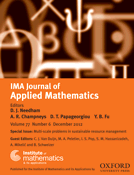
IMA JOURNAL OF APPLIED MATHEMATICS
Pioneering Research for a Mathematical TomorrowThe IMA Journal of Applied Mathematics, published by Oxford University Press, serves as a pivotal platform for disseminating innovative research in the field of applied mathematics. With its ISSN 0272-4960 and E-ISSN 1464-3634, the journal has established itself as an essential resource for academics and practitioners, showing notable engagement with both theoretical and practical aspects of mathematics. Spanning over five decades since its inception in 1965, the journal covers a broad range of topics aimed at addressing complex real-world problems through mathematical modeling and computational techniques. Holding a Q3 quartile ranking in the applied mathematics category for 2023, and a Scopus rank of #310 out of 635, it plays a significant role in contributing to the academic discourse within this dynamic field. Despite not being open access, the journal's robust reputation and commitment to rigorous peer review ensure that cutting-edge research remains accessible to its audience of researchers, professionals, and students dedicated to advancing mathematical sciences. Its ongoing commitment to exceptional scholarship makes the IMA Journal of Applied Mathematics a vital resource for those seeking to explore and apply mathematical principles in various contexts.
Applied Mathematics Letters
Connecting Scholars to Cutting-Edge Mathematical DiscoveriesApplied Mathematics Letters is a prestigious journal dedicated to the dissemination of significant research in the field of applied mathematics. Published by PERGAMON-ELSEVIER SCIENCE LTD in the United Kingdom, this journal serves as a vital resource for researchers, professionals, and students alike, aiming to bridge theoretical findings and practical applications. With an impressive impact factor placing it in the Q1 category and ranked 33 out of 635 in the Applied Mathematics category by Scopus, it showcases influential articles that contribute to advancements across various applications of mathematics. The journal's coverage from 1988 to 2025 ensures a rich archive of research that remains relevant and insightful for contemporary studies. Currently, it operates under a subscription-based model, providing access to cutting-edge research that forms the backbone of mathematical application in science and engineering. To become part of this dynamic community of scholars, readers are encouraged to explore the latest findings and ongoing discussions that highlight the interplay between mathematics and its real-world impacts.
ZEITSCHRIFT FUR ANGEWANDTE MATHEMATIK UND PHYSIK
Elevating Knowledge in Applied Mathematics and PhysicsZEITSCHRIFT FUR ANGEWANDTE MATHEMATIK UND PHYSIK, published by Springer International Publishing AG, is a leading journal in the fields of applied mathematics and physics, highly regarded as evidenced by its prestigious Q1 rankings in 2023 across multiple categories, including Applied Mathematics, Mathematics (miscellaneous), and Physics and Astronomy (miscellaneous). With an ISSN of 0044-2275 and an E-ISSN of 1420-9039, this journal covers a broad spectrum of research from theoretical frameworks to practical applications, making it an indispensable resource for researchers, professionals, and students alike. With converged years running from 1950 to 2024, it offers a rich history of contributions to the scientific community and remains vital for current advancements in mathematics and physics. While not an open-access journal, its subscription model ensures high-quality, peer-reviewed content that fosters innovation and collaboration across disciplines. The journal is conveniently located in Cham, Switzerland, providing a central hub for global research dissemination in these critical areas of study.
BIT NUMERICAL MATHEMATICS
Transforming Challenges into Solutions in Numerical Mathematics.BIT Numerical Mathematics, published by Springer, is a prestigious journal in the field of Applied Mathematics and Computational Mathematics, with an ISSN of 0006-3835 and an E-ISSN of 1572-9125. Since its inception in 1961, the journal has become a cornerstone for researchers and practitioners alike, offering high-quality articles that advance the understanding and application of numerical methods in various domains. With its impressive 2023 rankings in the Q1 category for multiple disciplines—including Applied Mathematics, Computational Mathematics, Computer Networks and Communications, and Software—the journal consistently showcases significant contributions to the mathematical community. Although it does not offer Open Access, BIT Numerical Mathematics continues to reach a vast audience through its rigorous peer-reviewed content. As it converges towards 2024, the journal remains committed to publishing cutting-edge research that addresses fundamental challenges in numerical analysis and algorithm development, ensuring its relevance in an ever-evolving scientific landscape.

TAIWANESE JOURNAL OF MATHEMATICS
Fostering innovation in mathematics for a global audience.TAIWANESE JOURNAL OF MATHEMATICS, published by the Mathematical Society of the Republic of China, is a pivotal platform for disseminating innovative research in the field of mathematics. Established in 1997 and currently encompassing works until 2024, this journal aims to foster a global dialogue among mathematicians, researchers, professionals, and students interested in diverse mathematical topics, including theoretical and applied concepts. The journal, which holds a respectable Q2 ranking in Mathematics (miscellaneous) for 2023, is acknowledged for its commitment to quality and scholarly excellence, also being listed in Scopus with a rank of #234 out of 399 in General Mathematics, positioning it in the 41st percentile among its peers. By providing unrestricted access to its research outputs, TAIWANESE JOURNAL OF MATHEMATICS ensures that vital findings are available to a broad audience, thus contributing significantly to the advancement of mathematical sciences both in Taiwan and globally.
JOURNAL OF COMPUTATIONAL AND APPLIED MATHEMATICS
Advancing the Frontiers of Applied MathematicsJOURNAL OF COMPUTATIONAL AND APPLIED MATHEMATICS, published by Elsevier, stands as a premier platform for researchers and practitioners in the fields of applied and computational mathematics. With an impressive convergence history from 1975 to 2025, this journal has established itself as a crucial reference point for innovative mathematical theories, methodologies, and applications. Holding a distinguished position in Scopus rankings—#85 out of 635 in Applied Mathematics and #36 out of 189 in Computational Mathematics—it operates in the highly competitive Q2 quartile for both disciplines as of 2023. Although currently not designated as an open-access journal, it remains widely respected for its rigorous peer-review process and high-quality research contributions. Researchers and professionals seeking to advance their work and engage with cutting-edge developments will find this journal an invaluable resource, fostering a deeper understanding and collaboration within the mathematical community.

JOURNAL OF COMPUTATIONAL MATHEMATICS
Bridging Theory and Application in MathematicsJOURNAL OF COMPUTATIONAL MATHEMATICS, published by GLOBAL SCIENCE PRESS, is a distinguished peer-reviewed academic journal dedicated to advancing the field of computational mathematics. With a focus on high-quality research that bridges theoretical and practical applications, this journal aims to disseminate innovative methodologies and robust algorithms that address complex mathematical problems. Operating without an open-access model, it maintains a reputable standing with a Q2 category classification in computational mathematics as of 2023, showcasing its influence and relevance within the academic community. The journal, which has been in publication since 1996, continues to evolve, providing a platform for researchers, practitioners, and students to engage with cutting-edge developments up to 2024. By contributing to the body of knowledge in computational mathematics, this journal plays a vital role in fostering collaboration and advancement in related disciplines.