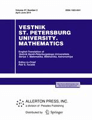
Vestnik St Petersburg University-Mathematics
Scope & Guideline
Cultivating Academic Excellence in Mathematics
Introduction
Aims and Scopes
- Applied Mathematics and Mechanics:
The journal frequently publishes papers focusing on the application of mathematical methods to solve real-world problems in mechanics, fluid dynamics, and material science. - Mathematical Modeling and Simulation:
A significant portion of the research involves the development of mathematical models and simulations, particularly in dynamics, vibrations, and control systems. - Theory of Differential Equations:
The journal showcases research on ordinary and partial differential equations, focusing on their qualitative and quantitative analysis, including stability and control aspects. - Numerical Methods and Computational Mathematics:
There is a strong emphasis on numerical analysis, with articles discussing algorithms, computational techniques, and applications to various mathematical problems. - Probability and Statistics:
Research in probability theory and statistics is prevalent, particularly in relation to stochastic processes and their applications in engineering and natural sciences. - Algebra and Functional Analysis:
The journal also includes contributions in abstract algebra, functional analysis, and their applications to other mathematical disciplines. - Research History and Educational Insights:
Notably, the journal features reviews and historical accounts of mathematical research, reflecting on the contributions of the St. Petersburg School of Mathematics.
Trending and Emerging
- Machine Learning and Artificial Intelligence:
There has been a marked increase in the application of machine learning techniques to solve mathematical problems, reflecting the broader trend in mathematics and engineering towards integrating AI methodologies. - Complex Systems and Nonlinear Dynamics:
Research exploring complex systems, chaos theory, and nonlinear dynamics is on the rise, showcasing a shift towards understanding intricate mathematical models that describe real-world phenomena. - Mathematical Biology and Ecology:
Emerging themes in mathematical biology and ecological modeling are becoming more prominent, indicating a growing interest in applying mathematical techniques to biological and environmental issues. - Control Theory and Optimization:
The journal has seen a surge in publications related to control theory and optimization problems, emphasizing their applications in engineering and technology. - Stochastic Processes and Random Systems:
There is an increasing focus on stochastic models and their applications in various fields, reflecting a broader trend towards incorporating randomness and uncertainty in mathematical modeling.
Declining or Waning
- Classical Mechanics:
Although classical mechanics has a foundational role in mathematics, papers specifically focusing on traditional mechanics concepts seem to be decreasing, possibly overshadowed by more modern mathematical applications. - Static Equations and Elasticity:
Research focusing on static equilibrium problems and classical elasticity theory appears to be declining, as new methodologies and interdisciplinary approaches gain traction. - Pure Algebraic Structures:
There seems to be a waning interest in purely theoretical algebraic structures without direct applications, as more applied mathematical studies are favored. - Traditional Statistical Methods:
The focus on classical statistical methods is decreasing, with a noticeable shift towards machine learning and computational statistics, indicating a transition in preferred methodologies. - Historical Mathematical Analysis:
While historical insights into mathematics remain relevant, the frequency of papers dedicated solely to historical analysis seems to be diminishing in favor of contemporary mathematical challenges.
Similar Journals

Italian Journal of Pure and Applied Mathematics
Elevating Research Standards in MathematicsThe Italian Journal of Pure and Applied Mathematics, published by FORUM EDITRICE UNIV UDINESE, is an esteemed platform dedicated to the dissemination of high-quality research within the field of mathematics. With an ISSN of 1126-8042 and an E-ISSN of 2239-0227, this journal serves as a crucial resource for mathematicians seeking to contribute to current discussions and advancements in both pure and applied mathematical sciences. Although the journal currently holds a quartile rank of Q4 in the field of miscellaneous mathematics and is positioned within the 10th percentile of Scopus rankings, it remains committed to fostering valuable academic discourse. This journal particularly welcomes submissions that explore innovative mathematical theories and methodologies, offering a unique insight into the diverse aspects of mathematical research. Operating under a traditional access model, it provides a gateway for researchers, professionals, and students to deepen their understanding and expand their contributions to the mathematical community. With coverage spanning from 2010 to 2024, the journal continues to enhance its reputation as a reliable source of contemporary mathematical scholarship.
Afrika Matematika
Fostering collaboration and excellence in mathematical scholarship.Afrika Matematika is a prominent academic journal published by SPRINGER HEIDELBERG, dedicated to advancing research in the field of mathematics. With an ISSN of 1012-9405 and E-ISSN of 2190-7668, the journal has earned recognition for its contributions to diverse areas within mathematics, particularly through its designation in the Q3 quartile of the 2023 mathematics category and ranking 113 out of 399 in general mathematics on Scopus, reflecting a commendable 71st percentile standing. Covering a wide array of topics, the journal serves as an essential platform for researchers, professionals, and students engaged in mathematical studies and practical applications. Although not open access, Afrika Matematika maintains a rigorous peer-review process to ensure the high quality and relevance of its published articles, which are pivotal in shaping the mathematical landscape in Africa and beyond. With a convergence of scholarly work spanning from 2011 to 2024, this journal underscores its commitment to fostering a vibrant academic community that inspires innovation and collaboration in mathematical research.
Lithuanian Mathematical Journal
Catalyzing Collaboration in the World of MathematicsLithuanian Mathematical Journal is a prominent academic publication that has been advancing the field of mathematics since its inception in 1973. Published by SPRINGER, this journal provides a platform for researchers, professionals, and students to disseminate their findings and engage with the latest developments in various branches of mathematics. With an ISSN of 0363-1672 and an E-ISSN of 1573-8825, it is accessible to a global audience, primarily serving as a hub for mathematical discourse and innovation. Despite its current categorization in Q4 within the miscellaneous mathematics category and holding a Scopus rank of #284 out of 399, the journal continuously aims to elevate its impact by contributing to significant mathematical research. The importance of this journal lies not only in its rigorous peer-review process but also in its commitment to fostering academic collaboration and knowledge exchange in a structured yet dynamic environment.
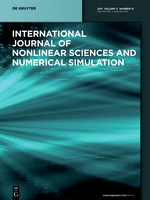
INTERNATIONAL JOURNAL OF NONLINEAR SCIENCES AND NUMERICAL SIMULATION
Advancing the Frontiers of Nonlinear ScienceINTERNATIONAL JOURNAL OF NONLINEAR SCIENCES AND NUMERICAL SIMULATION, published by WALTER DE GRUYTER GMBH, serves as a premier platform for advancing knowledge in the vibrant domains of applied mathematics, computational mechanics, and various fields of engineering and physics. With an ISSN of 1565-1339, this journal has been at the forefront of disseminating significant research findings since its inception in 2000. Its commitment to quality is reflected in its category quartiles for 2023, ranked Q2 in Computational Mechanics and Engineering (miscellaneous), and Q3 in multiple engineering disciplines. Although it currently operates under a subscription model, the journal remains dedicated to presenting groundbreaking studies that explore complex nonlinear phenomena and numerical methodologies. As an invaluable resource for researchers, professionals, and students alike, the journal aims to foster innovation and collaboration across related fields, enhancing both theory and application through its peer-reviewed articles.
PROCEEDINGS OF THE EDINBURGH MATHEMATICAL SOCIETY
Charting new territories in mathematical thought.PROCEEDINGS OF THE EDINBURGH MATHEMATICAL SOCIETY, published by Cambridge University Press, stands as a cornerstone within the realm of mathematical research, providing a platform for original papers that push the boundaries of various mathematical disciplines. With a rich history dating back to 1883, this journal has evolved through several converged years, reflecting the dynamic nature of mathematical inquiry. As a Q2 category journal in the field of Mathematics (miscellaneous) according to the latest rankings, it situates itself within the upper tier of academic publications, offering an essential resource for researchers and professionals alike. While it currently does not offer open access options, the journal's contributions are invaluable, facilitating dialogue and collaboration among scholars. The journal's commitment to advancing mathematical knowledge makes it a vital publication for those engaged in the study and application of mathematical theories and principles.

NONLINEARITY
Shaping the Future of Mathematical PhysicsNONLINEARITY is a premier academic journal published by IOP Publishing Ltd, dedicated to advancing the field of complex systems through the lens of nonlinear science. Since its inception in 1988, the journal has established itself as a vital resource for researchers and professionals alike, offering a robust platform for disseminating high-quality research in areas such as applied mathematics, mathematical physics, and statistical and nonlinear physics. With an impressive Q1 ranking across multiple pertinent categories, including Applied Mathematics and Mathematical Physics, NONLINEARITY ranks among the top journals globally, making it essential reading for those seeking to deepen their understanding of nonlinear phenomena. Although it does not operate under an open-access model, its rich repository of rigorous articles significantly contributes to academia, fostering innovative thought and facilitating cutting-edge research. Located in the heart of the United Kingdom at TEMPLE CIRCUS, TEMPLE WAY, BRISTOL BS1 6BE, NONLINEARITY continues to be at the forefront of the scientific community, championing new discoveries and interdisciplinary dialogue within its dynamic scope.
Bulletin of the Malaysian Mathematical Sciences Society
Exploring New Dimensions of Mathematical ResearchThe Bulletin of the Malaysian Mathematical Sciences Society, published by SPRINGER NATURE, is a prominent academic journal dedicated to advancing the field of mathematics. With an ISSN of 0126-6705 and an E-ISSN of 2180-4206, the journal has established itself as a vital resource for researchers, professionals, and students alike. Based in Singapore, it boasts an impressive Q2 ranking in the miscellaneous mathematics category for 2023, alongside a notable position of 90th out of 399 in the general mathematics Scopus rankings, placing it in the 77th percentile. The Bulletin serves to disseminate innovative research findings, foster mathematical dialogue, and promote collaboration among the global mathematical community, with coverage ranging from theoretical frameworks to practical applications. Readers can expect an engaging mix of original research articles, reviews, and communications that contribute significantly to the evolving landscape of mathematical sciences.

Punjab University Journal of Mathematics
Elevating the discourse of theoretical and applied mathematics.Punjab University Journal of Mathematics is a prestigious academic journal published by the Department of Mathematics at the University of Punjab, Pakistan. Dedicated to advancing the field of mathematics, this journal provides a platform for researchers, educators, and students to disseminate their findings, foster scholarly dialogue, and promote innovative mathematical research. With a strong focus on theoretical and applied mathematics, the journal maintains a rigorous peer-review process to ensure high-quality publications that significantly contribute to the mathematical community. Although currently not indexed in prominent databases, the journal aims to elevate its visibility and impact through consistent publication of cutting-edge research. The absence of Open Access reflects a commitment to quality and thorough review, but researchers are encouraged to seek out this valuable resource for its insights and diverse contributions to mathematics.

Siberian Electronic Mathematical Reports-Sibirskie Elektronnye Matematicheskie Izvestiya
Bridging Disciplines through Mathematical InsightsSiberian Electronic Mathematical Reports (Sibirskie Elektronnye Matematicheskie Izvestiya) is a prominent academic journal dedicated to the dissemination of cutting-edge research in the field of mathematics. Published by the esteemed Sobolev Institute of Mathematics in the Russian Federation, this journal provides a vital platform for scholars from around the globe to share their innovative findings and methodologies. With an ISSN of 1813-3304 and an impressive recognition within the academic community, the journal currently holds a Q2 classification in Mathematics (miscellaneous) and ranks #256 out of 399 in general mathematics according to Scopus, indicating its relevance and contribution to the field. While operating on an open-access model, Siberian Electronic Mathematical Reports ensures that high-quality research is readily accessible, promoting collaboration and knowledge sharing among researchers, professionals, and students. Covering a broad spectrum of mathematical topics, it aims to foster interdisciplinary connections and advance the understanding of mathematical principles in various applications. As it converges years from 2011 to 2024, this journal remains an essential resource for those looking to stay updated on significant advancements and contemporary discussions within the mathematical sciences.
FORUM MATHEMATICUM
Elevating Mathematical Discourse Since 1989FORUM MATHEMATICUM, published by WALTER DE GRUYTER GMBH, is a distinguished academic journal based in Germany, known for its significant contributions to the field of mathematics. With an ISSN of 0933-7741 and an E-ISSN of 1435-5337, the journal features comprehensive studies ranging from applied mathematics to diverse mathematical disciplines. Having maintained a commendable presence since 1989, FORUM MATHEMATICUM has achieved notable classification rankings, including Q2 in Applied Mathematics and Q1 in miscellaneous Mathematics as of 2023. Additionally, it holds a Scopus rank within the top 60th percentile in General Mathematics, making it a prominent platform for researchers and professionals seeking rigorous analysis and innovative methodologies in mathematics. While the journal does not currently offer open access, its rich content is pivotal for advancing mathematical theory and applications, appealing to students and seasoned academics alike.