COMPUTERS ENVIRONMENT AND URBAN SYSTEMS
Scope & Guideline
Pioneering Research at the Nexus of Ecology and Urbanism
Introduction
Aims and Scopes
- Integration of Computational Techniques:
The journal emphasizes the application of advanced computational techniques such as machine learning, deep learning, and artificial intelligence in urban studies, allowing for more precise modeling and analysis of urban systems. - Sustainability and Resilience:
Research often focuses on sustainable urban development, exploring how urban systems can be designed to be more resilient to environmental changes and disasters, particularly in the context of climate change. - Data-Driven Decision Making:
Utilizing big data and geospatial data analytics, the journal promotes research that aids decision-making processes in urban planning, enhancing the understanding of urban dynamics and citizen engagement. - Participatory Urban Planning:
The journal features studies on participatory methods in urban planning, including the use of digital tools and social media to engage communities in the planning process. - Urban Mobility and Accessibility:
A significant focus is placed on understanding urban mobility patterns and accessibility issues, particularly in relation to public transport and active transportation modes. - Spatial Analysis and Modeling:
The journal provides a platform for innovative spatial analysis methods, including agent-based modeling and simulation techniques, to study urban phenomena.
Trending and Emerging
- Smart Cities and Technologies:
Research on smart city initiatives, including the integration of IoT (Internet of Things) and smart technologies in urban infrastructure, is rapidly increasing, highlighting the role of technology in enhancing urban living. - Health and Wellbeing in Urban Spaces:
There is a growing emphasis on the impact of urban environments on public health and wellbeing, particularly in relation to designing spaces that promote physical activity and mental health. - Equity and Social Justice:
Emerging themes focus on social equity in urban planning, examining how urban policies and infrastructures affect different demographic groups, particularly marginalized communities. - Climate Adaptation Strategies:
With climate change becoming a pressing issue, research focused on urban adaptation strategies and resilience planning is on the rise, addressing how cities can cope with environmental changes. - Data Ethics and Privacy:
As urban studies increasingly rely on big data, there is an emerging focus on ethical considerations and privacy issues related to data collection and usage in urban research.
Declining or Waning
- Traditional Urban Planning Methods:
There is a noticeable decline in research focusing solely on traditional urban planning methods, as the field increasingly embraces data-driven and computational approaches. - Static Models of Urban Dynamics:
Static models that do not incorporate temporal dynamics are becoming less common, as the emphasis shifts toward understanding the dynamic nature of urban environments through real-time data. - Generalized Case Studies:
Research that presents generalized findings without specific contextual analysis is waning, with a growing preference for studies that provide localized insights and tailored solutions. - Non-Participatory Approaches:
The focus on non-participatory urban planning approaches is decreasing, as there is a stronger push for community engagement and participatory methodologies in urban research.
Similar Journals

Urbe-Revista Brasileira de Gestao Urbana
Empowering Urban Futures through Open Access ResearchUrbe-Revista Brasileira de Gestão Urbana is a prominent academic journal dedicated to the field of urban management and development, published by the esteemed Pontificia Universidade Catolica do Paraná (PUCPR). This open-access journal, actively disseminating knowledge since 2009, focuses on advancing awareness and understanding of urban planning, architecture, and geographical issues in Brazil and beyond. With an impressive impact reflected in its 2023 quartile rankings—Q2 in Architecture, Q3 in Geography, Planning and Development, and Q3 in Urban Studies—Urbe serves as a vital platform for researchers and professionals alike. The journal strives to foster interdisciplinary dialogue and provide valuable insights into contemporary urban challenges, making it an essential resource for those engaged in the study and practice of urban management. Scholars can access it freely, enhancing its reach and relevance in an increasingly interconnected world.
JOURNAL OF URBAN TECHNOLOGY
Fostering Interdisciplinary Dialogue in Urban InnovationJOURNAL OF URBAN TECHNOLOGY is a premier academic journal published by Routledge Journals, Taylor & Francis Ltd, focusing on the intersection of technology and urban studies. With a strong commitment to advancing knowledge in urban environments, this journal has achieved impressive rankings, being classified in the top Q1 quartile for Urban Studies and holding a position of #16 out of 279 in its category according to Scopus. It serves as a vital platform for researchers, professionals, and students interested in exploring innovative solutions and theoretical considerations in urban technology, offering a comprehensive range of articles that cover both empirical and conceptual works. While the journal is not open access, it provides exceptional insights and fosters interdisciplinary dialogue, making it an essential resource for anyone engaged in shaping the future of urban spaces. Established in 1992 and continuing to significantly influence the field, the JOURNAL OF URBAN TECHNOLOGY stands out as a key publication for those committed to exploring the complexities of urban life in the digital age.
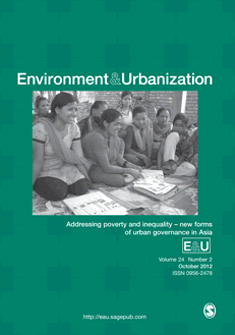
ENVIRONMENT AND URBANIZATION
Leading the dialogue on urbanization and ecological balance.Environment and Urbanization is a leading interdisciplinary journal published by SAGE Publications Ltd, dedicated to advancing knowledge in the fields of Environmental Science and Urban Studies. With a strong focus on the interactions between urban environments and ecological systems, this journal has established itself as a pivotal resource for researchers, professionals, and students interested in sustainable urban development and environmental management. Since its inception in 1989, Environment and Urbanization has continually provided high-quality, peer-reviewed articles that foster a deeper understanding of contemporary urban challenges, making it a highly cited publication with an impressive impact factor. As evidenced by its Q1 ranking in both Environmental Science (miscellaneous) and Urban Studies for 2023, the journal stands at the forefront of research, boasting notable Scopus rankings in its fields. By remaining committed to publishing cutting-edge research, the journal aims to influence policy and practice across the globe, ultimately aiding in the creation of more resilient and livable urban areas.
APPLIED GEOGRAPHY
Shaping the future of interdisciplinary research in applied geography.APPLIED GEOGRAPHY, published by Elsevier Science Ltd, stands as a premier journal within the fields of environmental science, geography, planning and development, as well as tourism, leisure, and hospitality management. With an impressive 2023 impact factor that reflects its high citation rates, this journal is ranked Q1 in several categories, underscoring its significance and influence in interdisciplinary research. Covering a broad range of topics from innovative environmental practices to spatial analysis and socio-economic factors affecting tourism, APPLIED GEOGRAPHY promotes insightful discussions and practical applications that are vital for advancing knowledge and practice in these fields. Researchers, professionals, and students will find the journal's rigorous peer-reviewed articles invaluable for staying informed about the latest trends and findings impacting the geospatial landscape. As an essential resource, APPLIED GEOGRAPHY aims to foster interdisciplinary collaborations and inspire scholarly dialogue, making it a cornerstone for those engaged in the study and application of geography across various sectors.
CITIES
Connecting Scholars to the Heart of Urban IssuesCITIES is an esteemed academic journal published by Elsevier Science Ltd, focusing on interdisciplinary research pertaining to urban environments, their development, and associated sociopolitical dynamics. Since its inception in 1983, CITIES has become a vital resource for scholars and practitioners in the fields of Urban Studies, Sociology, Political Science, and Tourism, Leisure, and Hospitality Management, reflecting its distinguished status with a 2023 Q1 ranking in multiple categories. With an impressive Scopus rank placing it among the top percentile of journals in these domains, it serves as a platform for innovative research and dialogue on pressing urban issues. Although it currently does not offer open access, CITIES attracts a global readership dedicated to advancing knowledge on urbanism. Scholars and professionals seeking to contribute to the evolving discourse on urban life will find CITIES an essential publication, bridging theories and practice for a better understanding of our urban future.
EURE-REVISTA LATINOAMERICANA DE ESTUDIOS URBANO REGIONALES
Exploring the Dynamics of Urban Life in Latin AmericaEURE-REVISTA LATINOAMERICANA DE ESTUDIOS URBANO REGIONALES, published by the Pontificia Universidad Católica de Chile, is a pivotal journal in the field of Urban Studies, focusing on the complexities and dynamics of urban and regional environments across Latin America. Since its inception in 1979 and transitioning to an open-access format in 1997, this journal aims to provide a platform for scholars, policymakers, and practitioners to share innovative research and insights on urban development, policy, and sustainability. With an impact factor robust enough to rank it in the Q2 category within Urban Studies and a Scopus rank of #124 out of 279, EURE stands out as a significant contributor to understanding urban phenomena in the region. Researchers and students alike will find in this journal a wealth of empirical studies, theoretical discussions, and case analyses, enriching the discourse on urban challenges and opportunities in contemporary Latin America.

Territorios
Illuminating the Pathways of Urban TransformationTerritorios, an esteemed Open Access journal published by UNIV ROSARIO in Colombia since 1999, serves as a critical platform for the dissemination of knowledge in the fields of Geography, Urban Studies, and Development Planning. With an ISSN of 0123-8418 and an E-ISSN of 2215-7484, the journal has been recognized for its commitment to promoting rigorous research and innovative practices within its scope. In the 2023 evaluation, it achieved notable rankings, placing in the Q4 category in Geography, Planning and Development, and Q3 in Urban Studies, reflecting its growing impact in the social sciences. Although currently positioned in the lower percentiles, the journal plays an important role in amplifying diverse voices and perspectives, encouraging scholarly dialogue in an ever-evolving urban landscape. The address of the journal's home is found at PROGRAMA PSICOLOGIA, FAC MED, CARRERA 24 63 C-69 QUINTA DE MUTIS, BOGOTA, COLOMBIA. Researchers, professionals, and students seeking a comprehensive understanding of contemporary geographical issues and urban development trends will find Territorios to be an invaluable resource.

Smart Cities
Exploring the Intersection of Technology and Urban LifeSmart Cities is an esteemed academic journal published by MDPI, dedicated to the interdisciplinary exploration of urban innovation through advanced technologies, particularly in the realms of Artificial Intelligence, Electrical and Electronic Engineering, and Urban Studies. Since its inception in 2018, the journal has established itself as a prominent source of cutting-edge research, maintaining a commendable ranking within the top quartile (Q1) across its focus areas. With an impressive impact factor reflective of its influence—ranked 6th out of 279 in Urban Studies and within the top 15% in related engineering and computer science fields—the journal ensures accessibility to its content through an Open Access model, enabling researchers, professionals, and students from around the globe to engage with and contribute to the ongoing dialogue about the future of smart urban environments. Situated in Switzerland, the journal is positioned at the nexus of innovation and urban development, making it an indispensable resource for those seeking to advance knowledge and applications in smart city initiatives.

ACE-Architecture City and Environment
Advancing Knowledge in Architecture and Urban EnvironmentsACE-Architecture City and Environment, published by Universitat Politècnica de Catalunya in Spain, serves as an essential repository for innovative research and insights that intersect the fields of architecture, urban studies, and environmental planning. Since its establishment as an Open Access journal in 2006, it has facilitated widespread accessibility to scholarly work, fostering a collaborative and inclusive academic community. The journal has consistently maintained a prominent standing within its field, reflected in its 2023 Quartile rankings—, Q3 in Geography, Planning and Development, and Q2 in Urban Studies. With a publication horizon extending from 2011 to 2024 and an impressive Scopus ranking among peers, it offers a comprehensive platform for researchers to disseminate their findings and engage with contemporary challenges in urban environments. ACE is pivotal for professionals and students alike, striving to shape the future of sustainable architecture and urban planning through rigorous scholarship.

Planlama-Planning
Elevating Discussions on Urban DevelopmentPlanlama-Planning is a distinguished journal published by KARE PUBL, dedicated to the evolving field of urban and regional planning. With its ISSN 1300-7319, it provides a platform for researchers, practitioners, and students to share innovative research and comprehensive reviews on critical planning issues and methodologies. Situated in Istanbul, Turkiye, the journal aims to facilitate discussions that address contemporary challenges in planning and promote sustainable development. Although currently not an open-access journal, it upholds rigorous peer-review standards to ensure high-quality publications. With a commitment to advancing knowledge and fostering collaboration across disciplines, Planlama-Planning stands as a crucial resource for those engaged in shaping cities and communities worldwide.