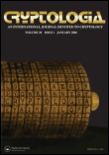
CRYPTOLOGIA
metrics 2024
Empowering Scholars in the Evolving World of Cryptography
Introduction
CRYPTOLOGIA, published by Taylor & Francis Inc, is a pivotal journal dedicated to the field of cryptography and its applications. With an ISSN of 0161-1194 and an E-ISSN of 1558-1586, this journal has been a significant platform since its inception in 1977, promoting rigorous peer-reviewed research for scholars and practitioners alike. Although the journal's coverage was discontinued in Scopus after 2018, its legacy continues through a devoted readership, and it remains influential in the domains of Computer Science and Applied Mathematics, as indicating by its Scopus rankings. CRYPTOLOGIA presents a crucial repository of knowledge for those engaged in the evolving challenges of secure communication and information integrity. Researchers, professionals, and students interested in cryptographic protocols and theory can find invaluable insights and advancements within its pages, all while benefiting from the quality assurance of a reputable publisher.
Metrics 2024
 -0.300.60-
Metrics History
Rank 2024
Scopus
IF (Web Of Science)
JCI (Web Of Science)
Quartile History
Similar Journals

International Journal of Mathematics and Computer Science
Exploring Innovative Solutions in Mathematical SciencesThe International Journal of Mathematics and Computer Science (ISSN: 1814-0424, E-ISSN: 1814-0432), published by Lebanese University, serves as a vital platform for disseminating innovative research and advancements in the fields of mathematics and computer science. With a compelling range of topics including Algebra, Applied Mathematics, Computational Mathematics, and Statistical Analysis, this journal caters to a broad audience of researchers, professionals, and students. Spanning the years from 2017 to 2025, it has established a presence in several key quartiles, including Q3 rankings in Applied Mathematics and Computational Mathematics, and a Q4 ranking in Algebra and Number Theory. While currently not an open-access journal, it provides valuable insights through its rigorous peer-reviewed process, enhancing its relevance in both theoretical and applied domains. Furthermore, its presence in Scopus rankings reflects its commitment to quality, making it an essential resource for anyone looking to explore the intersection of mathematics and computer science.
PROGRAMMING AND COMPUTER SOFTWARE
Unveiling Insights into Evolving Programming TechniquesPROGRAMMING AND COMPUTER SOFTWARE is a distinguished journal committed to advancing the field of software development and programming methodologies. Published by PLEIADES PUBLISHING INC, this journal has been a valuable resource since its inception in 1978, reaching out to researchers, professionals, and students alike. With an emphasis on rigorous peer-reviewed articles, the journal holds a Q3 ranking in the realm of Software according to the latest 2023 Category Quartiles. Though it does not offer open access, the journal ensures that high-quality research is disseminated to its audience, providing insights into evolving programming techniques, software engineering challenges, and innovative solutions. With its convergence of years extending to 2024, PROGRAMMING AND COMPUTER SOFTWARE remains a pivotal publication, fostering a deeper understanding of the complexities in computer programming while supporting the broader software community.
Discrete Mathematics and Applications
Pioneering Research in Discrete and Applied Mathematical Fields.Discrete Mathematics and Applications, published by WALTER DE GRUYTER GMBH, is a vital academic journal catering to the expansive fields of Discrete Mathematics and Applied Mathematics. With an ISSN of 0924-9265 and an E-ISSN of 1569-3929, it serves as a reputable platform for disseminating innovative research and developments within these domains. The journal has been contributing to the academic landscape since its inception in 1991 and continues to actively publish impactful studies through 2024. Despite its current positioning in Q4 of both the Applied Mathematics and Discrete Mathematics and Combinatorics categories, the journal is dedicated to fostering essential discussions that advance understanding and application of discrete mathematical concepts. It provides researchers, professionals, and students with access to a wealth of knowledge, encouraging collaboration and growth within the field. With its strategic German headquarters in Berlin and a focused aim to enhance the visibility and significance of discrete mathematics in real-world applications, Discrete Mathematics and Applications stands out as an important resource for those seeking to contribute to the ongoing evolution of mathematical sciences.

Cryptography
Advancing Knowledge in Information SecurityCryptography, an esteemed journal published by MDPI, focuses on the rapidly evolving fields of cryptography and information security, providing a platform for researchers and practitioners to share their findings and advancements. Since its inception in 2017, it has embraced an Open Access model, allowing unrestricted access to high-quality research articles, thereby fostering collaboration and innovation among academics globally. Based in Switzerland, this journal aims to cover a broad spectrum, from theoretical foundations to practical applications, contributing significantly to fields such as Applied Mathematics and Computer Science. Its impressive rankings in reputable databases like Scopus reflect its relevance and quality, holding a Q2 category in multiple disciplines, including Computational Theory and Mathematics and Computer Networks and Communications. With the continuous rise in importance of cybersecurity and data protection, Cryptography serves as a vital resource for professionals, students, and researchers dedicated to advancing knowledge in these critical areas.
Cryptography and Communications-Discrete-Structures Boolean Functions and Sequences
Advancing secure communications through discrete mathematics.Cryptography and Communications - Discrete Structures, Boolean Functions and Sequences is a distinguished journal published by Springer, focusing on the crucial intersections of cryptography, discrete mathematics, and communication systems. With a significant presence in the academic community since its inception in 2009, the journal has established a robust reputation, holding a Q1 ranking in Applied Mathematics and notable positions in other relevant categories, reflecting its impact in the field. Researchers and professionals will find this journal engaging as it rigorously explores the theoretical underpinnings and practical applications of boolean functions and sequences, essential for advancing secure communication protocols and efficient data processing. Despite not currently offering open access, the journal is highly regarded for its quality peer-reviewed articles, making it a vital resource for scholars aiming to contribute to or stay at the forefront of cryptographic research. Its continual publication through 2024 ensures an ongoing dialogue in this rapidly evolving field, enhancing understanding and innovation among its readership in the United States and beyond.

JSIAM Letters
Bridging Theory and Practice in MathematicsJSIAM Letters, with ISSN 1883-0609 and E-ISSN 1883-0617, is an esteemed journal published by the Japan Society of Industrial and Applied Mathematics (JSIAM). Focusing on the latest advancements in the field of industrial and applied mathematics, this journal serves as a vital platform for researchers, professionals, and students to disseminate their findings and exchange innovative ideas. Although it currently does not offer Open Access options, JSIAM Letters maintains a strong reputation for high-quality, peer-reviewed articles that contribute to the growth and application of mathematical techniques in various industrial contexts. With a commitment to fostering collaboration within the mathematical community, JSIAM Letters plays a crucial role in bridging the gap between theoretical research and practical application, making it indispensable for anyone interested in the intersection of math and industry.
Journal of Information and Telecommunication
Exploring Innovations in Information Technology and Telecommunications.Journal of Information and Telecommunication, published by TAYLOR & FRANCIS LTD, is a distinguished open access journal that has been enhancing the global discourse since its establishment in 2017. With an ISSN of 2475-1839 and an E-ISSN of 2475-1847, this journal is located in the United Kingdom and dedicates its focus to the fields of information technology, telecommunications, and related disciplines. Boasting a respectable Q2 quartile ranking across various categories including Computer Networks and Communications, Electrical and Electronic Engineering, and Computer Science Applications in 2023, it ranks notably in the top percentiles of scopus rankings, asserting its significance in the academic community. The journal's commitment to open access since its inception has fostered widespread accessibility, encouraging research dissemination and collaboration on a global scale. By providing a platform for high-quality research, it aims to unite researchers, professionals, and students in their pursuit of innovation and excellence in the ever-evolving digital landscape.
DESIGNS CODES AND CRYPTOGRAPHY
Advancing Knowledge in Codes and Secure CommunicationDesigns, Codes and Cryptography is a renowned peer-reviewed journal published by Springer, dedicated to the interdisciplinary fields of applied mathematics, computer science, and discrete mathematics. With an exceptional impact factor, this journal is recognized for its high-quality research contributions and currently holds a prestigious Q1 ranking in multiple categories, including Applied Mathematics and Theoretical Computer Science, as of 2023. Featuring an extensive range of articles from 1991 to 2024, the journal serves as a pivotal platform for professionals, researchers, and students alike, focusing on innovative developments in coding theory, cryptography, and their practical applications in computing and secure communication. The journal's scope encompasses theoretical foundations, as well as algorithmic and applied aspects, making it an essential resource for advancing knowledge in the rapidly evolving fields of computer science and mathematics.
INFORMATION PROCESSING LETTERS
Innovating the Future of Computational ScienceINFORMATION PROCESSING LETTERS, published by ELSEVIER and with an ISSN of 0020-0190, is a prominent academic journal that serves as a vital resource in the fields of Computer Science, Information Systems, and Signal Processing, among others. As evidenced by its Q3 ranking across various categories in 2023, including Computer Science Applications and Theoretical Computer Science, it provides a rigorous platform for the dissemination of innovative research and theoretical developments. Researchers and professionals can delve into a wide array of subjects pertinent to information processing, contributing to advancements in technology and data management. Although it does not offer Open Access options, the journal maintains an influential presence in scholarly discourse, making it a crucial reference for those engaged in computational innovations and system optimizations. With coverage from 1971 to 2025, it continues to be integral for both seasoned academics and emerging scholars.
Communications in Applied Mathematics and Computational Science
Elevating the discourse in mathematical sciences and their applications.Communications in Applied Mathematics and Computational Science is a premier journal published by MATHEMATICAL SCIENCE PUBL, dedicated to advancing the fields of applied mathematics and computational science. With an ISSN of 1559-3940 and an E-ISSN of 2157-5452, this journal has established itself as a significant platform for disseminating innovative research and methodologies. Covering a vast range of topics, from mathematical modeling and numerical analysis to computation theory and applications in computer science, it holds an impressive Q2 ranking in multiple categories as of 2023, including Applied Mathematics and Computational Theory. Researchers and practitioners can access high-caliber articles that contribute to both foundational understanding and practical applications, reflecting state-of-the-art advancements in the field. The journal encourages an open exchange of ideas and results, making it essential reading for academics and professionals aiming to stay at the forefront of contemporary computational techniques and applied mathematical research. With a publication timeline spanning from 2006 to 2024, it continues to enrich the intellectual landscape and foster collaboration across disciplines.