
Cuadernos de Estudios Gallegos
Scope & Guideline
Exploring the Depths of Galician Heritage
Introduction
Aims and Scopes
- Cultural Heritage Studies:
The journal emphasizes the preservation, interpretation, and promotion of Galician cultural heritage, including archaeological sites, historical artifacts, and intangible cultural practices. - Historical Analysis:
It provides a platform for exploring various historical periods in Galicia, from the Roman era to the modern age, examining social, political, and economic developments. - Archaeological Research:
The journal publishes original research on archaeological findings within Galicia, contributing to the understanding of the region's past and its significance in the broader Iberian context. - Environmental and Landscape Studies:
Articles often address the interplay between climate, landscape changes, and human activity, particularly in relation to significant historical events like the Little Ice Age. - Sociocultural Dynamics:
The exploration of immigration patterns, social structures, and cultural exchanges, especially in the context of Galician communities abroad, is a recurring theme. - Art and Architecture History:
The journal includes studies on the evolution of artistic styles and architectural practices in Galicia, reflecting the region's cultural exchanges and historical transformations.
Trending and Emerging
- Climate Change and Environmental Impact:
An increasing number of studies are exploring the effects of climate change on historical landscapes and societies, highlighting the relevance of environmental factors in historical narratives. - Migration and Diaspora Studies:
Research focusing on Galician emigration patterns and the integration of Galician communities abroad has gained traction, reflecting contemporary global migration dynamics. - Digital Archaeology and Technology Integration:
The use of modern technologies like aerial imagery and LiDAR for archaeological research is emerging, showcasing innovative methodologies in the study of historical sites. - Cultural Memory and Identity:
There is a growing emphasis on the concepts of cultural memory and identity, particularly in relation to Galician heritage and its representation in contemporary society. - Interdisciplinary Approaches:
The journal increasingly favors interdisciplinary studies that merge history, sociology, art, and environmental science, reflecting a holistic view of cultural studies.
Declining or Waning
- Medieval Political History:
Although historical studies remain a staple, there has been a noticeable decline in articles specifically focused on the intricate political dynamics of medieval Galicia. - Religious Studies in Historical Contexts:
Research on the role of religion in historical contexts, particularly during the Middle Ages, appears less frequently, suggesting a waning interest in ecclesiastical history. - Colonial and Global Studies:
Themes related to Galicia's colonial interactions and their global implications have diminished, possibly due to a shift towards more localized studies. - Traditional Craftsmanship and Folklore:
There is a noticeable decrease in publications centered on traditional crafts and folklore, indicating a possible shift towards more contemporary cultural studies. - Studies on the Iberian Peninsula's Broader Context:
Research that situates Galicia within the larger narrative of the Iberian Peninsula has become less prominent, focusing more on region-specific issues.
Similar Journals

Annales Instituti Archaeologici
Innovative Insights into the World of ArchaeologyAnnales Instituti Archaeologici is a distinguished journal published by INST ARHEOLOGIJU, dedicated to advancing research in the field of archaeology. With an ISSN of 1845-4046 and an E-ISSN of 1848-6363, this journal serves as a vital platform for the dissemination of innovative archaeological studies and findings, reflecting the evolving trends and methodologies in this fascinating discipline. Based in Croatia, the journal captures a global audience, emphasized by its Q3 ranking in both Archaeology categories as per the latest 2023 metrics, indicating a solid presence in the academic landscape. Although it does not currently offer Open Access options, its impactful contributions are recognized through its Scopus ranks, where it stands at #137/413 in Archaeology related to Arts and Humanities and #135/354 in Social Sciences. Researchers, professionals, and students interested in the latest archaeological research and its applications will find Annales Instituti Archaeologici to be an invaluable resource, promoting knowledge and fostering scholarly communication within the archaeological community.

Vegueta-Anuario de la Facultad de Geografia e Historia
Cultivating Knowledge in Geography, History, and BeyondVegueta-Anuario de la Facultad de Geografia e Historia, published by the esteemed Facultad de Geografía e Historia of the Universidad de Las Palmas de Gran Canaria, stands as a pivotal journal in the fields of geography, history, and the arts and humanities. With a rich publication history converging from 2019 to 2024, this journal holds a Q3 ranking in Arts and Humanities (miscellaneous), Q4 in Geography, Planning and Development, and Q2 in History for 2023, showcasing its growing impact and relevance in these disciplines. The journal has achieved impressive Scopus rankings, particularly in History (ranked 657th out of 1760), indicating its significant contribution to scholarly discourse. Although not currently Open Access, Vegueta aims to provide a platform for rigorous research, innovative perspectives, and critical insights, thereby fostering academic collaboration and discussion among researchers, professionals, and students alike. The journal is poised to be an essential resource for those interested in the intricate interplay of geography and history within the cultural landscape.

Cartagine-Studi e Ricerche
Bridging disciplines to enrich the study of the past.Cartagine-Studi e Ricerche is a distinguished academic journal published by UNIV STUDI CAGLIARI, dedicated to advancing the fields of Archaeology, Classics, and History. With an Open Access format since its inception in 2016, this journal ensures that scholarly research is freely available to a global audience, fostering knowledge dissemination and collaboration among researchers, professionals, and students. Based in Italy, it occupies a vital place in the academic community, holding a Q3 ranking in each of its categories for 2023, showcasing its relevance and impact in the disciplines it covers. Scopus rankings further validate its quality, with impressive percentiles reflecting its significant contributions to the landscape of arts and humanities. Spanning converged years from 2019 to 2024, Cartagine-Studi e Ricerche serves as a crucial resource for those engaged in the study of ancient cultures and historical contexts, inviting innovative research and critical discussions that shape our understanding of the past.
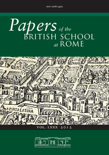
Papers of the British School at Rome
Unveiling the Rich Tapestry of Roman HistoryPapers of the British School at Rome, published by Cambridge University Press, is a prestigious journal that has been contributing to the fields of archaeology, history, and visual arts since its inception in 1902. With an ISSN of 0068-2462 and an E-ISSN of 2045-239X, this journal serves as an essential platform for innovative research and scholarly dialogue that explores the rich cultural heritage of Rome and its surrounding areas. The journal is ranked in the top quartiles for various categories, including Q1 in Visual Arts and Performing Arts, reflecting its significant impact and relevance in these fields. Despite its non-open access status, the journal boasts a robust readership, comprising researchers, professionals, and students eager to delve into the scholarly discussions it fosters. The Scopus rankings further affirm its reputation, with high percentiles in key areas, marking it as a vital resource for anyone invested in the academic study of classical and contemporary Roman culture. The journal's objective is to promote interdisciplinary research, making it a cornerstone for advancements in art history and archaeological studies.

Baltica
Advancing Knowledge in Earth and Planetary Sciences.Baltica is a distinguished journal housed under the Institute of Geology and Geography in Lithuania, focusing on the diverse realms of Earth and Planetary Sciences. Established in the mid-1990s, with a publication history dating back to 1994, the journal has continually sought to advance scholarly communication and innovation within the field. Although presently categorized in the Q4 quartile of Earth and Planetary Sciences, its contributions remain vital for researchers, professionals, and students interested in interdisciplinary approaches to understanding our planet’s dynamics. With an ISSN of 0067-3064 and an E-ISSN of 1648-858X, Baltica disseminates valuable findings and discussions that appeal to a broad academic audience, encouraging critical thinking and knowledge exchange. While the journal lacks Open Access options, it nonetheless serves as a significant platform for emerging and established scholars alike, facilitating a deeper engagement with critical geographical and geological research.
Kiva-Journal of Southwestern Anthropology and History
Connecting Cultures through Rigorous ScholarshipKiva - Journal of Southwestern Anthropology and History is a distinguished academic journal published by Routledge Journals, Taylor & Francis Ltd, that serves as a vital resource for scholars in the fields of anthropology, archaeology, and history. With an ISSN of 0023-1940 and an E-ISSN of 2051-6177, this journal has established itself as a significant avenue for scholarly communication since its inception in 1964. It consistently ranks in the top quartiles, including Q1 in Archaeology and Q2 in Anthropology, reflecting its high impact and rigorous peer-review process. Covering a wide array of topics pertinent to the Southwestern United States, Kiva invites original research articles, reviews, and methodological papers that advance understanding of the region's rich cultural heritage and historical narratives. While currently not open access, its commitment to disseminating quality research makes it an essential reading for researchers, professionals, and students aiming to explore the multifaceted dimensions of southwestern studies.
MONUMENTA NIPPONICA
Navigating the Depths of Japanese Culture and HistoryMONUMENTA NIPPONICA, published by Sophia University in Japan, is a distinguished academic journal dedicated to the interdisciplinary study of Japanese culture, history, and society. With a long-standing tradition since 1979, this journal offers a platform for scholars to disseminate research that explores the nuanced complexities of Japan's past and present. Although currently not open access, MONUMENTA NIPPONICA is indexed in Scopus and boasts respectable quartile rankings, including Q3 in History and Q4 in Anthropology and Cultural Studies, reflecting its significant yet niche contribution to the field. The journal's commitment to fostering scholarly discourse makes it an invaluable resource for researchers, students, and professionals interested in Japanese studies. Its address in Tokyo places it at the heart of Japanese academic inquiry, serving as a beacon for inquiries into the rich tapestry of Japan's cultural heritage.

Journal Asiatique
Advancing Scholarly Dialogue in Asian StudiesJournal Asiatique, published by PEETERS, is a distinguished academic journal based in Belgium with an ISSN of 0021-762X and an E-ISSN of 1783-1504, specifically serving the fields of Cultural Studies, History, Linguistics, and Literature. With a significant impact factor reflected through its categorization in the Q3 quartile for Cultural Studies, History, and Linguistics, and Q2 in Literature and Literary Theory, the journal provides a vital platform for scholarly discourse, encouraging researchers, professionals, and students to contribute to the evolution of these intertwined domains. The journal covers diverse aspects of Asian studies, including cultural, historical, and linguistic perspectives, and has been actively publishing since its establishment. While it does not offer an open-access option, the journal remains an esteemed resource for academic exploration and critical analysis, helping to elevate and disseminate knowledge within its vibrant community.
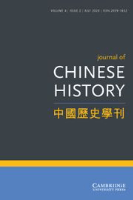
Journal of Chinese History
Connecting Scholars Worldwide Through the Lens of Chinese HistoryThe Journal of Chinese History, published by Cambridge University Press, is a leading scholarly journal that has established itself as a premier source for research on Chinese history, offering a platform for rigorous academic discourse and innovative analyses. With an ISSN of 2059-1632 and an E-ISSN of 2059-1640, this journal has been dedicated to the exploration of historical methodologies, cultural studies, and interdisciplinary approaches since its launch in 2017. As evidenced by its impressive Q1 ranking in History and Q2 in Cultural Studies for 2023, the journal maintains a high academic standard, ranking in the 89th and 79th percentiles respectively within Scopus rankings. The journal is committed to providing an open and critical forum for researchers, professionals, and students alike, ensuring that contributions reflect a diverse range of perspectives on China’s rich historical landscape. Its location in the United Kingdom bolsters its international outreach, attracting contributions and readership from around the globe. With objectives centered on fostering scholarly communication and critical engagement with Chinese history, the journal stands as an essential resource for those eager to delve into the complexities of China's past.
Tang Studies
Uncovering the Intricacies of Tang SocietyTang Studies, published by Johns Hopkins University Press, is a pivotal academic journal that delves into the cultural and historical contexts of the Tang dynasty, spanning significant years of research and contributions in the field. With an ISSN of 0737-5034 and an E-ISSN of 1759-7633, it serves as a vital resource for scholars and students alike, offering a wealth of peer-reviewed articles that illuminate the intricacies of Tang-era society, politics, art, and literature. Recognized in the Scopus rankings with a Q3 quartile in both Cultural Studies and History, this journal stands at the confluence of rigorous academic inquiry and cultural exploration. While it is not an open-access publication, readers can access its rich repository of knowledge to enhance their understanding of this significant period in Chinese history. As the journal continues to publish thought-provoking research, it solidifies its role as an influential platform for the advancement of knowledge and scholarship within the arts and humanities.