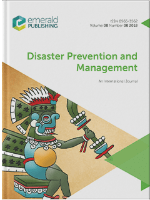
Disaster Prevention and Management
metrics 2024
Shaping policies for a safer, more prepared world.
Introduction
Disaster Prevention and Management, published by Emerald Group Publishing Ltd, is a leading journal in the fields of disaster management, public health, and environmental policy. With an ISSN of 0965-3562 and an E-ISSN of 1758-6100, this journal has made significant contributions to both theoretical and practical advancements since its inception in 1992. Operating from the United Kingdom, it holds a Q2 ranking across various categories, including Business, Management and Accounting, Health (Social Science), and Public Health, reflecting its pivotal role in academic discourse and policy formulation. By engaging with contemporary issues related to disaster risk reduction, emergency preparedness, and resilience strategies, Disaster Prevention and Management aims to foster a multidisciplinary approach, making it a vital resource for researchers, practitioners, and students seeking to navigate the complexities of disaster scenarios effectively. With an impressive Scopus ranking across multiple categories, researchers are encouraged to explore its diverse range of articles and reports available for their academic and professional endeavors.
Metrics 2024
 0.531.902.0066
Metrics History
Rank 2024
Scopus
IF (Web Of Science)
JCI (Web Of Science)
Quartile History
Similar Journals
International Journal of Disaster Risk Science
Transforming knowledge into action in disaster risk management.The International Journal of Disaster Risk Science, with ISSN 2095-0055 and E-ISSN 2192-6395, is a premier, peer-reviewed open-access journal published by Springer. Since its inception in 2011, the journal has been dedicated to advancing knowledge and practice in the field of disaster risk science, facilitating critical discussions around disaster preparedness, response, and resilience across various regions of the globe. This journal holds impressive rankings, including Q1 in Geography, Planning and Development, and Q1 in Safety Research for 2023, confirming its high impact within the academic community. With converged publication years from 2010 to 2024 and being ranked in the top 10% in multiple categories, it serves as an essential resource for researchers, professionals, and students alike. As an open-access journal, it ensures that cutting-edge research is freely available, promoting wider dissemination and engagement with topical issues in disaster risk management.
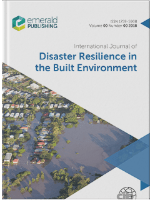
International Journal of Disaster Resilience in the Built Environment
Advancing resilience in every structure.International Journal of Disaster Resilience in the Built Environment is a leading peer-reviewed journal published by Emerald Group Publishing Ltd, focusing on the crucial intersection of disaster resilience and the built environment. Established in 2010, this journal serves as an essential platform for researchers, professionals, and students engaged in the fields of Building and Construction, as well as Safety, Risk, Reliability and Quality, maintaining a respectable Q3 ranking in both categories as of 2023. With a commitment to enhancing global knowledge on resilient construction practices, the journal examines innovative strategies to mitigate risk and enhance safety in built structures. Despite its robust academic reputation, it currently operates without an open access model, emphasizing its curated approach to high-quality scholarship. The publication aims to foster interdisciplinary collaboration and advance the development of sustainable practices within the context of disaster risk reduction, making it a vital resource for anyone dedicated to improving resilience in the built environment.
DISASTERS
Shaping the future of disaster studies with high-impact scholarship.DISASTERS, published by WILEY, is a premier academic journal dedicated to advancing the understanding of disasters across multiple disciplines, including Earth and Planetary Sciences and Social Sciences. With a historical publication span from 1977 to 2024, this journal has established itself as a vital resource within the academic community, boasting a Q1 category ranking in both fields, indicating its high impact and relevance. DISASTERS ranks impressively in Scopus, holding the #27 position in General Social Sciences and #36 in General Earth and Planetary Sciences, reflecting its influence in shaping disaster research and policy. The journal serves as a platform for interdisciplinary collaboration, offering researchers, professionals, and students critical insights into disaster management, response strategies, and risk reduction measures. Although it is not an Open Access journal, DISASTERS remains a cornerstone for those looking to contribute to and stay informed about the evolving landscape of disaster studies.

Revista de Urbanismo
Fostering Interdisciplinary Dialogue in Urban StudiesRevista de Urbanismo is a distinguished open-access journal published by the Facultad de Arquitectura y Urbanismo, Universidad de Chile, dedicated to advancing knowledge and dialogue within the fields of urban studies, geography, planning, and nature conservation. Since its inception in 1999, the journal has embraced an open-access model, ensuring that cutting-edge research is freely available to scholars, practitioners, and students worldwide. With an esteemed reputation, the journal has achieved notable rankings in 2023, including Q2 in Geography, Planning and Development and Urban Studies, showcasing its commitment to high-quality scholarly contributions. The journal not only serves as a platform for innovative ideas and research findings but also aims to influence urban policy and sustainable development practices, addressing the pressing challenges faced by cities today. By fostering interdisciplinary collaboration, Revista de Urbanismo plays a pivotal role in shaping the future of urban environments in Chile and beyond.
Jamba-Journal of Disaster Risk Studies
Empowering Research, Enhancing Resilience.Jamba-Journal of Disaster Risk Studies, published by AOSIS, serves as a vital resource in the fields of management, monitoring, policy, law, and safety research, with an ISSN of 1996-1421 and an E-ISSN of 2072-845X. Since its establishment as an Open Access journal in 2006, Jamba has dedicated itself to disseminating high-quality research that informs and enhances disaster risk management practices, particularly within the South African context and beyond. With a robust Impact Factor and acknowledgement in the Q2 and Q3 quartiles across critical categories in 2023, Jamba ranks favorably in Scopus, notably Rank #50/109 in Social Sciences (Safety Research) and Rank #218/399 in Environmental Science (Management, Monitoring, Policy and Law). The journal's convergence over the years—from 2013 to 2024—signals its commitment to adapting contemporary challenges in disaster risk studies. Scholars and practitioners are encouraged to explore Jamba as a go-to platform for innovative insights and collaborative discussions that impact policy-making and practical applications in disaster risk reduction.
Journal of Homeland Security and Emergency Management
Shaping the Future of Homeland Security ResearchJournal of Homeland Security and Emergency Management, published by Walter de Gruyter GmbH in Germany, is a leading platform for scholarly research dedicated to the critical fields of security and emergency management. With an impressive impact factor reflecting its high-quality publications, this journal plays an essential role in advancing knowledge within its scope that covers vital issues such as disaster preparedness, risk assessment, and organizational resilience. The journal's Scopus rankings highlight its distinguished standing, being in the top quartile for Safety Research and demonstrating significant impact across various fields including Business Management and Safety, Risk, Reliability, and Quality. Researchers, professionals, and students alike can access a wealth of information as this open-access journal from 2004 to 2024 is committed to disseminating critical insights and innovative practices essential for effective homeland security and emergency management strategies.
EURE-REVISTA LATINOAMERICANA DE ESTUDIOS URBANO REGIONALES
Pioneering Research in Urban and Regional StudiesEURE-REVISTA LATINOAMERICANA DE ESTUDIOS URBANO REGIONALES, published by the Pontificia Universidad Católica de Chile, is a pivotal journal in the field of Urban Studies, focusing on the complexities and dynamics of urban and regional environments across Latin America. Since its inception in 1979 and transitioning to an open-access format in 1997, this journal aims to provide a platform for scholars, policymakers, and practitioners to share innovative research and insights on urban development, policy, and sustainability. With an impact factor robust enough to rank it in the Q2 category within Urban Studies and a Scopus rank of #124 out of 279, EURE stands out as a significant contributor to understanding urban phenomena in the region. Researchers and students alike will find in this journal a wealth of empirical studies, theoretical discussions, and case analyses, enriching the discourse on urban challenges and opportunities in contemporary Latin America.
International Journal of Disaster Risk Reduction
Fostering collaboration for a disaster-resilient world.The International Journal of Disaster Risk Reduction is a leading academic publication dedicated to advancing the understanding and management of disaster risks, promoting innovative solutions and effective strategies for risk reduction. Published by ELSEVIER, this journal serves as a critical platform for researchers, professionals, and students in the fields of Geology, Geotechnical Engineering, and Safety Research. With an impressive impact factor and ranked in the top quartile (Q1) across its various categories as of 2023, it demonstrates exceptional quality and relevance in its contributions to science and engineering disciplines. The journal has been committed to disseminating high-quality research since its inception in 2012 and remains open for new submissions through 2024. The Scopus rankings reflect its prestigious position, with notable placements in Earth and Planetary Sciences and Social Sciences, highlighting its influence in shaping best practices for disaster risk governance. As an essential resource for anyone involved in disaster preparedness and mitigation, the International Journal of Disaster Risk Reduction fosters knowledge exchange and collaboration among stakeholders in the global community.
Journal of Disaster Research
Strengthening societal resilience through collaborative research.Journal of Disaster Research, published by FUJI TECHNOLOGY PRESS LTD, is a prominent Open Access journal that has been disseminating critical research on disaster management since its inception in 2007. Focusing on the interrelated fields of engineering and safety, the journal aims to advance knowledge and policy in disaster risk reduction, response, and resilience, making it an essential resource for researchers, practitioners, and policymakers alike. With an ISSN of 1881-2473 and E-ISSN 1883-8030, the journal covers a wide range of topics related to disaster studies, ensuring the dissemination of innovative solutions and diverse perspectives. Situated in Japan, the journal has been ranked Q3 in both Engineering (Miscellaneous) and Safety, Risk, Reliability, and Quality categories, showcasing its commitment to quality scholarship. As it converges its research contributions from 2006 to 2024, the Journal of Disaster Research continues to serve as a vital platform for advancing the science and practice of disaster research, thereby enhancing societal resilience against crises.
Journal of the Indian Society of Remote Sensing
Illuminating the Path of Remote Sensing ResearchJournal of the Indian Society of Remote Sensing, published by SPRINGER, stands as a prominent contribution to the fields of Earth and Planetary Sciences and Geography, Planning and Development. With an ISSN of 0255-660X and an E-ISSN of 0974-3006, this esteemed journal has been in circulation since 1973, showcasing a rich repository of research and advancements in remote sensing applications, methodologies, and technologies, specifically within the Indian context and beyond. The journal's impact is underscored by its placement in the Q2 category of both Earth and Planetary Sciences and Geography as of 2023, ranking impressively in the Scopus database with significant percentiles. With the intent to bridge the gap between theory and practical application, it invites scholars, researchers, and professionals to contribute innovative studies that enhance our understanding of remote sensing and its implications in various domains. The Journal of the Indian Society of Remote Sensing is a vital resource for anyone looking to remain at the forefront of research in this dynamic field.