
Eras
Scope & Guideline
Connecting Scholars Through the Lens of History
Introduction
Aims and Scopes
- Interdisciplinary Historical Analysis:
The journal emphasizes interdisciplinary approaches to historical analysis, integrating insights from various fields such as sociology, philosophy, and cultural studies to enrich understanding of historical events and their ongoing implications. - Cultural Memory and Representation:
A core area of focus is the examination of cultural memory, particularly how societies remember, represent, and interpret historical events, which is evident in studies of war, colonialism, and national identity. - Environmental and Social Justice Themes:
The journal also explores themes of environmental and social justice, highlighting narratives that connect human experiences with ecological concerns, as seen in discussions about conservation and indigenous perspectives. - Philosophical Discourse:
'Eras' includes philosophical inquiries, particularly those that interrogate historical thought and its impact on modern philosophical debates, providing critical reflections on figures such as Spinoza and Wittgenstein.
Trending and Emerging
- Decolonization and Race:
There is an increasing focus on themes of decolonization and race, particularly in the context of citizenship laws and historical injustices, suggesting a critical engagement with postcolonial studies and the re-examination of national identities. - Environmental Narratives:
Emerging discussions around environmental issues, especially those that connect historical narratives with contemporary ecological challenges, indicate a trend towards integrating environmental humanities within historical scholarship. - Memory Studies and War Representation:
The theme of memory studies, particularly in relation to the representation of war and trauma, is gaining traction, reflecting a growing interest in how societies process and remember their pasts in the context of national identity and cultural heritage. - Indigenous Knowledge and Philosophy:
Research exploring indigenous philosophies and knowledge systems, particularly from Aotearoa, is on the rise, indicating a trend towards inclusivity and recognition of diverse epistemologies in historical discourse.
Declining or Waning
- Traditional War Narratives:
There is a noticeable decline in traditional narratives of war that focus solely on military history, as recent publications have shifted towards more nuanced explorations of personal and collective memory related to war. - Eurocentric Perspectives:
The journal appears to be moving away from predominantly Eurocentric historical perspectives, as more recent issues reflect a broader range of cultural and geographical viewpoints, particularly from indigenous and non-Western contexts. - Formal Historical Methodologies:
The reliance on formal historical methodologies, such as strict chronological recounting of events, is becoming less common, with a growing preference for qualitative and interpretive approaches that emphasize narrative and context.
Similar Journals
Question
Exploring the dynamics of digital communication.Question is a premier open-access journal published by UNIV NACIONAL PLATA, INST INVESTIGACIONES & COMUNICACION-IICOM, dedicated to advancing scholarship in the field of communication and journalism. Since its inception in 2005, this journal has served as a vital platform for researchers, professionals, and students to disseminate innovative research findings and theoretical discussions that shape contemporary communication practices. Operating out of La Plata, Buenos Aires, Argentina, it engages a global audience by addressing critical topics within communications, including media studies, social communication, and the impact of digital technologies. With its robust commitment to open access, Question ensures that its high-quality content is freely available, fostering a collaborative academic environment and broadening the reach of research in the communications discipline. As a valuable resource, this journal stands at the intersection of academia and practice, inviting contributions that push the boundaries of knowledge in communication.

Nordeuropa Forum-Zeitschrift fur Kulturstudien
Exploring the Rich Tapestry of Northern European CultureNordeuropa Forum-Zeitschrift fur Kulturstudien is a distinguished academic journal devoted to the interdisciplinary study of Northern European cultures, facilitating critical discourse and scholarly exchange since its inception by the Humboldt University of Berlin. With an ISSN of 1863-639X, it has embraced the principles of Open Access since 1998, ensuring that research findings are available to a global audience without barriers. Located in the heart of Berlin at Unter den Linden 6, 10099, it serves as a pivotal platform for researchers, professionals, and students interested in cultural studies, social dynamics, and historical developments in Northern Europe. While its HIndex and quartile rankings reflect its emerging influence, the journal aims to foster innovative scholarship and inclusive dialogue within the academic community. Through its commitment to advancing knowledge and accessibility in culture studies, Nordeuropa Forum remains an invaluable resource for those seeking to explore the rich tapestry of Northern European heritage and contemporary issues.
HISTORICAL REFLECTIONS-REFLEXIONS HISTORIQUES
Exploring New Dimensions of Historical UnderstandingHistorical Reflections / Reflexions Historiques is a pivotal academic journal in the field of history, published by Berghahn Journals. Established to provide a platform for innovative historical scholarship, the journal offers a unique blend of theoretical discussions and empirical studies that critically engage with new interpretations and methodologies. With a robust reputation evidenced by its category ranking in the 2023 Q3 History quartile and a Scopus ranking of #1164 in the Arts and Humanities, Historical Reflections serves as an essential resource for researchers, professionals, and students alike. Although the journal is not available through open access, it contributes significantly to historical discourse through its diverse range of articles, fostering a deeper understanding of past events and their implications for the present and future. As it continues to evolve from its inception in 1977 to the present day, Historical Reflections remains committed to advancing the field through rigorous analysis and scholarly debate.
SOUNDINGS
Charting New Territories in Cultural Studies and Political ScienceSOUNDINGS, published by Penn State University Press, stands as a notable journal within the realms of the arts and humanities, cultural studies, and sociology and political science. With its ISSN 0038-1861 and E-ISSN 2161-6302, this academic periodical has been a platform for critical discourse and innovative research since its inception in the mid-1970s, although it has experienced several convergence periods. Though currently categorized in Q4 within its respective fields, including rankings that reflect its growing influence, SOUNDINGS continues to provide a rigorous space for interdisciplinary dialogue and scholarly reflection. Despite the absence of open access, the journal’s comprehensive articles are vital for researchers, professionals, and students seeking to deepen their understanding of complex cultural and societal dynamics. With its headquarters located at 820 North Univ Drive, U S B 1, Ste C, University Park, PA 16802, SOUNDINGS invites its readership to engage with contemporary issues through a rich lens of academic inquiry.
Indian Historical Review
Engaging with the Complexities of India's PastThe Indian Historical Review is a distinguished journal published by SAGE Publications India Pvt Ltd, dedicated to the comprehensive study and analysis of historical phenomena, particularly within the South Asian context. With an ISSN of 0376-9836 and an E-ISSN of 0975-5977, this journal has positioned itself as a pivotal resource for researchers and historians seeking to engage with contemporary and historical debates. Ranked in the third quartile (Q3) in History for 2023 and holding a Scopus rank of #1118 out of 1760 in the Arts and Humanities category, it reflects a commitment to quality and scholarly excellence. The journal encompasses a broad scope, publishing articles that delve into various historical methodologies and interpretations, encouraging discourse that bridges traditional narratives with innovative perspectives. Although the journal is not open access, its contributions remain invaluable for students, professionals, and scholars eager to deepen their understanding of historical studies. With a rich publication history since its convergence in 1999, The Indian Historical Review continues to be a significant forum for academic inquiry and discussion in the field.
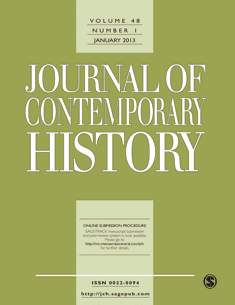
JOURNAL OF CONTEMPORARY HISTORY
Uncovering the Threads of Contemporary HistoryJOURNAL OF CONTEMPORARY HISTORY, published by SAGE PUBLICATIONS LTD, is a premier academic journal dedicated to the exploration of modern historical narratives and contemporary societal issues. Established in 1966, this journal has influenced scholarly discourse through a rich repository of research, analyses, and critical reflections, providing invaluable insights into cultural studies, sociology, and political science. With an impressive Q1 ranking in History and a notable Q2 ranking in Cultural Studies for 2023, it stands out in the academic community, ensuring rigorous peer-reviewed content that meets the highest scholarly standards. The journal is accessible through conventional subscriptions, reflecting its long-standing commitment to academic excellence. Based in the United Kingdom, it continues to serve as an indispensable resource for researchers, professionals, and students alike, bridging the gap between historical context and contemporary relevance.
SOUTHERN JOURNAL OF PHILOSOPHY
Fostering Intellectual Exchange in PhilosophyThe Southern Journal of Philosophy, published by Wiley, stands as a prestigious platform within the field of Philosophy, with a rich history dating back to 1963. As a Q1 journal, as classified in the 2023 category quartiles, it ranks favorably at #187 out of 806 in the Arts and Humanities field according to Scopus, placing it in the 76th percentile of its category. This esteemed journal not only publishes rigorous, peer-reviewed research, but also engages with critical philosophical discourse, fostering an inclusive environment for both established and emerging scholars. Although not an open access journal, it provides extensive coverage of vital philosophical topics, encouraging collaboration and intellectual exchange among researchers, professionals, and students alike. With its ongoing convergence of ideas leading into 2024 and beyond, the journal encourages submissions that push the boundaries of philosophical inquiry and contribute to the academic community.

Chinese Literature and Thought Today
Exploring the Nexus of Contemporary Chinese Thought and LiteratureChinese Literature and Thought Today is a dynamic academic journal dedicated to the exploration of contemporary Chinese literary and philosophical discourse. Published by Routledge Journals, Taylor & Francis Ltd, this journal aims to provide a platform for the dissemination of innovative research and critical analysis in the fields of literature and philosophy, focusing on the evolving dynamics of Chinese culture within a global context. With an ISSN of 2768-3524 and an E-ISSN of 2768-3532, it is committed to Open Access principles, ensuring that valuable insights are readily accessible to researchers and practitioners alike. Although it is currently positioned in the Q4 tier across various categories including Arts and Humanities and Literature and Literary Theory, the journal's nascent status promises a growing repository of knowledge that invites contributions aimed at provoking thoughtful dialogue in these interdisciplinary studies. As it converges over the years from 2022 to 2024, it offers an essential resource for anyone interested in the intersections of literature, thought, and culture in contemporary Chinese society.
SOCIAL HISTORY
Charting the Social Landscape of Historical InquirySOCIAL HISTORY, published by Routledge Journals, Taylor & Francis Ltd, is an esteemed journal dedicated to advancing the field of historical research, specifically focusing on the social dimensions of history. With an ISSN of 0307-1022 and an E-ISSN of 1470-1200, this journal has consistently contributed to the scholarly discourse since its inception in 1976. Positioned in the Q2 category for history in 2023, it ranks 240 out of 1760 in the Arts and Humanities, placing it in the top 14% of its field according to Scopus metrics. Although it is not an Open Access journal, its accessibility through institutional subscriptions ensures that a wide range of researchers, professionals, and students engage with its rich variety of articles that explore social history's diverse themes and methodologies. The journal aims to foster a deeper understanding of how historical events shape societies, offering valuable insights for those interested in the intricate interactions between past and present.

International Journal for History, Culture and Modernity
Advancing Scholarship in History and Cultural StudiesThe International Journal for History, Culture and Modernity, published by BRILL, stands as a pivotal platform for scholars and practitioners in the fields of history and cultural studies. With an ISSN of 2666-6529 and an E-ISSN of 2213-0624, this journal has been contributing to academic discourse since its inception in 2015. Focusing on contemporary historical analysis, cultural narratives, and modernity, it aims to unravel the intricacies of past and present, thereby fostering a nuanced understanding of societal evolution. Indexed in Scopus with notable rankings—Q2 in History and Q3 in Arts and Humanities (miscellaneous)—it appeals profoundly to researchers and students alike. The journal's commitment to open access ensures that its scholarly contributions remain widely available, making it an essential resource for those dedicated to advancing knowledge in the humanities. Situated in Leiden, Netherlands, at PLANTIJNSTRAAT 2, P O BOX 9000, it embodies a tradition of academic excellence that is integral for contemporary scholarship.