
European Journal of Pure and Applied Mathematics
Scope & Guideline
Exploring the Depths of Pure and Applied Mathematics
Introduction
Aims and Scopes
- Fractional Calculus and Differential Equations:
A significant portion of the journal's publications explores fractional calculus, particularly Caputo and Riemann-Liouville derivatives, and their applications in solving differential equations. - Graph Theory and Combinatorics:
The journal consistently publishes research related to graph theory, including domination in graphs, vertex cover problems, and various graph operations. - Mathematical Modeling and Numerical Methods:
Numerical simulations and mathematical modeling are core themes, addressing a range of applications from biological systems to financial mathematics, utilizing methods such as finite difference and Adomian decomposition. - Topology and Set Theory:
Research in topology, including continuity, separation axioms, and topological structures, plays a crucial role in the journal's scope, reflecting the foundational aspects of mathematics. - Algebra and Algebraic Structures:
The journal covers topics in algebra, including rings, algebras, ideals, and group theory, contributing to the understanding of algebraic structures and their properties.
Trending and Emerging
- Applied Mathematics in Biological Systems:
Recent publications have increasingly focused on mathematical modeling in biological contexts, such as disease spread models and ecological dynamics, highlighting the intersection of mathematics and life sciences. - Fuzzy Logic and Soft Computing:
There is a notable rise in research related to fuzzy sets, fuzzy algebras, and soft computing techniques, indicating a growing interest in handling uncertainty and imprecision in mathematical models. - Numerical Analysis and Computational Mathematics:
The journal has seen a surge in articles dedicated to numerical methods and their applications, particularly in solving complex differential equations and optimization problems, reflecting the importance of computational techniques in modern mathematics. - Fractional Differential Equations:
An increase in studies focusing on fractional differential equations and their applications in various fields has been observed, showcasing the expanding relevance of fractional calculus in contemporary research. - Graph Theory Applications in Network Science:
Research applying graph theory to network science, including social networks and communication networks, has gained traction, reflecting the increasing importance of mathematical frameworks in analyzing complex systems.
Declining or Waning
- Classical Analysis and Real Functions:
There is a noticeable decline in papers specifically focused on classical analysis, particularly those dealing with real-valued functions and traditional calculus topics. - Elementary Number Theory:
Research in elementary number theory, including topics like Diophantine equations and prime number theory, has become less frequent, suggesting a shift towards more advanced and abstract mathematical concepts. - Statistical Methods and Applications:
The frequency of publications related to traditional statistical methods appears to be decreasing, possibly due to the growing trend towards more complex statistical modeling and data analysis techniques.
Similar Journals
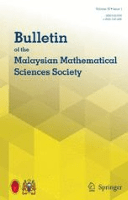
Bulletin of the Malaysian Mathematical Sciences Society
Connecting Ideas, Cultivating Knowledge in MathematicsThe Bulletin of the Malaysian Mathematical Sciences Society, published by SPRINGER NATURE, is a prominent academic journal dedicated to advancing the field of mathematics. With an ISSN of 0126-6705 and an E-ISSN of 2180-4206, the journal has established itself as a vital resource for researchers, professionals, and students alike. Based in Singapore, it boasts an impressive Q2 ranking in the miscellaneous mathematics category for 2023, alongside a notable position of 90th out of 399 in the general mathematics Scopus rankings, placing it in the 77th percentile. The Bulletin serves to disseminate innovative research findings, foster mathematical dialogue, and promote collaboration among the global mathematical community, with coverage ranging from theoretical frameworks to practical applications. Readers can expect an engaging mix of original research articles, reviews, and communications that contribute significantly to the evolving landscape of mathematical sciences.
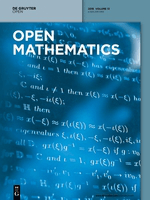
Open Mathematics
Championing Transparency in Mathematical InnovationOpen Mathematics, published by DE GRUYTER POLAND SP Z O O, is a prominent peer-reviewed journal that has been a vital platform for disseminating innovative research in the field of mathematics since its inception in 2015. With an impressive impact factor reflected by its Q2 ranking in the miscellaneous mathematics category and a commendable Scopus rank of #91 out of 399, it positions itself as a significant contributor to the mathematical community. This open access journal, headquartered in Poland, welcomes submissions that tackle diverse mathematical theories, applications, and methodologies, fostering knowledge exchange among researchers, professionals, and students globally. Since its launch, Open Mathematics has focused on bridging the gap between theoretical advancement and practical applications, making it an essential resource for anyone seeking to stay at the forefront of mathematical research and innovation. The journal offers easy online access, enhancing the visibility and impact of the valuable work published within its pages.
INTERNATIONAL JOURNAL OF MATHEMATICS AND MATHEMATICAL SCIENCES
Pioneering insights in the world of mathematical sciences.INTERNATIONAL JOURNAL OF MATHEMATICS AND MATHEMATICAL SCIENCES is a distinguished peer-reviewed journal published by HINDAWI LTD, dedicated to advancing the field of mathematics and its various applications. Since its inception in 1978, the journal has been committed to open access, ensuring that research is freely available to all, thereby fostering greater collaboration and dissemination of knowledge. With an impressive Q3 ranking in the Mathematics (miscellaneous) category and a notable Scopus rank in the 72nd percentile, this journal is a vital resource for researchers, professionals, and students. The journal covers a wide range of topics in mathematics, from theoretical explorations to applied methodologies, and it continues to serve as a platform for significant contributions in this evolving discipline. Its continuous publication from 1978 to present reflects its enduring relevance and impact in the mathematical sciences community.
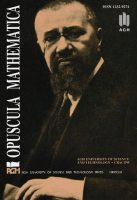
Opuscula Mathematica
Championing Accessibility in Mathematical ResearchOpuscula Mathematica is an esteemed open-access journal published by AGH University of Science & Technology Press in Poland, specializing in the field of mathematics. Since its inception, it has provided a collaborative platform for researchers and scholars to share innovative mathematical insights and solutions, expanding its reach globally. With an impressive Q2 ranking in the realm of miscellaneous mathematics for 2023 and a notable Scopus ranking of Rank #139/399, it stands as a significant conduit for researchers seeking to publish high-quality, peer-reviewed articles. The journal has embraced open-access principles since 2004, ensuring that advancements in mathematical research are accessible to all. By publishing original research, reviews, and scholarly notes, Opuscula Mathematica plays a pivotal role in enhancing the visibility of vital mathematical discoveries and fostering academic discourse. Its convergence years from 2012 to 2024 highlight the journal's commitment to ongoing relevance and evolution in a dynamic research landscape.
Turkish Journal of Mathematics
Advancing Mathematical Frontiers with Rigorous ResearchTurkish Journal of Mathematics is a prestigious academic publication dedicated to the advancement of mathematical research across a variety of subfields. Established in 1995 and published by the Tubitak Scientific & Technological Research Council Turkey, this journal has built a solid reputation, especially noted for its significant contributions to the field over the years, with its convergence spanning from 1995 to 2002 and again from 2006 to 2024. The journal, which holds a commendable Q2 ranking in Mathematics (miscellaneous) and is positioned in the 66th percentile of Scopus rankings for General Mathematics, aims to disseminate high-quality original research, reviews, and innovative methodologies to advance both theoretical and applied mathematics. Researchers, professionals, and students alike will find invaluable resources within its pages, providing insights that are pivotal for academic and practical applications in mathematics. Although it does not currently offer open access options, the journal remains an essential platform for those looking to engage with the forefront of mathematical inquiry.

TWMS Journal of Pure and Applied Mathematics
Enhancing Visibility of High-Impact Mathematical ResearchWelcome to the TWMS Journal of Pure and Applied Mathematics, a distinguished publication dedicated to advancing the field of mathematics through rigorous research and innovative applications. Published by the esteemed Institute of Applied Mathematics, this journal provides a platform for scholars and practitioners alike to share their findings and insights in both pure and applied mathematical disciplines. With a commitment to quality and integrity, the journal seeks to enhance the visibility and impact of mathematical research, reflected in its scholarly output. Although currently not an Open Access journal, the TWMS Journal aims to feature high-impact articles that contribute to both theoretical understanding and practical implementation. The journal’s address is located at Baku State University, ensuring its roots in a vibrant academic environment in Azerbaijan. As an essential resource in the mathematics community, the TWMS Journal of Pure and Applied Mathematics invites contributions that push the boundaries of knowledge and foster dialogue among researchers, professionals, and students.

Frontiers of Mathematics
Charting New Paths in the Realm of MathematicsFrontiers of Mathematics, published by SPRINGER HEIDELBERG, is an emerging academic journal dedicated to fostering the advancement of mathematical sciences from 2023 to 2024. With an ISSN of 2731-8648 and E-ISSN of 2731-8656, this journal is positioned in the category of Q2 in the miscellaneous mathematics domain, showcasing its commitment to quality research and innovation. Although in its nascent stages, it has swiftly established a foothold within the global academic landscape, holding a Scopus rank of #198/399 and a median percentile of 50, indicating a promising trajectory. By providing an open-access option, Frontiers of Mathematics ensures broad dissemination of research findings, fostering collaboration and knowledge sharing across the mathematical community. Researchers, professionals, and students alike will find this journal to be an invaluable resource, contributing to important discussions and advancements in various mathematical fields.
Ukrainian Mathematical Journal
Empowering Mathematicians with Rigorous ResearchThe Ukrainian Mathematical Journal is a prominent academic publication in the field of mathematics, focusing on a diverse range of topics that appeal to researchers, professionals, and students alike. Published by Springer, this journal has been an important platform for disseminating significant mathematical research since its inception in 1957. With the aim of fostering knowledge and collaboration within the mathematical community, the journal curates high-quality articles that meet rigorous scholarly standards, evidenced by its Q3 ranking in the miscellaneous mathematics category for 2023. Although it currently does not offer open access, the journal remains accessible through various institutional subscriptions. It serves as a vital resource for ongoing discourse in the field and invites contributions that further advance mathematical understanding.

Research in Mathematics
Exploring diverse mathematical landscapes with cutting-edge research.Research in Mathematics, published by TAYLOR & FRANCIS LTD, is an emerging academic journal dedicated to advancing the field of mathematics through innovative research and scholarship. With an E-ISSN of 2768-4830, this journal aims to foster discussion and dissemination of high-quality mathematical research across a broad spectrum of disciplines, including pure mathematics and applied mathematics. As part of its commitment to accessibility, Research in Mathematics operates on an open-access model, allowing researchers, professionals, and students to engage with groundbreaking studies without barriers. Despite its recent establishment since 2016, and with a current Scopus ranking that positions it in the lower percentile among its peers, the journal offers a platform for new voices in the mathematics community. Its objectives include enhancing visibility for novel mathematical concepts, methodologies, and applications that can significantly impact the academic and professional landscapes. Authors are encouraged to submit original research articles, review papers, and case studies that push the boundaries of mathematical knowledge.
JOURNAL OF THE AMERICAN MATHEMATICAL SOCIETY
Advancing Mathematical Frontiers with AuthorityThe Journal of the American Mathematical Society (ISSN: 0894-0347; E-ISSN: 1088-6834), published by the American Mathematical Society, stands as a pillar in the fields of mathematics and applied mathematics. This prestigious journal, with a remarkable impact factor and ranking in the top tier (*Q1*) within both the Applied Mathematics and general Mathematics categories, is recognized for its contribution to advancing mathematical research and theory. With data reflecting it as the 8th ranked journal in General Mathematics (top 2%) and the 34th in Applied Mathematics (top 6%), the journal consistently showcases groundbreaking studies and innovative methods that greatly influence academia and industry alike. Though not an open-access journal, it offers a wealth of resources and intellectual discourse for researchers, professionals, and students alike. Specializing in comprehensive and theoretical aspects of mathematics, the Journal remains dedicated to publishing articles that promote understanding and propel the field forward, highlighting its significance as an essential tool for those engaged in mathematical research.