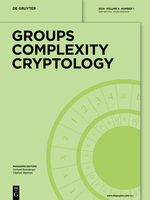
Groups Complexity Cryptology
metrics 2024
Innovating Cryptographic Solutions Through Collaborative Research
Introduction
Groups Complexity Cryptology, published by EPISCIENCES, is an esteemed Open Access journal that has been contributing to the fields of Applied Mathematics, Computational Mathematics, Computational Theory, and Computer Networks and Communications since its inception in 2009. With its headquarters located in France, this journal serves as a crucial platform for disseminating innovative research and solutions in cryptology and related areas. As of 2023, it proudly holds Q4 rankings across several categories in Scopus, indicating its recognized, yet emerging position within the academic community. Additionally, it is indexed under various categories such as Applied Mathematics, where it ranks in the 24th percentile, showcasing its potential for growth and increased visibility among researchers. The journal adheres to an open-access model introduced in 2020, allowing for widespread accessibility and engagement with cutting-edge research. This enhances the journal's mission to foster academic communication and collaboration among researchers, professionals, and students interested in the complex interplay of groups, complexity, and cryptography.
Metrics 2024
 0.140.100.2013
Metrics History
Rank 2024
Scopus
IF (Web Of Science)
JCI (Web Of Science)
Quartile History
Similar Journals

Groups Geometry and Dynamics
Exploring the Intersections of Geometry and DynamicsGroups Geometry and Dynamics is a pioneering open-access journal published by the European Mathematical Society (EMS), dedicated to advancing the fields of discrete mathematics, combinatorics, geometry, and topology. With its ISSN 1661-7207 and E-ISSN 1661-7215, this journal serves the global mathematical community by providing a platform for high-quality research and insightful discussions. Established in 2009 and showcasing innovative findings through to its converged years of 2024, it has achieved notable rankings, securing a Q1 category in Discrete Mathematics and Combinatorics and a Q2 in Geometry and Topology, indicating its substantial impact within these domains. The journal's presence in Scopus ranks underscores its significance, positioned within the top echelons of its categories. As an open-access publication since 2021, it enhances accessibility and visibility for researchers, professionals, and students alike. Located in Berlin, Germany, and backed by a commitment to fostering collaborative research, Groups Geometry and Dynamics aims to be a leading voice in the mathematical discourse, challenging and inspiring inquisitive minds in the ever-evolving world of mathematics.
Computability-The Journal of the Association CiE
Unveiling New Dimensions in ComputabilityComputability - The Journal of the Association CiE, published by IOS PRESS, is a premier academic journal dedicated to advancing the field of computational theory and its applications. Established in 2012, this journal serves a diverse audience, including researchers, professionals, and students involved in the realms of Artificial Intelligence, Computational Theory and Mathematics, and Theoretical Computer Science. With robust categorization in Q2 and Q3 quartiles for various related fields, it provides a vital platform for innovative research and discussions that shape the landscape of computational technologies. Although it operates under a subscription model, the quality of published content ensures significant academic contributions and offers valuable insights relevant to contemporary scientific challenges. Researchers interested in the intersection of computation and its practical implications will find Computability an essential resource for exploring cutting-edge developments and fostering scholarly exchange.
JOURNAL OF CRYPTOLOGY
Exploring the Frontiers of Applied Mathematics in CryptologyJOURNAL OF CRYPTOLOGY, published by SPRINGER, stands at the forefront of research in the domains of applied mathematics, computer science applications, and software security. With a history of significant contributions since its inception in 1988, this esteemed journal encompasses a broad range of topics in cryptology, including but not limited to encryption, security protocols, and information security systems. Holding a prestigious Q1 classification in multiple fields, it ranks #45 out of 635 in Applied Mathematics and has esteemed positions in Computer Science categories, reflecting its influence and recognition in the academic community, as evidenced by its high percentiles. As a vital resource for researchers, professionals, and students, the JOURNAL OF CRYPTOLOGY not only aims to disseminate innovative findings and methodologies but also fosters an engaging discourse within the cryptology and cybersecurity realms. Notably, it offers access through traditional subscription models, ensuring that readers benefit from a rigorous selection of high-impact research articles. Explore groundbreaking advancements and contribute to the ongoing dialogue in this pivotal field through your engagement with our journal.

Theory of Computing
Pioneering Research in Computational TheoryTheory of Computing, published by the University of Chicago, Department of Computer Science, is a prestigious journal that has established itself as a leading platform in the fields of Computational Theory and Theoretical Computer Science. With its ISSN 1557-2862, the journal has earned a reputation for high-quality, peer-reviewed research, positioning itself in the Q1 quartile for both Computational Theory and Mathematics, as well as Theoretical Computer Science as of 2023. Despite its limited open access options, the journal remains a vital resource for researchers and academics, providing insights that push the boundaries of theoretical frameworks and methodologies in computer science. The journal's commitment to rigorous scholarship serves to foster innovation and deepen understanding in a rapidly evolving field, making it an essential reference for professionals, students, and practitioners alike.
DESIGNS CODES AND CRYPTOGRAPHY
Empowering the Future of Secure Computing and DesignDesigns, Codes and Cryptography is a renowned peer-reviewed journal published by Springer, dedicated to the interdisciplinary fields of applied mathematics, computer science, and discrete mathematics. With an exceptional impact factor, this journal is recognized for its high-quality research contributions and currently holds a prestigious Q1 ranking in multiple categories, including Applied Mathematics and Theoretical Computer Science, as of 2023. Featuring an extensive range of articles from 1991 to 2024, the journal serves as a pivotal platform for professionals, researchers, and students alike, focusing on innovative developments in coding theory, cryptography, and their practical applications in computing and secure communication. The journal's scope encompasses theoretical foundations, as well as algorithmic and applied aspects, making it an essential resource for advancing knowledge in the rapidly evolving fields of computer science and mathematics.
RICERCHE DI MATEMATICA
Bridging Theory and Practice in MathematicsRICERCHE DI MATEMATICA, published by SPRINGER-VERLAG ITALIA SRL, is a prominent academic journal situated at the intersection of mathematics and its applications, with an ISSN of 0035-5038 and an E-ISSN of 1827-3491. Based in Italy, this journal serves as a crucial platform for disseminating innovative research findings and theoretical advancements in the diverse fields of applied mathematics and general mathematics, currently ranked in the Q3 quartile as per the 2023 category evaluations. The journal's standing is underlined by its impressive Scopus rankings, securing the 61st position out of 399 in General Mathematics and the 224th in Applied Mathematics, placing it well within the 84th and 64th percentiles respectively. Catering to a global audience of researchers, professionals, and students, RICERCHE DI MATEMATICA not only celebrates mathematical exploration but also enhances understanding through open discourse by fostering connections among scholars from various mathematical disciplines. With a converged publication cycle spanning from 2007 to 2024, the journal is committed to promoting high-quality research that shapes the future of mathematical sciences.

Advances in Mathematics of Communications
Exploring New Frontiers in Mathematical SciencesAdvances in Mathematics of Communications, published by the American Institute of Mathematical Sciences (AIMS), is a leading journal dedicated to the dissemination of high-quality research in the fields of algebra, number theory, applied mathematics, discrete mathematics, combinatorics, and computer networks. Established in 2008, this journal has quickly established itself as a significant contributor to mathematical communications, holding a reputable position in the Scopus rankings, with impressive category quartiles, including Q2 rankings in key areas such as Algebra and Number Theory and Applied Mathematics. Besides its rigorous peer-review process, the journal facilitates the growth of innovative ideas and methodologies that bridge the gap between theory and application. With no open access restrictions, Advances in Mathematics of Communications aims to provide an inclusive platform for researchers, professionals, and students to share their findings and insights, fostering collaboration and advancing the global knowledge base in the mathematical sciences. The journal's commitment to excellence ensures its role as an essential resource in the ever-evolving landscape of mathematics.

Rad Hrvatske Akademije Znanosti i Umjetnosti-Matematicke Znanosti
Connecting Scholars through Mathematical ExcellenceRad Hrvatske Akademije Znanosti i Umjetnosti-Matematicke Znanosti is a distinguished journal published by the Croatian Academy of Sciences and Arts, focusing on the vast domain of mathematics and its multifaceted applications. Established in Croatia, this journal serves as a vital platform for scholars and practitioners to disseminate innovative and significant research findings in mathematical science. With an ISSN of 1849-2215, it has been indexed in Scopus, achieving a notable Q3 ranking in the miscellaneous category of mathematics, which reflects its influence and reach within the academic community. While currently not classified as an open-access journal, it endeavors to offer accessible insights and foster collaboration among researchers, professionals, and students. Published annually, it spans diverse topics critical to advancing mathematical understanding and promotes the exchange of ideas across international boundaries. Emphasizing quality, this journal contributes to the ongoing dialogue in the mathematical sciences, thereby strengthening academic ties and enhancing knowledge dissemination.
COMBINATORICA
Exploring the Depths of Discrete Mathematics ExcellenceCOMBINATORICA, published by Springer Heidelberg, is a leading international journal dedicated to advancing the fields of Discrete Mathematics and Combinatorics. With an illustrious history dating back to 1981 and a remarkable commitment to excellence, this journal has earned its place in the highest echelons of academic publishing, currently ranked in the Q1 category for both Computational Mathematics and Discrete Mathematics and Combinatorics. Located in Germany and recognized for its high-quality research contributions, COMBINATORICA fosters innovative discussions and disseminates significant findings that shape contemporary mathematical theory. Although it does not offer Open Access options, its rigorous peer-review process ensures that each publication meets the highest scholarly standards, making it an essential resource for researchers, professionals, and students engaged in mathematical sciences. With an impactful H-Index reflecting its citation influence, COMBINATORICA continues to be a pivotal platform for groundbreaking research in combinatorics and its applications.
MONATSHEFTE FUR MATHEMATIK
Connecting Past Insights with Future DiscoveriesMONATSHEFTE FUR MATHEMATIK, published by Springer Wien, stands as a pivotal academic journal in the field of mathematics, with its esteemed history tracing back to 1890. With an ISSN of 0026-9255 and an E-ISSN of 1436-5081, this journal encompasses a rich array of topics and contributions within the realm of mathematical research, catering to both historical and contemporary discourse. Although not an open access journal, it maintains a Q2 rank in the mathematical category as per the 2023 assessment, illustrating its significant impact and relevance, as evidenced by its Scopus ranking of #160/399, placing it at the 59th percentile within the general mathematics category. Published in Austria, MONATSHEFTE FUR MATHEMATIK provides a platform for researchers, professionals, and students to explore innovative mathematical theories and applications through its various converged years of contributions, from 1890 to 2024. This journal is an essential resource for anyone invested in advancing their understanding of mathematical concepts and fostering scholarly dialogue in the field.