INDAGATIONES MATHEMATICAE-NEW SERIES
Scope & Guideline
Exploring the depths of theory and application in mathematics.
Introduction
Aims and Scopes
- Algebra and Number Theory:
Research in this area encompasses topics such as algebraic structures, number theory, and Diophantine equations, often exploring deep connections between these fields and their applications. - Geometry and Topology:
This scope includes studies on geometric structures, topological properties, and their implications in various mathematical contexts, providing essential insights into the nature of spaces and shapes. - Dynamical Systems and Ergodic Theory:
A significant focus on dynamical systems, including ergodic theory and its applications, reflecting the journal's commitment to understanding complex systems and their long-term behaviors. - Mathematical Analysis and Function Theory:
Papers in this area deal with real and complex analysis, including functional analysis, exploring properties of functions and their applications in various mathematical theories. - Combinatorics and Discrete Mathematics:
Research on combinatorial structures, graph theory, and their applications highlights the journal's interest in discrete mathematics and its relevance to broader mathematical problems. - Probability and Statistics:
This area covers probabilistic models and statistical methods, emphasizing the journal's commitment to understanding randomness and uncertainty in mathematical contexts. - Computational Mathematics:
Papers focusing on algorithms, numerical methods, and computational techniques showcase the journal's dedication to bridging theoretical mathematics with practical applications. - Mathematical Physics:
Research that connects mathematical theories with physical applications, particularly in areas such as quantum mechanics, statistical mechanics, and field theory.
Trending and Emerging
- Advanced Algebraic Structures:
There is a growing interest in exploring complex algebraic structures, such as those arising in noncommutative algebra and algebraic geometry, reflecting a trend towards deeper theoretical exploration. - Interdisciplinary Applications of Mathematics:
An increasing number of papers illustrate the application of mathematical theories to other fields, including physics, biology, and computer science, showcasing the relevance and utility of mathematics in diverse contexts. - Ergodic Theory and Statistical Mechanics:
Research in ergodic theory, particularly its connections to statistical mechanics and dynamical systems, is gaining traction, indicating a broader interest in understanding complex systems. - Nonlinear Dynamics and Chaos Theory:
A notable rise in the exploration of nonlinear dynamics and chaos theory reflects a trend towards understanding complex behaviors in mathematical systems. - Mathematical Modeling and Simulation:
There is an increasing emphasis on mathematical modeling and simulation techniques, particularly in applied mathematics, indicating a shift towards practical applications of theoretical research.
Declining or Waning
- Classical Analysis Techniques:
There is a noticeable decrease in papers applying classical methods of analysis, such as traditional calculus or elementary function theory, in favor of more modern, abstract approaches. - Basic Combinatorial Enumeration:
Topics focused on simple combinatorial enumeration techniques have waned, with a shift towards more complex combinatorial structures and their applications. - Elementary Number Theory:
The frequency of publications specifically addressing elementary number theory concepts has diminished, possibly due to a trend towards more advanced and abstract number-theoretic topics. - Basic Geometric Constructions:
Research centered on elementary geometric constructions and principles appears to be less prevalent, as the focus shifts to more advanced geometric theories and applications.
Similar Journals

Forum of Mathematics Pi
Championing Open Access in Mathematical ScholarshipForum of Mathematics Pi, published by Cambridge University Press, stands at the forefront of mathematical research, providing an open-access platform since 2013. With an ISSN of 2050-5086, this journal has rapidly established itself within the mathematical community, particularly noted for its high impact in the realms of Algebra and Number Theory, Analysis, Discrete Mathematics and Combinatorics, Geometry and Topology, Mathematical Physics, and Statistics and Probability, as evidenced by its 2023 Q1 rankings across these categories. Its placement within the top quartile signifies its importance and influence, attracting submissions from leading researchers and academicians around the globe. The journal’s diverse scope and rigorous peer-review process ensure a high standard of scholarly excellence, making it an indispensable resource for professionals, students, and researchers eager to stay informed about cutting-edge mathematical advancements. Access to its comprehensive array of articles is openly available, promoting a culture of collaboration and knowledge sharing in the mathematics community.

Portugaliae Mathematica
Innovating the Future of Mathematics, One Paper at a TimePortugaliae Mathematica is a distinguished open-access journal published by the European Mathematical Society (EMS), dedicated to the field of mathematics. With its ISSN 0032-5155 and E-ISSN 1662-2758, this journal aims to disseminate high-quality research papers, reviews, and notable contributions in various domains of mathematics. Located in Germany, it has been actively publishing since 2011 and operates under the address Publishing House GmbH, Inst Mathematik, Technische Universität Berlin, Straße 17, Juni 136, Berlin 10623, Germany. The journal has embraced an open-access model since 2022, enhancing the accessibility of mathematical research to a global audience. With a current Scopus rank placing it in the 29th percentile in the miscellaneous mathematics category, it provides a platform for both emerging and well-established researchers to share their findings. Despite its Q4 ranking, the journal plays a crucial role in fostering mathematical inquiry and collaboration. Researchers, professionals, and students alike will find Portugaliae Mathematica an invaluable resource for enriching their expertise and staying abreast of developments in the mathematical sciences.

CANADIAN JOURNAL OF MATHEMATICS-JOURNAL CANADIEN DE MATHEMATIQUES
Advancing mathematical excellence, one article at a time.Canadian Journal of Mathematics - Journal Canadien de Mathématiques is a prestigious peer-reviewed journal published by Cambridge University Press, which aims to advance the field of mathematics through the dissemination of high-quality research articles. With its ISSN 0008-414X and E-ISSN 1496-4279, the journal plays a pivotal role in fostering mathematical research and collaboration. It has been recognized for its impactful contributions, currently holding a category quartile ranking of Q2 in Mathematics (miscellaneous) for 2023 and sits in the 66th percentile among its peers according to Scopus rankings. As the journal continues its convergence from its inception in 1994 through to 2024, it remains a vital resource for researchers, professionals, and students seeking to stay at the forefront of mathematical developments. The journal does not operate under an open access model, allowing for a curated collection of articles that adhere to rigorous academic standards.
TRANSACTIONS OF THE AMERICAN MATHEMATICAL SOCIETY
Championing Excellence in Mathematical ResearchTRANSACTIONS OF THE AMERICAN MATHEMATICAL SOCIETY, published by the American Mathematical Society, is a premier journal in the field of mathematics that has been contributing to the advancement of mathematical knowledge since 1900. With an ISSN of 0002-9947 and an E-ISSN of 1088-6850, this journal holds a prestigious position in the academic landscape, evidenced by its Q1 rankings in both Applied Mathematics and Miscellaneous Mathematics categories as of 2023. With a Scopus ranking of #97 in General Mathematics and a percentile standing of 75th, the journal is recognized for its rigorous peer-review process and the quality of the research it publishes. Though it does not currently offer open access options, it essentially serves as a vital resource for researchers, professionals, and students seeking critical insights and developments in mathematical theory and applications. The Transactions aim to publish high-quality research articles that foster the exchange and dissemination of ideas, supporting the growth of both theoretical and applied mathematics within the global scholarly community.
JOURNAL OF THE AMERICAN MATHEMATICAL SOCIETY
Pioneering Innovations in Mathematics and BeyondThe Journal of the American Mathematical Society (ISSN: 0894-0347; E-ISSN: 1088-6834), published by the American Mathematical Society, stands as a pillar in the fields of mathematics and applied mathematics. This prestigious journal, with a remarkable impact factor and ranking in the top tier (*Q1*) within both the Applied Mathematics and general Mathematics categories, is recognized for its contribution to advancing mathematical research and theory. With data reflecting it as the 8th ranked journal in General Mathematics (top 2%) and the 34th in Applied Mathematics (top 6%), the journal consistently showcases groundbreaking studies and innovative methods that greatly influence academia and industry alike. Though not an open-access journal, it offers a wealth of resources and intellectual discourse for researchers, professionals, and students alike. Specializing in comprehensive and theoretical aspects of mathematics, the Journal remains dedicated to publishing articles that promote understanding and propel the field forward, highlighting its significance as an essential tool for those engaged in mathematical research.

Korean Journal of Mathematics
Bridging Theory and Application in Mathematics.The Korean Journal of Mathematics, published by the Kangwon-Kyungki Mathematical Society, is an esteemed platform dedicated to advancing the field of mathematics. With an ISSN of 1976-8605 and E-ISSN of 2288-1433, the journal features a range of scholarly articles that emphasize both theoretical and applied aspects of mathematics, catering to researchers, professionals, and students alike. Although it is not open access, the journal maintains a commitment to academic rigor and integrity, ensuring high-quality contributions to the mathematical community. As it converges from years 2021 to 2024, the Korean Journal of Mathematics is poised to enhance its visibility within the Scopus database, currently ranking #354 out of 399 in the general mathematics category, reflecting its potential for growth and impact in the mathematical sciences. With its strategic focus and institutional backing from Kangwon National University, the journal serves as a vital resource for fostering research and dialogue in the ever-evolving landscape of mathematics.
PUBLICACIONS MATEMATIQUES
Pioneering Insights in Mathematical SciencePUBLICACIONS MATEMATIQUES is a prestigious academic journal published by Universitat Autònoma de Barcelona, specializing in the diverse field of mathematics and its applications. With an esteemed Q1 ranking in Mathematics (miscellaneous) for 2023, this journal holds a significant position in the mathematical community, reflecting a commitment to high-quality research that spans both theoretical and practical aspects of mathematics. Although it operates without an Open Access model, it remains accessible to a global audience, featuring contributions that range from pure mathematical theories to interdisciplinary applications. Based in Spain, its influence and reach extend internationally, making it a vital resource for researchers, professionals, and students alike who seek to stay informed and engaged with cutting-edge developments in mathematics. The journal's continuous publication since 2002 further underscores its role in advancing mathematical research and fostering scholarly dialogue.
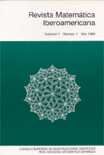
REVISTA MATEMATICA IBEROAMERICANA
Championing high-quality research in mathematics.REVISTA MATEMATICA IBEROAMERICANA, published by the EUROPEAN MATHEMATICAL SOCIETY, is a leading open-access journal dedicated to advancing the field of mathematics. Since its inception in 1996, the journal has provided a platform for high-quality research up to 2024, achieving a prestigious Q1 ranking in the miscellaneous mathematics category and placing it within the top 77th percentile of the Scopus rankings. Based in Spain, this journal fosters a vibrant academic community by disseminating innovative research, theoretical insights, and applications within the broad scope of mathematics. With its commitment to open access established in 2022, REVISTA MATEMATICA IBEROAMERICANA ensures that groundbreaking research is accessible to scholars, practitioners, and students worldwide, emphasizing the importance of collaboration and knowledge sharing in the mathematical sciences. The journal is a vital resource for anyone invested in the evolution of mathematics, providing a rich array of articles that contribute to both the theoretical and applied landscapes of the discipline.
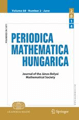
Periodica Mathematica Hungarica
Elevating Research Standards in Mathematical Studies.Periodica Mathematica Hungarica is a prestigious academic journal published by Springer, focusing on the field of mathematics, with a particular emphasis on miscellaneous mathematical studies. Established in 1971, this journal has maintained its commitment to advancing mathematical research and its applications, making significant contributions over its converged years through 2024. With a Q2 ranking in the mathematics category as of 2023, it establishes itself as a vital resource within the mathematical community. Researchers and academics will find its inclusion in the Scopus database, ranking #189 out of 399 in general mathematics, indicative of its impact and relevance. Although it does not feature open access, the journal provides a wealth of high-quality peer-reviewed articles, thereby serving as an essential platform for the dissemination of innovative mathematical theories, methodologies, and findings. Engaging with the content of Periodica Mathematica Hungarica is crucial for anyone looking to stay at the forefront of mathematical research and development.
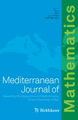
Mediterranean Journal of Mathematics
Advancing Mathematical Frontiers in the Mediterranean BasinThe Mediterranean Journal of Mathematics, published by SPRINGER BASEL AG, is a prominent platform dedicated to the advancement of mathematical research and education. Since its inception in 2004, this journal has been pivotal in disseminating high-quality research across various fields of mathematics, currently holding a notable Q2 ranking in the miscellaneous mathematics category as of 2023. With its ISSN 1660-5446 and E-ISSN 1660-5454, the journal enjoys a respected position in the academic community, evident by its Scopus rank of 129 out of 399 in General Mathematics, placing it in the 67th percentile. While primarily a subscription-based journal, it remains committed to providing a comprehensive resource for researchers, professionals, and students, fostering dialogue and exploration within the mathematical sciences. The Mediterranean Journal of Mathematics, based in Basel, Switzerland, continues to contribute significantly to the evolution of mathematical theory and practice, marking its relevance as we approach its 20th anniversary in 2024.