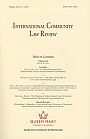
International Community Law Review
Scope & Guideline
Contributing to Global Legal Scholarship.
Introduction
Aims and Scopes
- International Human Rights Law:
The journal consistently explores themes related to the protection and promotion of human rights at both national and international levels, addressing contemporary challenges and legal frameworks. - International Environmental Law:
A significant focus is placed on the intersection of environmental issues and international law, particularly in relation to climate change, sustainability, and corporate responsibility. - International Criminal Law:
The journal covers developments in international criminal law, including issues of accountability, justice for victims, and the implications of armed conflict on legal standards. - Customary International Law:
The publication frequently investigates the role and evolution of customary international law, including its formation and application in various contexts. - International Trade and Investment Law:
The journal addresses legal aspects of international trade and investment, analyzing dispute resolution mechanisms and the impact of global economic policies. - Global Governance and International Organizations:
The journal examines the role of international organizations, such as the UN and WTO, in shaping global governance frameworks and legal standards.
Trending and Emerging
- Climate Change and Environmental Justice:
There is a growing emphasis on the legal implications of climate change, with discussions surrounding environmental justice, corporate accountability, and the rights of vulnerable populations. - Indigenous Rights and Sustainability:
Emerging themes include the recognition of indigenous rights within international law, particularly concerning sustainability and environmental governance. - Responses to Geopolitical Conflicts:
The journal has increasingly focused on the legal ramifications of recent geopolitical conflicts, such as the war in Ukraine, exploring issues of legality, sanctions, and international accountability. - Intersection of Public Health and International Law:
The COVID-19 pandemic has prompted a rise in discussions about the intersection of public health law and international legal obligations, particularly regarding state cooperation and human rights. - Corporate Social Responsibility (CSR) and Human Rights:
There is a notable trend towards exploring the role of corporations in human rights protection, particularly in relation to business practices and environmental sustainability.
Declining or Waning
- Traditional Military Law:
The focus on traditional military law, including the laws of war and armed conflict, has waned in favor of broader discussions on human rights and environmental impacts of conflict. - Historical Analyses of International Law:
There seems to be a decrease in papers solely dedicated to historical perspectives on international law, as contemporary issues take precedence over historical context. - Regional Focus on Specific Legal Systems:
There is a noticeable reduction in articles that concentrate exclusively on regional legal systems, with a shift towards more global or comparative analyses. - Legal Theory and Philosophy:
Papers that delve deeply into legal theory or philosophical underpinnings of international law are less frequent, indicating a shift towards practical applications and case studies. - International Law and Cultural Issues:
Discussions specifically linking international law with cultural considerations have diminished, possibly overshadowed by more pressing global issues.
Similar Journals
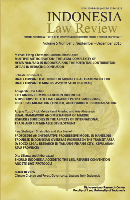
Indonesia Law Review
Connecting Researchers with Contemporary Legal IssuesIndonesia Law Review is a premier open-access academic journal dedicated to advancing knowledge in the fields of law and social sciences, with particular emphasis on the Indonesian legal landscape. Established by the Indonesian Law Review, this journal has made significant strides since becoming open access in 2014, ensuring that research is freely available to a global audience. Based in Depok, West Java, the journal seeks to foster scholarly discourse on legal issues pertinent to Indonesia, while also contributing to the broader field of education and social sciences. With its current Scopus rankings placing it within the top tiers of law and social sciences, including a Q3 categorization in law and a Q4 classification in education and miscellaneous social sciences, the **Indonesia Law Review** serves as a vital platform for researchers, professionals, and students to disseminate their findings and engage with contemporary legal dilemmas. The journal is committed to providing a robust forum for innovative legal scholarship and is an essential resource for anyone seeking to understand the complexities of law in Indonesia and beyond.
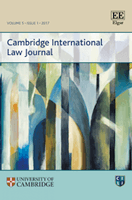
Cambridge International Law Journal
Connecting scholars and practitioners in international law.The Cambridge International Law Journal, published by Edward Elgar Publishing Ltd, is a pivotal resource for scholars and practitioners engaged in the dynamic field of international law. With an ISSN of 2398-9173 and an E-ISSN of 2398-9181, this journal provides a platform for interdisciplinary research, addressing contemporary legal issues and developments from a global perspective. Since its inception in 2012, it has garnered recognition, reflected in its 2023 Scopus rank of #549 out of 1025 in the category of Social Sciences (Law), positioning it in the 46th percentile. The journal embraces an open-access model, ensuring that its cutting-edge scholarship reaches a wide audience. The objective of the Cambridge International Law Journal is to foster dialogue among legal scholars, practitioners, and students, making significant contributions to the discourse around international legal frameworks. For those seeking comprehensive insights and analyses in law, this journal stands out as an essential resource.
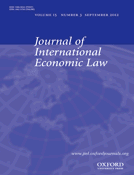
JOURNAL OF INTERNATIONAL ECONOMIC LAW
Shaping the Future of Economic Law Through Scholarly DialogueWelcome to the JOURNAL OF INTERNATIONAL ECONOMIC LAW, a prestigious academic journal published by Oxford University Press, dedicated to the interdisciplinary exploration of the intricate relationship between law and economics on a global scale. Since its inception in 1998, this quarterly journal has developed a reputation for excellence, currently holding a Q1 ranking in both Economics, Econometrics and Finance and Law categories. With an impressive Scopus ranking that places it in the 94th percentile for law and the 82nd percentile for economics, it serves as an essential resource for researchers, professionals, and students aiming to advance their understanding of international economic regulations and policies. Our goal is to foster scholarly dialogue and inform legal practices by publishing cutting-edge research, critical reviews, and comprehensive analyses relevant to contemporary issues in international economic law. Although the journal maintains subscription-only access, it remains a crucial platform for disseminating influential ideas and practices within the global academic community, encouraging rigorous debate and innovative thinking in this dynamic field.
Law & Practice of International Courts and Tribunals
Exploring the Dynamics of Global JusticeLaw & Practice of International Courts and Tribunals is a prestigious academic journal published by BRILL, focusing on the interplay between international law and the functioning of international courts and tribunals. Since its inception in 2007, the journal has established itself as a crucial platform for scholarly discourse, achieving a Q1 ranking in Law and notable placements in categories such as Political Science and Sociology. With a commitment to advancing knowledge, it serves researchers, practitioners, and students alike, facilitating a deeper understanding of the legal frameworks that govern international adjudication. Despite its non-open access model, the journal's content is highly regarded for its rigorous peer-reviewed articles, which lend critical insights into evolving legal practices and cultural dialogues within the international legal community.

Journal of East Asia and International Law
Connecting East Asian Legal Insights with Global DiscourseThe Journal of East Asia and International Law, published by the YIJUN Institute of International Law, serves as a vital platform for scholarly discourse in the field of law, with a particular focus on the complexities of East Asian legal systems and their interactions within the global context. Established in 2011 and based in Seoul, South Korea, this journal has been pivotal in fostering research that examines legal issues impacting East Asia, making significant contributions to the understanding of international law in this dynamic region. With its ISSN 1976-9229, the journal provides a valuable resource for researchers, professionals, and students interested in the evolving legal landscapes of East Asia. Though currently categorized in the Q4 quartile for law in the Scopus rankings, its dedication to enhancing legal scholarship positions it as a relevant player among emerging international law journals, encouraging submissions that explore innovative legal approaches and analyses. As ongoing interdisciplinary discussions deepen, the Journal of East Asia and International Law aims to enrich the academic community's understanding of international legal frameworks within East Asian contexts.

Canadian Yearbook of International Law
Connecting Scholars to the Evolving Landscape of LawCanadian Yearbook of International Law, published by Cambridge University Press, serves as a vital platform for scholarly discourse within the realms of law and international relations. With a rich history dating back to 1989, the journal engages a diverse audience of researchers, academics, and practitioners by offering insightful analyses of contemporary legal issues and policy debates. Although the journal currently holds a Q4 quartile ranking in both the law and political science categories, it remains an essential resource for understanding the evolving landscape of international law. Despite the current limitations in access options, the journal's rigorous peer-review process ensures that each publication maintains high academic standards, encouraging thoughtful discussions that contribute to both theoretical and applied aspects of international law. The Canadian Yearbook helps bridge gaps in knowledge and fosters greater understanding among scholars worldwide, enhancing its significance in the academic community.
European Journal of International Law
Connecting scholars to pressing international legal issues.The European Journal of International Law (EJIL), published by Oxford University Press, stands as a leading platform for the dissemination of innovative research in the realms of International Law and Political Science. With an impressive ISSN of 0938-5428 and E-ISSN of 1464-3596, this prestigious journal has achieved Q1 rankings in both Law and Political Science and International Relations categories as of 2023, emphasizing its significance among contemporary scholarly publications. Spanning contributions from a diverse range of disciplines, the EJIL serves as an essential resource for researchers, professionals, and students alike, promoting critical dialogue on pressing international legal issues. Although currently not offered as an open-access journal, it continues to retain a high impact factor, as evidenced by its substantial Scopus rankings, placing it within the top percentiles in multiple categories. Its commitment to scholarly excellence is reflected in a convergence of research trends from 2005 to 2024, and it remains dedicated to fostering informed discourse on global legal frameworks and their implications.
AMERICAN JOURNAL OF INTERNATIONAL LAW
Pioneering Insights in International LawThe American Journal of International Law, published by Cambridge University Press, stands as a crucial platform for scholarly discourse in the fields of law, political science, and international relations. With a longstanding tradition since its inception in 1937, this prestigious journal has maintained a remarkable reputation, reflected in its Q1 ranking in both Law and Political Science and International Relations as of 2023. It is recognized for its rigorous peer-review process and impactful contributions to the understanding of legal frameworks and international governance. Researchers and practitioners alike will find the journal invaluable, not only for its comprehensive analyses and original research articles but also for its commitment to advancing the field. Although it does not offer open access, its accessibility through academic institutions ensures that a broad audience can engage with its content, making it essential reading for those involved in international legal scholarship.
Asian Journal of International Law
Empowering Legal Discourse Across BordersThe Asian Journal of International Law, published by Cambridge University Press, is a premier academic journal dedicated to advancing the discourse on international law across Asia and beyond. With its ISSN 2044-2513 and E-ISSN 2044-2521, the journal has carved a significant niche in the field, achieving a Scopus rank of #463 out of 1025 in the Social Sciences category, placing it in the 54th percentile. As of 2023, it holds a Q3 category in law, reflecting its growing influence and recognition within the academic community. The journal features peer-reviewed articles that critically engage with contemporary legal issues, promote scholarly debate, and provide insights into the legal frameworks affecting the Asia-Pacific region. With no open access options currently available, it caters primarily to academics, professionals, and students seeking in-depth knowledge and critical analysis. The Asian Journal of International Law aims to be at the forefront of international legal scholarship, fostering an understanding of the complex legal landscapes that shape our world.
JOURNAL OF CONFLICT & SECURITY LAW
Navigating the Nexus of Law, Conflict, and SecurityThe Journal of Conflict & Security Law, published by Oxford University Press, is an essential source of scholarly information in the fields of law, conflict studies, and security policy. With an ISSN of 1467-7954 and an E-ISSN of 1467-7962, this journal has been a significant platform for rigorous academic discourse since its inception in 2005. It is recognized for its contributions to the legal frameworks surrounding conflict and security, currently holding a Q3 ranking in Law and Q4 in both Safety Research and Safety, Risk, Reliability, and Quality for the year 2023. With its Scopus rankings placing it in the 61st percentile in Social Sciences Law, the journal serves as a key reference point for researchers and professionals looking to navigate the complexities of contemporary security challenges. Though the journal is not open access, its detailed analyses are critical for informed policy-making and academic inquiry, making it indispensable for students, scholars, and practitioners alike. For comprehensive insights and empirical studies, Journal of Conflict & Security Law remains at the forefront of legal and security research.