INTEGRAL EQUATIONS AND OPERATOR THEORY
metrics 2024
Advancing the frontiers of algebra and analysis.
Introduction
INTEGRAL EQUATIONS AND OPERATOR THEORY, published by SPRINGER BASEL AG, stands at the forefront of research in the fields of algebra, number theory, and analysis, with an esteemed categorization of Q2 in both disciplines as of 2023. With its ISSN 0378-620X and E-ISSN 1420-8989, this journal not only maintains a rigorous standard for scholarly contributions but also offers a vital platform for discourse on theoretical and applied aspects of integral equations and operator theory. Established in 1978, it has nurtured academic growth and innovation, with contributions continuing up to 2024. The journal holds respectable Scopus rankings, placed 43rd out of 119 in Algebra and Number Theory, and 110th out of 193 in Analysis, establishing its relevance and impact within the mathematical community. Researchers, professionals, and students alike will find INTEGRAL EQUATIONS AND OPERATOR THEORY to be an invaluable resource for advancing knowledge, fostering collaboration, and inspiring future studies within these critical areas of mathematics.
Metrics 2024
 0.650.800.9051
Metrics History
Rank 2024
Scopus
IF (Web Of Science)
JCI (Web Of Science)
Quartile History
Similar Journals

Journal of Mathematical Analysis
Innovating the Intersection of Theory and ApplicationThe Journal of Mathematical Analysis, published by UNIV PRISHTINES in Serbia, offers a dedicated platform for the dissemination of innovative research in the fields of mathematical analysis and applied mathematics. With an ISSN of 2217-3412 and a convergence period from 2020 to 2024, this journal aims to foster significant advancements in both theoretical and practical aspects of mathematics. Categorized in the Q4 quartile for Analysis, Applied Mathematics, and miscellaneous Mathematics as of 2023, it serves as an essential resource for researchers and professionals alike, providing key insights into the evolving landscape of mathematical inquiry. Although it is an open access journal, facilitating global readership, its Scopus rankings reflect its emerging status, with rankings indicating a 51st percentile in Mathematics (miscellaneous) and 28th percentile in Applied Mathematics. This journal not only aims to contribute to academic discourse but also seeks to bridge gaps between mathematical theory and real-world applications, making it a vital resource for students and professionals engaged in the complexities of mathematical research.
CZECHOSLOVAK MATHEMATICAL JOURNAL
Pioneering Research in MathematicsCzechoslovak Mathematical Journal is a distinguished academic journal published by Springer Heidelberg, dedicated to advancing the field of mathematics through the dissemination of high-quality research. With an ISSN of 0011-4642 and E-ISSN 1572-9141, this journal has been a pivotal platform for mathematicians and researchers from around the globe since its inception. The journal holds a Q3 ranking in the field of Mathematics (miscellaneous), demonstrating its commitment to providing a forum for the latest mathematical theories and applications, particularly in general mathematics, as indicated by its Scopus rank of #285/399 and 28th percentile in the field. While currently not offering open access options, the journal continues to attract a wide readership by making its valuable content available through traditional subscription models. The Czechoslovak Mathematical Journal serves as an essential resource for researchers, professionals, and students aiming to stay informed about recent developments and breakthroughs in mathematics, with focus years converging from 1995 to 2024.
BULLETIN OF THE LONDON MATHEMATICAL SOCIETY
Empowering the Mathematical Community with Quality ResearchThe BULLETIN OF THE LONDON MATHEMATICAL SOCIETY, published by Wiley, is a distinguished journal that serves as a vital resource in the field of mathematics. With its ISSN 0024-6093 and E-ISSN 1469-2120, this journal has consistently provided a platform for innovative research and scholarly discourse since its inception in 1969. Recognized for its quality, it currently holds an impressive Q1 ranking in the mathematics category, a testament to its significance in disseminating influential findings and trends in the mathematical sciences. Researchers and practitioners can rely on the BULLETIN for its comprehensive coverage of both theoretical and applied mathematics, which caters to a diverse audience ranging from professionals to students alike. Though it does not currently offer Open Access options, its articles can be accessed through institutional subscriptions, ensuring that significant works reach the academic community effectively. With contributions that span over five decades, the journal continues to shape mathematical research and inspire future advancements in the discipline.
JOURNAL OF FUNCTIONAL ANALYSIS
Inspiring Collaboration in the World of Functional AnalysisThe JOURNAL OF FUNCTIONAL ANALYSIS, published by Academic Press Inc Elsevier Science, stands as a premier platform in the field of analysis, encompassing a broad spectrum of topics pertinent to functional analysis and its applications. With an impressive impact factor and categorized in Q1 for the year 2023, it ranks as one of the top journals in Mathematics (Analysis), placing it in the 77th percentile among its peers. This journal, founded in 1967, continues to provide researchers, professionals, and students with cutting-edge insights, rigorous publications, and a vibrant forum for scholarly discourse. The journal remains committed to advancing knowledge in the discipline and fostering an environment that encourages innovation and collaboration. Although it does not offer open access options, its high standards for publication ensure that each issue is replete with high-quality research that significantly contributes to the field. The journal's comprehensive coverage aligns well with the evolving landscape of functional analysis, making it an indispensable resource for anyone seeking to deepen their understanding and engage with current trends in this essential area of mathematics.

Operators and Matrices
Elevating Mathematical Discourse with Quality PublicationsOperators and Matrices is a distinguished academic journal dedicated to the fields of algebra, number theory, and analysis, published by ELEMENT. Operating from Croatia since its inception in 2009, this journal provides a vital platform for groundbreaking research, aiming to foster advancements in mathematics through the publication of high-quality articles. With an ISSN of 1846-3886, it has secured a respectable Q3 category ranking in both the Algebra and Number Theory and Analysis categories according to the latest metrics. Current Scopus rankings position it at #83/119 in Algebra and Number Theory and #153/193 in Analysis, indicating its growing influence in the academic community. Although it does not provide open access, the journal strives to promote a robust exchange of ideas and methodologies that illuminate complex mathematical concepts, thereby appealing to researchers, professionals, and students alike. By contributing to Operators and Matrices, scholars can place their work within a significant context, advancing their professional footprint in the mathematical landscape.
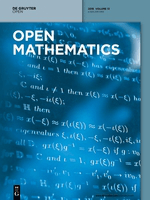
Open Mathematics
Championing Transparency in Mathematical InnovationOpen Mathematics, published by DE GRUYTER POLAND SP Z O O, is a prominent peer-reviewed journal that has been a vital platform for disseminating innovative research in the field of mathematics since its inception in 2015. With an impressive impact factor reflected by its Q2 ranking in the miscellaneous mathematics category and a commendable Scopus rank of #91 out of 399, it positions itself as a significant contributor to the mathematical community. This open access journal, headquartered in Poland, welcomes submissions that tackle diverse mathematical theories, applications, and methodologies, fostering knowledge exchange among researchers, professionals, and students globally. Since its launch, Open Mathematics has focused on bridging the gap between theoretical advancement and practical applications, making it an essential resource for anyone seeking to stay at the forefront of mathematical research and innovation. The journal offers easy online access, enhancing the visibility and impact of the valuable work published within its pages.
Transactions of the London Mathematical Society
Bridging Ideas and Innovations in Mathematical SciencesTransactions of the London Mathematical Society is a prestigious journal published by WILEY, dedicated to advancing the field of mathematics across various sub-disciplines. With its commitment to Open Access since 2014, the journal ensures that research findings are widely disseminated and accessible to a global audience, enhancing collaboration and innovation in the mathematical community. Based in the United States, this journal enjoys a prominent position within the academic landscape, evidenced by its Q1 ranking in the 2023 Mathematics (miscellaneous) category and its ranking of 181 out of 399 in the General Mathematics category on Scopus, placing it at the 54th percentile. The journal publishes high-quality, peer-reviewed research articles and surveys that aim to foster advanced study and discussion in mathematical sciences, making it an invaluable resource for researchers, professionals, and students alike. With a focus on original research and significant contributions, the Transactions of the London Mathematical Society continues to play a crucial role in the evolution of mathematical inquiry.

Dissertationes Mathematicae
Exploring the Depths of Mathematical Knowledge.Dissertationes Mathematicae is a prestigious academic journal published by the Polish Academy of Sciences Institute of Mathematics (IMPan), renowned for its contributions to the field of mathematics since its inception. With an impressive Q1 ranking in the miscellaneous mathematics category for 2023 and positioned at Rank #73 out of 399 in General Mathematics according to Scopus, this journal serves as a pivotal platform for disseminating high-quality research and innovative theoretical developments. Spanning from 2000 to 2024, it focuses on a broad range of mathematical disciplines, encouraging interdisciplinary collaboration and advancing mathematical understanding globally. While it currently does not offer open access, the journal is highly regarded in academic circles and continues to attract submissions from respected researchers and institutions. With a commitment to excellence and a notable impact factor, Dissertationes Mathematicae plays a crucial role in the ongoing development of mathematical theories and applications, making it an essential resource for researchers, professionals, and students alike.
EXPOSITIONES MATHEMATICAE
Unveiling New Perspectives in MathematicsEXPOSITIONES MATHEMATICAE, published by Elsevier GmbH, stands as a significant journal in the realm of mathematics, catering primarily to researchers, professionals, and students. With an ISSN of 0723-0869 and an E-ISSN of 1878-0792, this journal has made its mark in the academic community, boasting a Q2 classification in the miscellaneous mathematics category for 2023, illustrating its prominence within its field. The journal addresses a diverse scope of mathematical topics, encouraging the publication of original research and innovative theories while maintaining rigorous academic standards. As it converges from 2004 to 2024, EXPOSITIONES MATHEMATICAE continues to be an essential resource for advancing mathematical knowledge and fostering scholarly communication, despite being a non-open-access publication. Its location in Munich, Germany further anchors it within a rich intellectual tradition, providing accessibility for the mathematical community worldwide.
POSITIVITY
Shaping the Future of Analysis and ComputationPOSITIVITY is a distinguished journal published by Springer, focusing on cutting-edge research in the realms of Mathematics, Analysis, and Theoretical Computer Science. Since its inception in 1997, the journal has fostered intellectual rigor and innovation, catering to a diverse audience of researchers, professionals, and students alike. With an esteemed Q2 ranking in 2023 across multiple categories including General Mathematics, Analysis, and Theoretical Computer Science, POSITIVITY serves as a significant platform for disseminating high-impact findings that advance knowledge in these fields. Though it does not operate under an Open Access model, the journal provides critical insights that contribute to its commendable standing, reflected in its Scopus rankings, which highlight the journal's influence within the academic community. The ongoing publication until 2024 ensures that POSITIVITY remains at the forefront of mathematical discourse, making it an invaluable resource for those dedicated to pushing the boundaries of theoretical and applied mathematics.