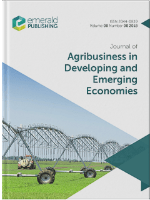
Journal of Agribusiness in Developing and Emerging Economies
Scope & Guideline
Advancing Knowledge in Agribusiness and Economic Development
Introduction
Aims and Scopes
- Agricultural Value Chains:
The journal emphasizes the analysis and improvement of agricultural value chains, highlighting the roles of various stakeholders, including farmers, traders, and consumers, in enhancing efficiency and sustainability. - Food Security and Nutrition:
Research on food security and nutrition is a core focus, addressing the challenges of food availability, accessibility, and utilization, particularly in the context of developing economies. - Impact of Climate Change:
The journal explores the implications of climate change on agricultural productivity, food systems, and rural livelihoods, providing empirical evidence and policy recommendations for adaptation strategies. - Technology and Innovation Adoption:
There is a significant emphasis on the adoption of innovative technologies in agriculture, including precision farming, digital tools, and sustainable practices that enhance productivity and market access. - Gender Dynamics in Agriculture:
The journal addresses gender issues in agribusiness, focusing on the roles and empowerment of women in agricultural practices, market participation, and decision-making processes. - Market Integration and Trade:
Research on market integration, trade policies, and their effects on local and international agricultural markets is a key area, analyzing how global market trends impact developing economies.
Trending and Emerging
- Digital Transformation in Agriculture:
The integration of digital technologies, such as mobile applications and blockchain, into agricultural practices is increasingly emphasized, showcasing how technology can enhance efficiency, transparency, and market access. - Sustainability and Climate Resilience:
Research focusing on sustainability practices and climate resilience strategies is gaining traction, reflecting a broader commitment to addressing environmental challenges and promoting sustainable agribusiness. - Consumer Behavior and Preferences:
There is a growing interest in understanding consumer behavior, preferences, and willingness to pay for agricultural products, particularly those with sustainability certifications, indicating a shift towards market-driven research. - Public-Private Partnerships:
The role of public-private partnerships in enhancing agricultural productivity and innovation is emerging as a significant theme, highlighting collaborative approaches to address agricultural challenges. - Youth Involvement in Agriculture:
Research exploring the engagement of youth in agricultural value chains and their entrepreneurial potential is on the rise, recognizing the importance of younger generations in driving agribusiness innovation.
Declining or Waning
- Traditional Agricultural Practices:
There is a noticeable decline in research focused on traditional agricultural practices, as the journal increasingly prioritizes modern techniques and innovations that address contemporary challenges in agribusiness. - Static Economic Models:
The use of static economic models for analyzing agricultural markets is becoming less common, with a shift towards dynamic models that better capture the complexities and uncertainties of agribusiness environments. - Regional Case Studies:
While regional case studies were once a staple of the journal, there has been a decrease in their prevalence, possibly due to a growing preference for comparative studies that draw broader conclusions across multiple contexts. - Conventional Supply Chain Analysis:
Research centered around conventional supply chain analysis is declining, as the focus shifts towards integrated and sustainable supply chain frameworks that incorporate modern challenges such as climate change and social equity. - Focus on Single-Crop Studies:
The journal has seen a reduction in studies that focus exclusively on single-crop analyses, moving towards more holistic approaches that consider multi-crop systems and their interdependencies.
Similar Journals
Journal of the Asia Pacific Economy
Navigating the Complexities of the Asia Pacific EconomyThe Journal of the Asia Pacific Economy is a leading academic journal dedicated to exploring economic, political, and social developments across the Asia Pacific region. Published by Routledge Journals, Taylor & Francis Ltd, this journal has been a pivotal platform for scholarly communication since its inception in 1996, contributing to a deeper understanding of regional dynamics through a rigorous peer-review process. With an impressive positioning in the Q2 category across multiple disciplines, including Development, Geography, Planning and Development, and Political Science and International Relations, the journal excels in disseminating high-quality research that influences policy and academic discourse. Researchers and professionals alike benefit from its accessibility and scholarly relevance, drawing from diverse methodologies and theoretical frameworks to address pressing issues of the Asia Pacific economy. As it continues to publish until 2024, the journal remains dedicated to advancing knowledge and fostering collaboration within the academic community.

Agricultura Sociedad y Desarrollo
Advancing Sustainable Practices for a Resilient SocietyAgricultura Sociedad y Desarrollo is a renowned journal published by COLEGIO POSTGRADUADOS, focusing on the intricate relationship between agriculture, society, and sustainable development. With an ISSN of 1870-5472 and an E-ISSN of 2594-0244, this journal plays a critical role in disseminating cutting-edge research and practical insights essential for advancing agricultural sciences and fostering community resilience. Although Agricultura Sociedad y Desarrollo is not open access, its commitment to quality ensures that the materials published meet rigorous academic standards, promoting innovation and collaboration among researchers, policymakers, and practitioners. Positioned in the heart of Mexico, the journal highlights regional agricultural challenges while contributing to global discussions on sustainable development. With the growing emphasis on integrating social sciences in agriculture, this journal stands out as a vital source of knowledge and discussion for those keen on enhancing agricultural practices and societal development.
FOOD POLICY
Catalyzing change in food-related governance and practices.FOOD POLICY, published by Elsevier Science Ltd, is a premier journal in the fields of Development, Economics, Food Science, and Policy studies, with a distinct focus on the intersection of food systems and policy frameworks. With an impact factor that places it in the Q1 category across five key disciplines in 2023, this journal is recognized for its rigorous research and influential contributions to the understanding of food-related governance and socio-economic dynamics. Its strong Scopus rankings, including a startling 25th position in Sociology and Political Science and 10th in Development, emphasize its critical role in shaping contemporary discourse around food security, agricultural policies, and sustainable practices. Although it operates under a traditional access model, FOOD POLICY remains an essential resource for researchers, practitioners, and students seeking to explore innovative policy solutions and their socio-economic implications. With a rich publication history stretching from 1975 to 2024, this journal strives to influence both academic thought and real-world practices in food policy.

NJAS-Impact in Agricultural and Life Sciences
Innovating solutions for sustainable agriculture and environmental health.NJAS-Impact in Agricultural and Life Sciences is a pivotal open-access journal, published by Taylor & Francis Ltd, focusing on the interdisciplinary nexus between agricultural practices and life sciences. Anchored in the United Kingdom, this journal aims to provide a comprehensive platform for the dissemination of innovative research that addresses critical challenges in environmental sustainability, agricultural productivity, and biological advancements. With its inaugural issue dated from 2023 to 2024, NJAS prominently features the latest empirical studies, reviews, and theoretical contributions that enrich existing knowledge and provoke thought among researchers and practitioners alike. Although currently ranking within the lower percentiles across various Scopus categories, the journal aspires to establish itself as a significant contributor to the dialogue on agricultural and environmental sciences. As scholars in these fields seek to bridge the gaps in understanding, NJAS invites submission from diverse perspectives, underscoring the importance of collaborative knowledge-building in addressing the complexities of our changing global landscape.

Journal of Agricultural Extension
Advancing Agricultural Extension for Global ImpactThe Journal of Agricultural Extension serves as a premier platform for the dissemination of innovative research and practices in the field of agricultural extension, playing a crucial role in enhancing agricultural development and education. Published by the AGRICULTURAL EXTENSION SOCIETY OF NIGERIA and boasting an Open Access policy since 2012, this journal aims to increase accessibility to vital information that supports agricultural professionals and researchers. With ISSN 1119-944X and E-ISSN 2408-6851, it encompasses a wide range of topics pertinent to agricultural sciences, education, and development, with its articles contributing to informed practices that uplift rural communities. Although currently categorized in the Q4 quartile across various fields, its commitment to enhancing knowledge export and collaborative research is evident, as it seeks to improve its global standing by 2024. The journal's commitment to quality research makes it an indispensable resource for students, professionals, and researchers dedicated to advancing agricultural practices in Nigeria and beyond.

Asian Journal of Agriculture and Development
Transforming agricultural practices through rigorous scholarship.Asian Journal of Agriculture and Development is a prestigious academic journal dedicated to advancing the field of agricultural research and development within the context of Southeast Asia. Published by the Southeast Asian Regional Center for Graduate Study and Research in Agriculture, this journal plays a vital role in disseminating innovative findings and best practices critical for sustainable agricultural development in the region. With a focus on interdisciplinary studies that integrate agricultural science, policy development, and socio-economic factors, the journal invites researchers, professionals, and students to contribute rigorous research that addresses contemporary challenges faced by the agriculture sector. Although it operates within a non-open access framework, the journal aims to ensure wide visibility and accessibility of its publications through strategic collaborations and institutional partnerships. By engaging with its content, stakeholders can gain valuable insights and foster meaningful dialogue that drives forward agricultural progress in Asia.
CANADIAN JOURNAL OF AGRICULTURAL ECONOMICS-REVUE CANADIENNE D AGROECONOMIE
Empowering Researchers in Agricultural EconomicsCanadian Journal of Agricultural Economics - Revue Canadienne d’Agroéconomie, published by Wiley, is a premier journal dedicated to the innovative and interdisciplinary study of agricultural economics. With an impressive impact factor highlighting its significance, this journal consistently ranks in the Q1 quartile across multiple categories, including Agronomy and Crop Science, Animal Science and Zoology, Ecology, Economics and Econometrics, and Global and Planetary Change. As part of its robust content, the journal spans articles from 1952 to 2024, contributing valuable insights into the interface of agricultural practices and economic theory. Researchers and professionals in the field will find this journal essential for exploring critical issues affecting agriculture, food security, and sustainability in a global context. Despite its traditional publishing model, the journal's rigorous peer-review process ensures high-quality scholarly contributions that are pivotal for advancing knowledge and academic discourse in agricultural economics.

PAKISTAN JOURNAL OF AGRICULTURAL SCIENCES
Exploring Agricultural Frontiers for a Sustainable FutureWelcome to the Pakistan Journal of Agricultural Sciences, a prominent platform for disseminating vital research findings in the fields of agronomy, crop science, food science, plant science, and soil science. Published by the prestigious University of Agriculture in Faisalabad, this journal aims to enhance the scientific discourse surrounding agricultural innovation and sustainability in Pakistan and beyond. With an ISSN of 0552-9034 and E-ISSN of 2076-0906, the journal serves as a valuable resource for researchers, professionals, and students interested in cutting-edge agricultural developments. As of 2023, the journal is ranked in the Q3 category for Agronomy and Crop Science as well as Food Science and positioned in Q4 for Plant and Soil Science, highlighting its growing impact within a competitive academic landscape. While the Pakistan Journal of Agricultural Sciences is not currently open access, it provides a comprehensive archive of research converging from 2011 to 2024, ensuring that critical knowledge remains accessible to those striving to advance the agricultural sciences. Join us in our mission to foster innovation and support sustainable practices in agriculture.
Competition & Change
Shaping Tomorrow’s Management Through Insightful ResearchCompetition & Change is a premier journal published by SAGE Publications Ltd, dedicated to the field of business, management, and accounting. With an impressive 2023 Q1 ranking and a notable Scopus rank of #39 out of 218 in its category, it stands out as an influential platform for contemporary research, thus reflecting an esteemed 82nd percentile in terms of impact. The journal spans a broad array of topics surrounding the dynamics of competition and change within various business environments, making it essential reading for professionals, academics, and students alike. Designed to foster dialogue and innovation, the journal publishes high-quality original research articles, reviews, and case studies that examine critical challenges and trends in business today. With its commitment to pioneering insights and interdisciplinary approaches, Competition & Change is poised to shape the future of management scholarship and practice.

Australasian Agribusiness Review
Empowering Agribusiness through High-Quality ResearchAustralasian Agribusiness Review, published by the University of New England's Business School Center for Agribusiness, is a premier journal dedicated to advancing the study and practice of agribusiness in the Australasian region and beyond. With a commitment to fostering high-quality research, this journal serves as a crucial platform for scholars and industry professionals alike, offering insights into contemporary issues, innovations, and challenges within the agribusiness sector. Although it currently does not operate on an open access model, its publications are critical for anyone keen on understanding the economic, social, and environmental dimensions of agribusiness. The ISSN 1833-5675 and E-ISSN 1442-6951 uniquely identify this resource, making it easily searchable for researchers and academics. Engaging with this journal will equip readers with a deeper understanding of agribusiness dynamics and contribute to the ongoing conversation around sustainable practices in the industry.