JOURNAL OF BANKING & FINANCE
metrics 2024
Your Gateway to Cutting-Edge Financial Research
Introduction
Welcome to the Journal of Banking & Finance, a premier publication in the fields of finance and economics, expertly published by Elsevier. With its esteemed Q1 ranking in both the Economics and Econometrics and Finance categories for 2023, this journal frequently garners significant attention from researchers, professionals, and academics alike. Established in 1977, it has become a crucial resource for the latest research and advancements in banking and financial services, influencing policies and practices on a global scale. The journal's commitment to high-quality, peer-reviewed content ensures that it not only contributes to academic discourse but also drives real-world financial innovation. As part of the respected Elsevier publishing collection, the journal's rigorous standards and comprehensive analysis serve as indispensable tools for those seeking to understand and navigate the complexities of the financial landscape. Located in the Netherlands, the Journal of Banking & Finance continues to play a vital role in shaping the future of financial research through its impactful insights and research contributions.
Metrics 2024
 1.663.604.40197
Metrics History
Rank 2024
Scopus
IF (Web Of Science)
JCI (Web Of Science)
Quartile History
Similar Journals
Annals of Finance
Unlocking the Complexities of Modern FinanceThe Annals of Finance, published by Springer Heidelberg in Germany, stands as a pivotal journal within the realms of Economics, Econometrics, and Finance. With a dedicated convergence of research from 2005 to 2024, this esteemed publication features thought-provoking articles that address both theoretical and practical aspects of finance, earning it a commendable Q2 category ranking in the 2023 metrics for both Economics, Econometrics and Finance as well as Finance. The journal serves an essential role in disseminating knowledge and fostering advancements in the field, appealing to researchers, professionals, and students alike. Its rigorous peer-review process ensures the integrity and quality of published works, making it a reliable source for cutting-edge findings and discussions within the finance community. For those looking to navigate the complexities of modern finance through rigorous research, the Annals of Finance is an invaluable resource.
International Journal of Theoretical and Applied Finance
Unveiling the nuances of theoretical and applied finance.International Journal of Theoretical and Applied Finance is a distinguished publication in the field of finance, serving as a critical platform for the dissemination of innovative research and theoretical insights since its inception in 2003. Published by World Scientific Publishing Co Pte Ltd in Singapore, this journal boasts an impressive Q2 ranking in the realms of Economics, Econometrics, and Finance (miscellaneous) and a solid Q3 status in Finance for 2023. With a commitment to advancing knowledge in the complex world of theoretical frameworks and applied financial practices, it welcomes original research articles, comprehensive reviews, and case studies that explore varied facets of finance. Researchers, professionals, and students benefit from the journal's rigorous peer-review process and an ever-expanding repository of knowledge, making it an indispensable resource in the financial academic community. The journal does not currently offer open access, reflecting its selective approach to publishing high-quality content aimed at a specialized audience.

EMERGING MARKETS FINANCE AND TRADE
Navigating the Future of Finance in Emerging MarketsEmerging Markets Finance and Trade is a leading academic journal published by Routledge Journals, Taylor & Francis Ltd, specializing in the dynamic field of finance and trade within emerging markets. This journal boasts an impressive impact factor and ranks in the top quartiles of its categories, attaining Q1 status in Economics, Econometrics and Finance (miscellaneous) and Q2 in Finance as of 2023. With a strong focus on innovative research, it publishes cutting-edge studies and insights that are crucial for understanding the complexities of financial systems in emerging economies. The journal, with ISSN numbers 1540-496X and 1558-0938 for its electronic version, offers a platform for both established researchers and newcomers in the field, highlighting the latest trends, policies, and challenges in finance and trade from 2002 to 2024. While it maintains a subscription-based access model, its significant contributions make it a must-read for academics, professionals, and students alike who seek to navigate and influence the rapidly evolving landscape of emerging markets.
Critical Finance Review
Pioneering new insights in the dynamic world of finance.Critical Finance Review is a premier academic journal dedicated to advancing the field of finance through the publication of high-quality research that spans various dimensions of the discipline. Published by NOW PUBLISHERS INC, this journal has quickly established itself as a leading source of innovative finance scholarship, achieving a notable Q1 classification in the 2023 finance category. Operating under a rigorous peer-review process, the journal ensures the academic integrity and relevance of its content, which attracts contributions from both emerging and established scholars. With an ISSN of 2164-5744 and E-ISSN 2164-5760, it is accessible to a global audience, though it operates under traditional access models. The journal welcomes a diverse range of topics including, but not limited to, risk management, financial markets, and quantitative finance, making it an essential resource for researchers, professionals, and students who are keen to explore the complexities of financial systems and develop new insights in the ever-evolving landscape of finance. Based in the United States, Critical Finance Review holds a significant position within the academic community, fostering a collaborative environment that encourages innovative thinking and practical applications of financial theories.
Journal of Financial Stability
Empowering insights into contemporary financial challenges.The Journal of Financial Stability, published by Elsevier Science Inc., is a renowned academic journal that serves as a premier platform for the dissemination of innovative research in the fields of finance, economics, and econometrics. With an ISSN of 1572-3089 and an E-ISSN of 1878-0962, this journal has established itself as a leader in its category, ranking Q1 for both Economics and Finance in the 2023 category quartiles. This positions it amongst the top 13% of journals in Economics and the top 35% in Finance, according to Scopus rankings. Covering a wide range of topics related to financial stability, the journal aims to fulfill its objective of advancing scholarly communication and providing researchers, professionals, and students with valuable insights into contemporary financial challenges and innovations. Operating from the Netherlands and converging from 2004 to 2024, the Journal of Financial Stability continues to contribute significantly to the academic landscape, inviting submissions that push the boundaries of knowledge and understanding in financial systems.

Annual Review of Financial Economics
Catalyzing Discourse in Economic and Financial ResearchAnnual Review of Financial Economics, published by Annual Reviews, stands as a pivotal journal in the fields of Economics and Finance, recognized for its rigorous analysis and comprehensive reviews since its inception in 2010. With an impressive impact factor reflected in its Q1 ranking in both Economics and Econometrics and Finance for 2023, this journal serves as an essential resource for researchers, professionals, and students keen on understanding the dynamic interplay of financial theories and practices. The ISSN 1941-1367 and E-ISSN 1941-1375 signal its commitment to accessibility and dissemination of cutting-edge research within the community. Addressing crucial topics from market behavior to economic modeling, each annual volume synthesizes the latest findings and theoretical advancements, thus contributing significantly to the global discourse within financial economics. With its high Scopus rankings, including a finance rank of #75 out of 317, the journal continues to foster a deep understanding of financial systems and their implications, serving as an invaluable tool for anyone engaged in the broader economic landscape.
Review of Financial Economics
Illuminating the Intersection of Economics and FinanceReview of Financial Economics, published by WILEY, stands as a prominent peer-reviewed journal in the fields of economics and finance. Established in 1994, this journal provides a platform for rigorous research and thoughtful discourse, contributing to the advancement of knowledge in financial theory and its applications. With an HIndex indicative of its citation impact, it ranks in the Q3 quartile for both Economics and Econometrics, as well as Finance, based on the 2023 categorization, underscoring its role in the academic community. Although it does not currently offer Open Access, the journal remains accessible to a wide audience through institutional subscriptions. Researchers, professionals, and students are encouraged to engage with its insightful articles that address contemporary issues and advancements within financial economics, fostering a deeper understanding of the complex interplay between economic systems and financial markets.
JOURNAL OF FINANCIAL RESEARCH
Unveiling Trends in Financial ResearchThe JOURNAL OF FINANCIAL RESEARCH, published by WILEY, stands as a pivotal platform for disseminating innovative research in the fields of finance and accounting since its inception in 1978. With an ISSN of 0270-2592 and an E-ISSN of 1475-6803, this journal aims to address contemporary challenges and trends within the financial research landscape. It has achieved notable recognition, being placed in the Q2 category for both Finance and Accounting in the 2023 rankings, signifying its relevance and impact within the academic community. Although it does not currently offer open access, the journal is accessible through various academic databases, catering to a diverse audience of researchers, professionals, and students keen on advancing their knowledge and understanding of financial systems and methodologies. With an evolving scope that encompasses empirical studies, theoretical frameworks, and practical applications, the JOURNAL OF FINANCIAL RESEARCH is committed to contributing valuable insights into the complexities of financial practices and policies.
Indonesian Capital Market Review
Fostering Open Access to Capital Market ResearchIndonesian Capital Market Review is a prominent academic journal dedicated to the exploration of financial markets, investment strategies, and economic policies within Indonesia and Southeast Asia. Published by Universitas Indonesia, this journal has been an essential resource for researchers, professionals, and students since its inception in 2009, offering open access to its content to promote wider dissemination of knowledge. With an ISSN of 1979-8997 and an E-ISSN of 2356-3818, it aims to bridge the gap between theoretical frameworks and practical applications in the capital markets. By rigorously vetting its publications, the journal enhances the academic discourse surrounding financial systems, thereby empowering stakeholders with empirical insights. The commitment to open access ensures that groundbreaking research is readily available to a global audience, advancing the understanding of capital market dynamics in Indonesia and beyond.
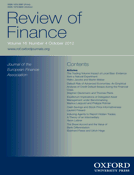
Review of Finance
Exploring the intersections of finance, accounting, and economics.The Review of Finance, published by Oxford University Press, stands as a premier academic journal in the fields of Finance, Accounting, and Economics. With an ISSN of 1572-3097 and an impressive track record stretching from 2001 to 2024, this journal is consistently recognized for its high-quality research, reflected in its Q1 rankings across key categories, including Accounting, Finance, and Economics and Econometrics. The Review of Finance is dedicated to advancing the understanding of financial phenomena through robust empirical and theoretical insights, making it an essential resource for researchers and professionals alike. Additionally, its strong Scopus rankings, placing it in the top percentiles, highlight its influence and relevance in ongoing academic discourse. Although the journal is not open access, it remains widely accessible through academic institutions, ensuring that its valuable contributions reach an extensive audience. The editorial board invites submissions that promise to further engage the academic community in the dynamic intersections of finance, accounting, and economic research.