JOURNAL OF ENVIRONMENTAL LAW
Scope & Guideline
Innovating solutions for pressing ecological challenges.
Introduction
Aims and Scopes
- International Environmental Law:
The journal frequently publishes articles that explore international treaties, conventions, and case law that shape global environmental governance, emphasizing the role of international law in addressing transboundary environmental issues. - National and Regional Environmental Legislation:
There is a consistent focus on the examination of national laws and regulations, particularly in the EU, UK, and other jurisdictions, analyzing their effectiveness in addressing local environmental challenges. - Climate Change Law:
A significant emphasis is placed on the legal dimensions of climate change, including litigation, constitutional rights, and regulatory frameworks aimed at mitigation and adaptation strategies. - Public Participation and Environmental Justice:
The journal highlights the role of public participation in environmental decision-making processes, drawing attention to issues of access to justice, rights of affected communities, and the impact of environmental laws on marginalized groups. - Interdisciplinary Approaches to Environmental Law:
The journal supports interdisciplinary scholarship that integrates insights from various fields such as economics, political science, and sociology to enrich the understanding of environmental law and policy.
Trending and Emerging
- Rights-Based Approaches to Environmental Protection:
There is a notable increase in discussions surrounding the recognition of environmental rights, including the right to a healthy environment and the rights of nature, as legal frameworks evolve to support these concepts. - Climate Litigation and Accountability:
Recent trends show a growing body of literature focusing on climate litigation, particularly cases that seek to hold governments and corporations accountable for their environmental impact, reflecting a shift towards legal action as a tool for climate advocacy. - Impact of International Agreements:
The journal has seen an uptick in articles analyzing the implications of international agreements, such as the Paris Agreement, on domestic law and policy, indicating a trend towards integration of global commitments into local legal contexts. - Interdisciplinary Environmental Law Scholarship:
There is a rising interest in interdisciplinary approaches that incorporate insights from science, economics, and social justice into environmental law, promoting a more holistic understanding of environmental issues. - Innovative Regulatory Mechanisms:
Emerging themes include the exploration of new regulatory frameworks, such as market-based instruments and collaborative governance, as effective strategies for addressing complex environmental challenges.
Declining or Waning
- Traditional Environmental Regulations:
There seems to be a decreasing emphasis on conventional regulatory approaches, such as command-and-control mechanisms, as newer frameworks and innovative solutions are gaining traction in the discourse. - General Environmental Policy Discussions:
Broader discussions on environmental policy without specific legal implications are appearing less frequently, indicating a shift towards more targeted analyses that emphasize legal frameworks and case studies. - Historical Perspectives on Environmental Law:
Papers focusing on historical analyses of environmental law's development are becoming less prominent, suggesting a move towards contemporary issues and future-oriented legal challenges.
Similar Journals
European Journal of International Law
Navigating the complexities of international law with insight.The European Journal of International Law (EJIL), published by Oxford University Press, stands as a leading platform for the dissemination of innovative research in the realms of International Law and Political Science. With an impressive ISSN of 0938-5428 and E-ISSN of 1464-3596, this prestigious journal has achieved Q1 rankings in both Law and Political Science and International Relations categories as of 2023, emphasizing its significance among contemporary scholarly publications. Spanning contributions from a diverse range of disciplines, the EJIL serves as an essential resource for researchers, professionals, and students alike, promoting critical dialogue on pressing international legal issues. Although currently not offered as an open-access journal, it continues to retain a high impact factor, as evidenced by its substantial Scopus rankings, placing it within the top percentiles in multiple categories. Its commitment to scholarly excellence is reflected in a convergence of research trends from 2005 to 2024, and it remains dedicated to fostering informed discourse on global legal frameworks and their implications.

Melbourne Journal of International Law
Fostering Dialogue on the Evolution of International LawThe Melbourne Journal of International Law (ISSN: 1444-8602, E-ISSN: 1444-8610), published by the esteemed University of Melbourne, Melbourne Law School, is a premier forum for scholarly discussion and research in the field of international law. This journal aims to provide rigorous and innovative analyses of contemporary legal issues that transcend national borders, making significant contributions to both theory and practice. With its commitment to disseminating high-quality scholarship, the journal engages a diverse readership, including researchers, legal practitioners, and students, fostering a rich dialogue on the complexities of international legal frameworks. Although it does not currently offer open access, the Melbourne Journal of International Law remains a vital resource for those seeking to navigate the evolving landscape of international jurisprudence.
Review of European Comparative & International Environmental Law
Exploring innovative solutions for pressing environmental challenges.Review of European Comparative & International Environmental Law is a leading academic journal published by WILEY that serves as a vital platform for scholars and practitioners in the fields of environmental law, geography, and policy analysis. With its ISSN 2050-0386 and E-ISSN 2050-0394, it provides comprehensive insights into the comparative and international aspects of environmental legislation and governance. The journal is noted for its rigorous peer-review process and has achieved commendable rankings, including Q1 in Law and Q2 in Geography, Planning, and Development in the 2023 category quartiles. Furthermore, it holds impressive Scopus rankings, placing it within the 92nd percentile for social sciences law. The scope of the journal encompasses interdisciplinary research addressing contemporary environmental challenges, making it an invaluable resource for those engaged in the development, monitoring, and policy-making around environmental law. Published since 2013 and continuing through 2024, Review of European Comparative & International Environmental Law plays a crucial role in fostering scholarly dialogue and influencing environmental policy worldwide, ensuring access to state-of-the-art research and innovative solutions for a sustainable future.
International Community Law Review
Illuminating Challenges in International Law.International Community Law Review, published by MARTINUS NIJHOFF PUBLISHERS, is a distinguished journal that contributes significantly to the fields of law and international relations. With an ISSN of 1871-9740 and an E-ISSN of 1871-9732, this journal serves as a vital platform for scholarly discourse on issues pertaining to international law, promoting a deeper understanding and engagement with complex legal frameworks and global challenges. Currently classified in the Q3 quartile for Law and Political Science and International Relations, the International Community Law Review ranks 475 out of 1025 in the Law category and 386 out of 706 in Political Science, reflecting a moderate impact in the academic community. Though it does not currently offer Open Access, the journal's extensive coverage from 2007 through 2024 ensures that it remains a relevant resource for researchers, professionals, and students. Published in the Netherlands, this journal aims to foster the development of international legal thought, support academic research, and facilitate discussions that shape modern international legal practices.

Juridical Tribune-Tribuna Juridica
Connecting Scholars to the Pulse of Public AdministrationWelcome to the Juridical Tribune-Tribuna Juridica, an esteemed journal dedicated to the interdisciplinary exploration of legal studies, political science, and public administration. Published by EDITURA ASE in Romania, this open-access journal has been a beacon of knowledge since its inception in 2011, making scholarly research accessible to a global audience. With a robust focus on contemporary issues in law and governance, the journal is categorized in the Q2 and Q3 quartiles across several fields, highlighting its significance in Education, Law, Political Science and International Relations, and Public Administration. Its impressive ranking, standing at the 71st percentile in Law and the 60th percentile in Political Science, showcases its contribution to advancing academic discourse. The journal spans a convergence of years from 2019 to 2024, reflecting its commitment to ongoing, relevant research. Scholars, practitioners, and students alike are invited to delve into the rich resources available through this journal, fostering insights and dialogue that are crucial in today's dynamic legal and political landscape.

Environmental and Planning Law Journal
Illuminating Challenges in Environmental GovernanceEnvironmental and Planning Law Journal is a significant publication in the fields of law and environmental studies, published by LAWBOOK CO LTD in Australia. This journal, with the ISSN 0813-300X, has established itself as a crucial resource since its inception in 1984, providing a platform for scholarly discourse around legal frameworks affecting environmental planning and policy. Despite its coverage discontinuation in databases like Scopus, its impact remains recognized, achieving a rank of #455 in the Social Sciences Law category, indicating its relevance in legal scholarship. The journal is classified in the lower quartiles, yet it continues to address vital issues in geography, planning, and management of environmental law, engaging with contemporary challenges faced by policy-makers and practitioners. With no open access options currently available, the journal invites subscriptions and institutional access for its valuable content, making it a notable cornerstone for researchers, students, and professionals dedicated to navigating the complexities of environmental law and planning.
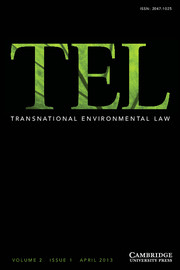
Transnational Environmental Law
Empowering scholars and practitioners in the fight for our planet.Transnational Environmental Law is a premier peer-reviewed journal published by CAMBRIDGE UNIVERSITY PRESS, dedicated to advancing the understanding of international and transnational environmental legal frameworks. With an ISSN of 2047-1025 and an E-ISSN of 2047-1033, this journal plays a crucial role in disseminating cutting-edge research from 2012 to 2024. It stands out in its field with impressive rankings, securing a Q1 category position in both Law and Management, Monitoring, Policy and Law categories in 2023. The journal's impact is underscored by its Scopus ranking, placing it in the top 4% in Social Sciences Law and the top 25% in Environmental Science Management. By facilitating dialogue among scholars, policymakers, and practitioners, Transnational Environmental Law provides vital insights on legal responses to global environmental challenges, fostering interdisciplinary collaboration essential for sustainable development. Researchers and professionals alike will find this journal an invaluable resource for staying abreast of the latest legal developments and policy discussions that shape our environmental future.
Anuario Colombiano de Derecho Internacional-ACDI
Elevating Global Legal Discourse from ColombiaAnuario Colombiano de Derecho Internacional-ACDI, published by UNIV ROSARIO, EDITORIAL, is a pivotal open-access journal established in 2008, focusing on the field of international law. Situated in Colombia, this journal serves as a vital platform for scholars, practitioners, and students to disseminate and discuss pivotal legal issues that resonate within an increasingly globalized context. With an impact factor reflecting its relevance—ranking in the Q3 category of law and positioned at the 33rd percentile among legal journals in the Scopus ranking—ACDI is a commendable source for academic research. The journal operates under a rigorous peer-review process, ensuring high standards of scholarly communication. Its commitment to accessibility fosters a broader dialogue among legal professionals worldwide, making it an essential resource for advancing knowledge and discourse in international law.

UNIVERSITY OF PITTSBURGH LAW REVIEW
Fostering Critical Discourse in Law and Policy.University of Pittsburgh Law Review is a prestigious academic journal that stands as a cornerstone in the field of legal scholarship. Published by the University of Pittsburgh, University Library System, this journal has been contributing to the discourse of the law since its inception, exemplifying a commitment to advancing scholarly work in various legal domains. Although its open access options are limited, the robust collection of articles and commentaries—spanning from 1973 to the present—provides an invaluable resource for researchers, professionals, and students alike. The journal currently ranks in the Q4 quartile within the field of law for 2023, indicating a specialized focus and offering significant opportunities for legal analysis and research. Positioned in a competitive landscape as Rank #784 out of 1025 in Scopus for Social Sciences - Law, it is an essential platform for emerging voices and innovative ideas that shape legal thought and policy. The University of Pittsburgh Law Review continues to foster critical examination and discussion, making it a vital resource for anyone engaged in the study or practice of law.
Law & Practice of International Courts and Tribunals
Illuminating the Pathways of International AdjudicationLaw & Practice of International Courts and Tribunals is a prestigious academic journal published by BRILL, focusing on the interplay between international law and the functioning of international courts and tribunals. Since its inception in 2007, the journal has established itself as a crucial platform for scholarly discourse, achieving a Q1 ranking in Law and notable placements in categories such as Political Science and Sociology. With a commitment to advancing knowledge, it serves researchers, practitioners, and students alike, facilitating a deeper understanding of the legal frameworks that govern international adjudication. Despite its non-open access model, the journal's content is highly regarded for its rigorous peer-reviewed articles, which lend critical insights into evolving legal practices and cultural dialogues within the international legal community.