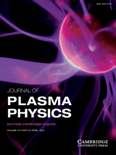
JOURNAL OF PLASMA PHYSICS
metrics 2024
Catalyzing innovation in plasma science.
Introduction
Welcome to the JOURNAL OF PLASMA PHYSICS, a premier publication dedicated to advancing understanding and research in the field of plasma physics. Published by Cambridge University Press, this journal has been a pivotal resource since its inception in 1967, supporting scholars and professionals engaged in the innovative exploration of plasma phenomena. With an impressive Q1 rating in Condensed Matter Physics, the journal not only holds a significant position in the academic community but also ranks within the top 50th percentile in the Scopus database. Although it currently does not offer open access, the journal provides a wealth of valuable research contributions aimed at fostering knowledge and collaboration among researchers, professionals, and students alike. The Journal of Plasma Physics is committed to publishing high-quality articles that push the boundaries of knowledge, ensuring its vital role in the ever-evolving landscape of physics research.
Metrics 2024
 0.912.102.2052
Metrics History
Rank 2024
Scopus
IF (Web Of Science)
JCI (Web Of Science)
Quartile History
Similar Journals
CONTRIBUTIONS TO PLASMA PHYSICS
Pioneering Research in the Realm of Plasma PhysicsCONTRIBUTIONS TO PLASMA PHYSICS is a distinguished journal dedicated to advancing the field of plasma physics, published by WILEY-V C H VERLAG GMBH. Since its inception in 1988, this journal has provided a platform for high-quality research, fostering collaboration and dissemination of knowledge in the condensed matter physics domain. With its current ranking of Q3 in the 2023 assessments, the journal is recognized for its contributions to the discipline, as indicated by its position in the Scopus rankings (Rank #252/434) and 42nd percentile within its category. Researchers and professionals engaged in plasma physics are encouraged to submit their work, as the journal aims to publish innovative studies that push the boundaries of current understanding and application in plasma phenomena. While currently not offering open access, the journal remains a vital resource for insights into the complexities and advancements in plasma research, operating from its base in Germany.
Applied Physics Express
Empowering Research with Impactful InsightsApplied Physics Express, published by IOP Publishing Ltd, is a leading journal that focuses on the rapid dissemination of research in applied physics, aimed at both academia and industry professionals. Operating from Japan, this prestigious journal features a broad scope within the domains of engineering and physics and astronomy, earning a significant place in the research community, as evidenced by its Q2 ranking in both disciplines for 2023. With a commitment to excellence, Applied Physics Express provides a platform for authors to share their innovative findings, promoting collaboration and advancement in the field. Its impact is further highlighted by its solid performance in Scopus rankings, featuring prominently within the engineering and physics categories. Although the journal does not currently operate under an open access model, it is dedicated to ensuring that high-quality research is accessible to its readers. Researchers, students, and professionals can find invaluable insights and cutting-edge studies within its pages, making it an essential resource for those engaged in applied physics and its interdisciplinary applications.

Jordan Journal of Physics
Navigating the Frontiers of Physics and AstronomyJordan Journal of Physics is a pivotal scholarly platform published by YARMOUK UNIVERSITY, DEANSHIP RESEARCH & GRADUATE STUDIES, dedicated to the field of physics and its applications. Established in 2008, this journal serves as a crucial avenue for disseminating quality research and insights in various subfields of physics and astronomy. As a publication in the Q4 category per the 2023 metrics, the journal, while currently placed in the lower quartile, offers a unique opportunity for emerging researchers to contribute their findings. With an ISSN of 1994-7607 and a commitment to fostering academic discourse, the Jordan Journal of Physics provides access to original research articles, reviews, and case studies aimed at enriching knowledge and innovation. While it does not presently offer open access, efforts are underway to expand its reach and visibility in the global academic context. Researchers and scholars will find this forum to be an essential resource for advancing their work and connecting with a community dedicated to exploration and understanding of the fundamental principles that govern our universe.
PHYSICA SCRIPTA
Exploring the Depths of Condensed Matter PhysicsPHYSICA SCRIPTA, established in 1970 and published by IOP Publishing Ltd, is a prestigious journal dedicated to the broad fields of physics, encompassing topics such as atomic and molecular physics, condensed matter physics, and mathematical physics. With an impressive commitment to advancing scientific knowledge, it holds a significant standing in the academic community, evidenced by its Q2 and Q3 rankings across various categories in 2023. The journal is instrumental for researchers, professionals, and students seeking to disseminate and engage with high-quality research, fostering collaboration and innovation within the field. Although it currently does not offer open access options, its robust editorial standards ensure the dissemination of impactful studies, contributing to its rising citation metrics. Published from the United Kingdom, PHYSICA SCRIPTA continues to be a vital resource for contemporary developments in physics, paving the way for future discoveries.

Kinetic and Related Models
Transforming Theoretical Concepts into Practical ApplicationsKinetic and Related Models, published by the American Institute of Mathematical Sciences (AIMS), is a distinguished journal that focuses on innovative research in the realms of kinetic theory, modeling, and numerical analysis. With an ISSN of 1937-5093 and an E-ISSN of 1937-5077, this journal offers critical insights and advances in mathematical sciences, making significant contributions to both theoretical and practical applications in these fields. As of 2023, it holds a respectable Q2 category ranking in both Modeling and Simulation and Numerical Analysis, reflecting its impact and relevance in the academic community, with Scopus ranks positioning it favorably among its peers. Although it operates through a subscription model, the journal is key for researchers aiming to remain at the forefront of mathematical modeling methodologies and numerical techniques. Established to serve the academic community since 2010, Kinetic and Related Models fosters interdisciplinary collaboration, catering not only to scholars but also to professionals and students looking to deepen their understanding and application of kinetic models in various recent contexts.

PHYSICS OF PLASMAS
Shaping the Landscape of Plasma Physics ResearchPhysics of Plasmas is a premier peer-reviewed journal published by AIP Publishing, focusing on the vital and interdisciplinary field of plasma physics. With an ISSN of 1070-664X, this journal presents cutting-edge research that spans a wide array of topics including fusion energy, astrophysical plasmas, and industrial applications of plasma technologies. As a recognized leader in the field, it holds a prestigious Q1 ranking in Condensed Matter Physics, reflecting its high impact and quality of published work. The journal's scope encompasses both fundamental studies and innovative applications, serving as an essential resource for researchers, professionals, and students alike. Although it does not offer open access, its rigorous selection process ensures that only the most significant contributions are highlighted. With a convergence of expertise from 1994 to 2024, Physics of Plasmas continually shapes the future of plasma research and technology, making it a critical avenue for sharing discoveries and advancements in this dynamic area of physics.
Journal of Physics Communications
Fostering Innovation in Physics and AstronomyJournal of Physics Communications, published by IOP Publishing Ltd, serves as a significant platform for the dissemination of innovative research in the realm of physics and astronomy. Since its inception in 2017, this Open Access journal has fostered a collaborative environment, allowing researchers, professionals, and students to share their findings and ideas without barriers. With an ISSN of 2399-6528, the journal has established its credibility in the academic community, achieving a ranking of Q3 in the 2023 category of Physics and Astronomy (miscellaneous), as well as a respectable position in Scopus with a rank of #122 out of 243 in its field. The journal's focus is on bridging theoretical concepts and practical applications, making it an essential resource for those engaged in the evolving landscape of physics. The Journal of Physics Communications not only aims to advance knowledge but also to inspire interdisciplinary collaboration, inviting contributions from diverse areas within physics. Authors and readers alike will find this journal particularly beneficial to stay updated on emerging trends and innovative research.

Plasma and Fusion Research
Connecting Researchers to the Heart of Plasma SciencePlasma and Fusion Research is a pivotal journal within the realm of plasma science and nuclear fusion, published by the Japan Society of Plasma Science and Nuclear Fusion Research. With an ISSN of 1880-6821, this journal serves as a vital platform for disseminating significant research findings and advancements from Japan and around the globe. Operating since 2006, it has steadily contributed to the field, reflected in its recognition as a Q3 journal in Condensed Matter Physics for the year 2023 and its ranking of #383 out of 434 in the Scopus categories, placing it in the 11th percentile. Although it currently does not offer open access, the journal's commitment to quality research makes it essential reading for researchers, professionals, and students keen on exploring the complexities of plasma dynamics, fusion technology, and their applications in energy production. Situated in Nagoya, Japan, the journal fosters a collaborative environment aimed at pushing the boundaries of knowledge in plasma physics and enhancing the understanding of fusion processes.
FUSION ENGINEERING AND DESIGN
Elevating Fusion Engineering Through Collaborative Research.FUSION ENGINEERING AND DESIGN is a premier scientific journal published by Elsevier Science SA, dedicated to advancing the field of fusion engineering, materials science, and related disciplines. Established in 1985 and running through 2024, this journal features cutting-edge research that spans multiple categories, including Civil and Structural Engineering, Mechanical Engineering, Materials Science, and Nuclear Energy and Engineering, holding a notable Q2 quartile ranking in each field as of 2023. Catering to a global audience of researchers and professionals, FUSION ENGINEERING AND DESIGN emphasizes the importance of interdisciplinary collaboration and innovative technology in tackling the complex challenges associated with fusion energy. Although it does not offer Open Access, the journal remains an essential resource for those seeking to stay abreast of developments that could shape the future of energy solutions and engineering methodologies. With a dedicated editorial board and a commitment to high-impact publication, this journal serves as a vital platform for disseminating transformative ideas and driving forward the scientific dialogue in fusion engineering.
PHYSICA D-NONLINEAR PHENOMENA
Pioneering Research in Nonlinear Dynamics Since 1980PHYSICA D-NONLINEAR PHENOMENA, published by Elsevier, serves as a leading academic journal at the forefront of the fields of Applied Mathematics, Condensed Matter Physics, Mathematical Physics, and Statistical and Nonlinear Physics. With an impressive track record since its inception in 1980, this journal has maintained a distinguished presence, noted for its Q1 ranking in multiple categories in 2023, showcasing its impact and relevance in the scientific community. The journal's commitment to advancing knowledge is reflected not only in its rigorous peer-reviewed articles but also through its high visibility and accessibility, aiding researchers, professionals, and students in staying abreast of the latest developments in nonlinear phenomena. Located in Amsterdam, Netherlands, PHYSICA D-NONLINEAR PHENOMENA is essential for those seeking to explore innovative research and contribute to groundbreaking discoveries in the realm of nonlinear dynamics.