JOURNAL OF QUANTITATIVE CRIMINOLOGY
Scope & Guideline
Enhancing Methodological Rigor in Criminology
Introduction
Aims and Scopes
- Quantitative Analysis of Crime Patterns:
The journal emphasizes the use of quantitative methods to analyze crime trends, patterns, and correlates. This includes the application of statistical models to understand the dynamics of criminal behavior and the effectiveness of various interventions. - Impact of Social and Environmental Factors on Crime:
Research published in the journal frequently explores how social structures, community characteristics, and environmental factors influence crime rates and criminal behavior, contributing to the understanding of crime in context. - Assessment of Criminal Justice Policies and Practices:
The journal provides a forum for evaluating the effectiveness of criminal justice policies, practices, and programs through rigorous empirical studies, aiming to inform policy-making and improve justice outcomes. - Interdisciplinary Approaches to Criminology:
The scope includes interdisciplinary studies that integrate perspectives from sociology, psychology, public policy, and public health to enrich the understanding of crime and criminal justice. - Focus on Racial and Ethnic Disparities in Crime:
A consistent focus on racial and ethnic disparities in crime, policing, and sentencing is evident, addressing critical social justice issues within the criminological framework.
Trending and Emerging
- Machine Learning and Predictive Analytics:
There is a growing trend towards the application of machine learning and predictive analytics in crime analysis, demonstrating the journal's embrace of advanced statistical techniques to forecast criminal behavior and optimize policing strategies. - Social Network Analysis in Crime Studies:
The use of social network analysis to understand co-offending patterns and the dynamics of criminal networks is increasingly prominent, highlighting the importance of relational data in criminology. - Impact of Environmental and Urban Factors on Crime:
Emerging research focuses on the interplay between urban design, environmental changes, and crime rates, underscoring the relevance of place-based factors in criminological research. - Longitudinal Studies of Criminal Behavior:
There is an increasing emphasis on longitudinal studies that track criminal behavior over time, providing insights into developmental trajectories and the impact of life events on offending. - Racial and Ethnic Disparities in Justice Outcomes:
Recent studies are increasingly addressing issues of racial and ethnic disparities in criminal justice outcomes, reflecting a growing awareness of social justice and equity in the field.
Declining or Waning
- Traditional Qualitative Approaches:
There has been a noticeable decrease in the publication of traditional qualitative research studies, as the journal increasingly prioritizes quantitative analyses and data-driven methodologies. - Static Models of Crime Analysis:
The reliance on static models that do not account for temporal dynamics in crime patterns appears to be declining, with a shift towards more dynamic and longitudinal approaches that capture changes over time. - Generalized Crime Prevention Strategies:
Research focusing on broad, generalized crime prevention strategies without empirical backing or specific contextual analysis is less prevalent, as the journal emphasizes evidence-based, context-specific interventions.
Similar Journals
Critical Criminology
Exploring the Depths of Crime and Society.Critical Criminology is an esteemed academic journal published by Springer, focusing on the interdisciplinary examination of crime and justice through a critical lens. With its ISSN 1205-8629 and E-ISSN 1572-9877, this journal provides a platform for innovative research that challenges mainstream criminological perspectives and explores the socio-political dimensions of crime. Recognized for its scholarly rigor, it holds a prestigious Q1 ranking in Law and a Q2 ranking in Sociology and Political Science, showcasing its vast influence in the field. The journal serves as an essential resource for researchers, practitioners, and students interested in the complexities of crime and the multitude of factors influencing criminal behavior. Although it operates under a subscription model, its significance is underscored by high performance metrics, including a remarkable 88th percentile rank in the Law category of Scopus, affirming its critical role in advancing criminological scholarship. Based in the Netherlands, Critical Criminology continues to attract contributions that shed light on contemporary issues and pursue paths of social justice and reform.
International Journal of Law Crime and Justice
Exploring the Nexus of Law, Crime, and JusticeThe International Journal of Law Crime and Justice, published by ELSEVIER SCI LTD, serves as a pivotal platform for the dissemination of cutting-edge research in the fields of law, crime, and justice. Established in 2008, the journal has established itself as a reputable source in its domain, holding a respectable Q2 ranking in Law, Political Science and International Relations, as well as Sociology and Political Science as of 2023. With an impact factor reflecting its influence, this journal ranks favorably within the top percentiles of Scopus in several social science categories, making it a critical resource for scholars and practitioners. The journal promotes open access, ensuring that vital research is accessible to a global audience. Scholars interested in the intricate intersection between legal studies, societal challenges, and crime will find the journal's objectives aligned with fostering knowledge and innovation in this dynamic field. Operating from its headquarters in London, England, the journal continues to invite substantial contributions that address contemporary issues and enhance our understanding of law and justice worldwide.
JOURNAL OF CRIMINAL JUSTICE
Exploring the intersection of law, psychology, and society.The JOURNAL OF CRIMINAL JUSTICE, published by Elsevier, stands at the forefront of interdisciplinary research at the nexus of law, psychology, and sociology. With an impressive impact factor and consistently ranking in the Q1 category across multiple disciplines, including Applied Psychology and Law, this journal serves as a vital platform for exploring critical issues in criminal justice policy, behavior, and system effectiveness. Since its inception in 1973, the journal has evolved its scope to encompass contemporary challenges and innovative responses within the field. Researchers, professionals, and students can benefit from access to high-quality, peer-reviewed articles that not only reflect current trends but also drive future discourse. Though currently not open access, the journal's rigorous standards ensure that all published works contribute significantly to advancing knowledge and practice in criminal justice and related areas.
International Journal of Comparative and Applied Criminal Justice
Illuminating critical dialogues in criminal justice.International Journal of Comparative and Applied Criminal Justice, published by ROUTLEDGE JOURNALS, TAYLOR & FRANCIS LTD, stands at the forefront of interdisciplinary research in the fields of law, sociology, and social psychology. With an ISSN of 0192-4036 and an E-ISSN of 2157-6475, this esteemed journal has been disseminating pivotal research since its inception in 1977. Recognized for its rigorous scholarship, it boasts a Q1 ranking in Law and positions itself within the top 85th percentile in Social Sciences - Law, emphasizing its impact on the academic community. Although primarily subscription-based, its accessibility ensures that critical findings reach a wide audience, supporting the advancement of knowledge across various disciplines. The journal's scope encompasses significant developments in applied criminal justice, making it an invaluable resource for researchers, policymakers, and students dedicated to understanding and improving justice systems globally. In its commitment to academic excellence, the journal continues to foster innovative dialogue and promote knowledge exchange, contributing significantly to current debates within the social sciences.

Crime and Justice-A Review of Research
Fostering insights for a just society through rigorous research.Crime and Justice: A Review of Research is a leading scholarly journal published by the University of Chicago Press, dedicated to advancing knowledge in the fields of sociology and political science, specifically through the lens of crime and justice studies. With an ISSN of 0192-3234 and an E-ISSN of 2153-0416, this academic journal offers a distinguished platform for researchers, practitioners, and students to explore contemporary issues, methodologies, and theoretical advancements within the domain. Ranked in the Q2 category for both sociology and political science as of 2023, it has gained recognition with an impressive Scopus rank of #150 out of 1466 in its field, placing it in the 89th percentile. The journal publishes comprehensive reviews and research articles that inform best practices and policies in crime prevention, law enforcement, and social justice, fostering a deeper understanding of the complexities surrounding crime and societal responses. Though it is not an open-access journal, the insightful research it presents is indispensable for academic discourse and practical application in addressing the multifaceted challenges of crime and justice in contemporary society.
Journal of Contemporary Criminal Justice
Exploring the Intersection of Law and Society.Journal of Contemporary Criminal Justice is a leading academic publication within the field of criminal justice, published by SAGE Publications Inc. This esteemed journal, bearing the ISSN 1043-9862 and E-ISSN 1552-5406, has been contributing significantly to the discourse on contemporary issues in justice systems since its inception in 1978. Renowned for its rigorous peer-reviewed articles, the journal holds an impressive 2023 ranking within the Q1 quartile in Law, further affirmed by its Scopus rank of #110 out of 1025 in the field of Social Sciences - Law, placing it in the 89th percentile. Though not an open access journal, it provides a vital platform for scholars, practitioners, and students seeking to explore and disseminate pioneering research and practical insights into the evolving criminal justice landscape. The journal covers a wide array of topics, from policy analysis to sociological perspectives, ensuring its relevance across multiple disciplines. With a commitment to advancing the understanding of justice in contemporary society, the Journal of Contemporary Criminal Justice is an essential resource for anyone engaged in the fields of criminology, criminal law, and social policy.

Journal of Penal Law and Criminology-Ceza Hukuku ve Kriminoloji Dergisi
Championing Open Access to Criminal Justice ResearchThe Journal of Penal Law and Criminology-Ceza Hukuku ve Kriminoloji Dergisi, published by ISTANBUL UNIV, is a prestigious platform dedicated to the advancement of knowledge in the fields of criminal law and criminology. With its Open Access policy adopted since 2017, it aims to promote the dissemination of research findings and theoretical discussions, ensuring that vital insights in criminal justice, legal reforms, and criminological studies are accessible to a global audience. This journal serves as a vital resource for academics, legal practitioners, and students alike, fostering interdisciplinary dialogue and encouraging innovative research. By focusing on contemporary issues in penal law and criminology, the journal enhances understanding and addresses the complexities of justice in a rapidly changing society. With an ISSN of 2148-6646 and an E-ISSN of 2602-3911, it continuously strives to maintain high scholarly standards and relevance in its contributions to the field.
CANADIAN JOURNAL OF CRIMINOLOGY AND CRIMINAL JUSTICE
Navigating the Complexities of Crime and SocietyCanadian Journal of Criminology and Criminal Justice is a premier peer-reviewed journal published by University of Toronto Press Inc., focusing on the vibrant fields of criminology and criminal justice. With an ISSN of 1707-7753 and an E-ISSN of 1911-0219, this journal serves as a key platform for interdisciplinary scholarship that aims to advance understanding and improve practices within the field. As a testament to its impact, it is classified in the Q2 quartile for both Law and Social Sciences (miscellaneous) categories as of 2023, reflecting its esteemed position within academic research, ranked #371 out of 1025 in Social Sciences - Law and #290 out of 604 in Social Sciences - Miscellaneous. Spanning from 2003 to 2024, this journal's content encompasses a wide array of topics and contributes to crucial dialogues concerning crime, justice policies, and societal implications. Though it is not an open access journal, researchers, professionals, and students will find a wealth of knowledge that is instrumental for developing impactful criminological studies and informing policy-making in the Canadian context and beyond. Based in Canada at Journals Division, 5201 Dufferin St, Downsview, Toronto, ON M3H 5T8, it stands as an essential resource for those engaged in criminology and criminal justice research.
JOURNAL OF RESEARCH IN CRIME AND DELINQUENCY
Pioneering impactful research in the realm of criminal justice.JOURNAL OF RESEARCH IN CRIME AND DELINQUENCY, published by SAGE PUBLICATIONS INC, stands as a premier outlet for groundbreaking research in the fields of crime and delinquency. With an ISSN of 0022-4278 and an E-ISSN of 1552-731X, this esteemed journal has been disseminating vital knowledge since 1964 and continues to do so with a forward-looking perspective extending to 2024. Renowned for its impactful contributions, the journal ranks in the Q1 quartile of Social Psychology for 2023, reflecting its status among the top-tier publications in the field with a Scopus ranking of 66/310, placing it in the 78th percentile. Though it is not an Open Access journal, it remains a crucial resource for researchers, professionals, and students seeking to deepen their understanding of criminal behavior and social responses. With articles that address current issues and trends, JOURNAL OF RESEARCH IN CRIME AND DELINQUENCY plays an essential role in shaping policies and practices within the criminal justice system and academia.
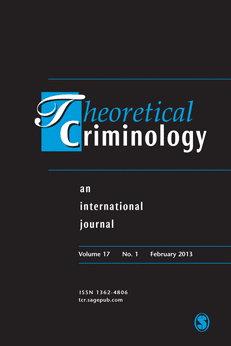
THEORETICAL CRIMINOLOGY
Exploring the Depths of Criminological TheoryTHEORETICAL CRIMINOLOGY is a premier academic journal published by SAGE PUBLICATIONS LTD that serves as a vital platform for the dissemination of cutting-edge research in the realms of law, sociology, and forensic medicine. Established in 1997 and converging into a comprehensive resource through 2024, this journal has achieved a remarkable reputation with a 2023 Q1 ranking in Law as well as in Sociology and Political Science, underscoring its influential contributions to these disciplines. Situated in the United Kingdom, it is recognized for its rigorous peer-reviewed content and holds prestigious positions in Scopus rankings, including Rank #34 in Social Sciences - Law and Rank #38 in Medicine - Pathology and Forensic Medicine, reflecting its commitment to academic excellence. Although it does not currently offer open access options, the journal ensures that its articles are accessible through institutional subscriptions, making it an indispensable resource for researchers, professionals, and students aiming to deepen their understanding of theoretical frameworks and contemporary issues in criminology.