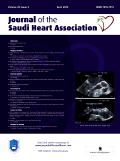
Journal of the Saudi Heart Association
Scope & Guideline
Empowering Heart Health Through Research and Collaboration
Introduction
Aims and Scopes
- Cardiovascular Diseases Research:
The journal publishes studies related to various cardiovascular diseases, aiming to enhance understanding, diagnosis, treatment, and prevention strategies. - Interventional Cardiology Techniques:
It includes research on novel interventional techniques and technologies in cardiology, such as catheter-based interventions and surgical approaches. - Pediatric Cardiology Insights:
The journal covers pediatric cardiology, focusing on congenital heart diseases and surgical outcomes in children, highlighting the need for specialized care in this demographic. - Heart Failure Management:
Research on heart failure therapies, guidelines, and management strategies is a core area, addressing both acute and chronic heart failure. - Epidemiology and Public Health:
The journal emphasizes epidemiological studies that explore the prevalence, risk factors, and outcomes of cardiovascular conditions in the Saudi and Middle Eastern populations. - Technological Innovations in Cardiology:
The journal features studies on the integration of technology in cardiology, including telemedicine, device innovations, and training methodologies.
Trending and Emerging
- Telemedicine and Remote Monitoring:
With the rise of digital health, there is a growing focus on telemedicine and remote monitoring technologies for managing cardiovascular conditions, especially post-COVID-19. - Personalized Medicine in Cardiovascular Care:
Research on personalized treatment approaches, including tailored therapies based on genetic, environmental, and lifestyle factors, is gaining traction. - Cardiovascular Impact of Systemic Conditions:
Emerging studies are increasingly focusing on how systemic conditions like diabetes, obesity, and COVID-19 influence cardiovascular health, reflecting a holistic view of patient care. - Interventional Strategies in High-Risk Populations:
There is an increasing trend towards studying interventional strategies in high-risk groups, particularly in pediatric and geriatric populations, to improve outcomes. - Quality Improvement and Patient Safety Initiatives:
Research focused on quality improvement measures and patient safety in cardiovascular care settings is trending, as healthcare systems aim to enhance care quality and reduce complications.
Declining or Waning
- Traditional Surgical Techniques:
Research on conventional surgical methods has seen a decline as the field moves towards minimally invasive and interventional approaches, reflecting the changing preferences in clinical practice. - Basic Science Research in Cardiology:
There has been a noticeable reduction in basic science studies focusing on biochemical and molecular mechanisms of cardiovascular diseases, as the journal increasingly prioritizes clinical applications and outcomes. - Longitudinal Studies without Immediate Clinical Application:
Longitudinal studies that do not provide immediate clinical implications or actionable insights are becoming less common, as the journal favors research with direct relevance to current clinical practices.
Similar Journals
International Heart Journal
Fostering Collaboration in Cardiology ExcellenceInternational Heart Journal, published by INT HEART JOURNAL ASSOC, serves as a pivotal platform for research and discourse in the fields of cardiology and cardiovascular medicine. With its ISSN 1349-2365 and E-ISSN 1349-3299, this esteemed journal is based in Japan and is located at the University of Tokyo, Graduate School of Medicine, Department of Cardiovascular Medicine. Since its inception in 2005, International Heart Journal has blossomed into a respected publication with an impact factor that signifies its growing relevance, ranking in the Q3 category of both cardiology and miscellaneous medicine as of 2023. This journal not only disseminates vital research findings but also fosters collaboration among researchers and healthcare professionals. Notable for its Open Access options, it ensures the availability of its content to a broader audience, thereby enhancing knowledge transfer and innovation in cardiovascular care. With an ongoing commitment to improve clinical practice and patient outcomes, the journal continues to be an essential resource for those dedicated to advancing the understanding of heart health and disease.
Kardiologia Polska
Exploring the Frontiers of Cardiovascular MedicineKardiologia Polska, the esteemed journal of the Polish Cardiac Society, has established itself as a vital resource in the field of cardiology and cardiovascular medicine since its inception in 1954. With an ISSN of 0022-9032 and an E-ISSN of 1897-4279, this journal serves as a platform for groundbreaking research and scholarly articles that contribute to the advancement of heart health. Although currently not an open access journal, it remains an essential reference for practitioners and researchers seeking to stay abreast of the latest developments in cardiovascular science. The journal reflects its scholarly depth through a Category Quartile of Q3 and a commendable Scopus ranking at the 48th percentile in its field. Published primarily in Poland, it caters to a global audience eager to explore comprehensive studies spanning clinical cardiology, innovative therapeutic approaches, and emerging cardiovascular trends. Join a thriving academic community by engaging with the invaluable insights and research contributions found within the pages of Kardiologia Polska.
Journal of Cardiovascular Emergencies
Enhancing patient outcomes through open access to critical cardiovascular knowledge.Journal of Cardiovascular Emergencies is a premier open-access journal dedicated to advancing the field of emergency cardiovascular care. Published by SCIENDO, the journal has been an essential resource for healthcare professionals since its inception in 2015, prioritizing the dissemination of cutting-edge research, case studies, and reviews that address acute cardiovascular conditions. With the ISSN 2457-5518 and E-ISSN 2457-550X, it stands as a valuable platform for researchers and practitioners alike, offering insights that can lead to improved patient outcomes in emergency settings. The journal, based in Warsaw, Poland, aims to foster collaboration and knowledge exchange within the growing community of cardiology and emergency medicine professionals. By making its content freely accessible, the Journal of Cardiovascular Emergencies underscores the importance of knowledge sharing in tackling the challenges presented by cardiovascular emergencies on a global scale.
Journal of Cardiology
Elevating understanding of cardiovascular diseases globally.Journal of Cardiology, published by ELSEVIER, stands as a prominent resource in the field of cardiology and cardiovascular medicine. With a rich history since its inception in 1987, this peer-reviewed journal aims to disseminate cutting-edge research that enhances the understanding and treatment of cardiovascular diseases. Its 2023 ranking places it in the Q2 category within its discipline, reflecting its significance and impact, as evidenced by a Scopus rank of #123 out of 387 journals, positioning it in the 68th percentile of its field. The journal is headquartered in Japan, providing a unique perspective on cardiological advances relevant not only to the Asian continent but also globally. Though it does not currently offer open access, the Journal of Cardiology remains a vital institutional resource for researchers, clinicians, and students seeking to push the boundaries of cardiovascular science and improve patient outcomes.

REVISTA ESPANOLA DE CARDIOLOGIA
Fostering Excellence in Cardiovascular ResearchREVISTA ESPANOLA DE CARDIOLOGIA is a premier journal dedicated to the dynamic field of cardiology, published by EDICIONES DOYMA S A in Barcelona, Spain. With an impressive Q1 status in the Medicine (miscellaneous) category for 2023, this journal is recognized for its significant contributions to cardiovascular research, evidenced by its rank of #61 out of 387 in the Scopus database, placing it within the top 16% of journals in its field. Covering a broad range of topics within cardiology, the journal aims to disseminate high-quality research, clinical studies, and educational content, fostering knowledge sharing among researchers, clinicians, and students alike. While it does not currently offer open access, the journal maintains a commitment to advancing cardiovascular health through rigorous peer-reviewed articles. With a publication history that spans from 2013 to 2024, REVISTA ESPANOLA DE CARDIOLOGIA is an essential resource for those seeking to stay at the forefront of cardiology advancements and practices.

ARCHIVOS DE CARDIOLOGIA DE MEXICO
Fostering innovation in heart health, one article at a time.ARCHIVOS DE CARDIOLOGIA DE MEXICO is a premier open-access journal dedicated to advancing research and clinical practice in the field of cardiology and cardiovascular medicine. Published by the Instituto Nacional de Cardiología Ignacio Chávez since 2001, this journal offers a valuable platform for the dissemination of high-quality, peer-reviewed articles that span diverse aspects of cardiovascular health. With its current categorization in the fourth quartile (Q4) of cardiology journals and a Scopus rank of #319 out of 387, ARCHIVOS DE CARDIOLOGIA DE MEXICO is positioned within the dynamic landscape of cardiovascular research, presenting opportunities for both emerging and established voices in the field. It aims to promote discussion and innovation across various topics in cardiology, making it a crucial resource for researchers, healthcare professionals, and students keen on keeping abreast of developments in cardiovascular science. Accessible online since 2009, this journal fosters collaboration and knowledge sharing among specialists worldwide, establishing itself as a significant contributor to the global discourse on heart health.

Nepalese Heart Journal
Elevating Cardiology Practices in Nepal and BeyondNepalese Heart Journal, published by the CARDIAC SOC NEPAL, serves as a premier platform for disseminating knowledge in the field of cardiology and cardiovascular health. With an ISSN of 2091-2978, this journal aims to bridge the gap between researchers, clinicians, and academicians by presenting high-quality, peer-reviewed articles that address clinical practices, innovative research, and emerging trends in heart disease management, especially within the context of Nepal and the surrounding region. Although it operates under a traditional publishing model, its commitment to excellence aids in reinforcing the scientific discourse in an area critical to public health. The journal is a valuable resource for professionals and students alike who are focused on advancing their understanding of cardiology and its implications for health policy and practice. Exploring the intersections of local challenges and global advancements in heart health, the Nepalese Heart Journal is poised to contribute meaningfully to the evolving landscape of cardiovascular research.
Netherlands Heart Journal
Exploring Innovations in Heart Health and Disease ManagementNetherlands Heart Journal is a premier academic publication dedicated to advancing knowledge in the field of cardiology and cardiovascular medicine. Published by BOHN STAFLEU VAN LOGHUM BV, this journal has established itself as a critical platform for researchers, professionals, and students seeking to explore groundbreaking findings and innovative practices in cardiovascular health. With an ISSN of 1568-5888 and E-ISSN 1876-6250, the journal boasts a respectable Q2 ranking in the Cardiology and Cardiovascular Medicine category, placing it in the top half of its field according to the 2023 quartiles. The Scopus ranking places it 130th out of 387 in the relevant category, indicating a commendable percentile rank of 66th, which attests to its influence and quality of published research. Spanning from 2005 to 2024, the journal endeavors to include a diverse array of topics, encompassing clinical practice, technological innovations, and public health considerations related to cardiovascular diseases. Researchers and practitioners are encouraged to engage with the journal's robust content, contributing to and benefiting from the collaborative effort to enhance cardiovascular health worldwide.

TEXAS HEART INSTITUTE JOURNAL
Pioneering Insights in Cardiology and Heart Health.TEXAS HEART INSTITUTE JOURNAL, published by the renowned Texas Heart Institute, stands as a pivotal resource in the field of cardiology and cardiovascular medicine. With a history spanning over four decades since its establishment in 1982, this journal addresses a wide range of topics within its scope, including clinical studies, innovative treatments, and groundbreaking research in heart health. Despite its Q3 ranking in both Cardiology and Cardiovascular Medicine, the journal is committed to fostering advancement in medical knowledge and practice, providing an essential platform for healthcare professionals and researchers alike. While currently lacking open access, the journal is recognized for its contributions to the field, aiming to illuminate critical healthcare discussions and promote the exchange of ideas. For those interested in staying at the forefront of cardiovascular research, TEXAS HEART INSTITUTE JOURNAL offers invaluable insights and the latest developments shaping the future of heart care.

Pakistan Heart Journal
Connecting Ideas, Transforming Cardiovascular Care.Pakistan Heart Journal, with the ISSN 0048-2706 and E-ISSN 2227-9199, is a premier publication by the Pakistan Cardiac Society, dedicated to advancing the field of cardiology and cardiovascular medicine. Established as an Open Access journal since 2011, it provides a valuable platform for researchers and clinicians to disseminate innovative findings and insights within this critical area of health. Based in Karachi, Pakistan, at the National Institute of Cardiovascular Diseases, this journal aims to foster an enriched understanding of cardiovascular health by publishing rigorous research, case studies, and review articles. Despite its current categorization as Q4 in the latest 2023 quartiles and a rank of 357/387 in the Scopus database, it plays a vital role in the academic community, encouraging collaborative efforts and dialogue among professionals. The journal aspires to converge diverse perspectives and innovations in cardiology from 2019 to 2024, thereby enhancing the quality and scope of cardiovascular research in the region and beyond.